Urinary tract infections, commonly referred to as UTIs, are very common in the US. Around 4 out of 10 women will experience at least one in their lifetime, and about 1 in 10 women get a UTI each year. Despite how common this medical condition is, UTIs are often miscoded, leading to denied claims, delayed payments, and extra work for healthcare staff. This brings about the importance of knowing how to select the correct code for each UTI case for a first-pass claim acceptance.
Choosing the right code depends on several factors, including the site of infection, whether it is acute or chronic, the type of bacteria involved, and whether the patient is pregnant or has a catheter. Understanding these details helps you document the visit properly and ensures insurance companies process the claim correctly.
Stick with us as we walk you through how to code bladder, kidney, urethral, pregnancy-related, and bacterial UTIs accurately. Our complete guide will help you reduce claim denials and make billing easier.
The most commonly used ICD-10-CM code for a urinary tract infection (UTI) is N39.0 – Urinary tract infection, site not specified. This code should only be used when the healthcare provider confirms a UTI but does not document the exact location of the infection.
If the documentation identifies the infection site, always choose a more specific ICD-10 code. For example, use N30.0 for acute cystitis, N10 for acute pyelonephritis, and N34.1 for nonspecific urethritis. Specific coding improves claim accuracy, reduces denials, and supports proper reimbursement.
Most UTIs are caused by bacteria like E. coli. The bacteria enter the urinary system and cause inflammation, impacting the bladder, kidneys, urethra, or ureters.
The symptoms usually depend on where the infection occurs. If it starts in the bladder, people often feel a burning sensation or need to urinate frequently. Kidney infections can bring fever, nausea, or back pain, while urethral infections may cause pain or discharge during urination.
UTIs are more common in women, but anyone can get them. They are also more likely during pregnancy or in people with diabetes or catheters. Getting the diagnosis right and documenting it clearly is important for accurate coding and timely payment.
ICD-10 codes for urinary tract infections are located in Chapters N00-N99, which cover diseases of the genitourinary system. Each code gives specific information about the type and location of the infection.
To code UTIs accurately, documentation should always include:
In urology medical billing services, these details are critical because they allow coders to assign the correct ICD-10 codes. Without complete information, coders may have to select unspecified codes, which often leads to claim delays, denials, or payment issues. Accurate documentation not only ensures smoother claims processing but also supports compliance and proper reimbursement for healthcare providers.
|
Condition | ICD-10-CM Code |
|
Urinary tract infection, site not specified | N39.0 |
|
Acute cystitis without hematuria | N30.0 |
|
Acute cystitis with hematuria | N30.01 |
|
Chronic cystitis with hematuria | N30.21 |
|
Acute pyelonephritis | N10 |
|
Chronic pyelonephritis | N11.0 |
|
Nonspecific urethritis | N34.1 |
|
UTI during pregnancy | O23 Series |
A urinary tract infection (UTI) is one of the most common diagnoses in healthcare. But sometimes the provider does not document the exact site of infection. In these cases, the ICD-10 code N39.0 is used for urinary tract infection, site not specified.
This is the general code for UTIs when the specific location, such as the bladder, kidneys, or urethra, is not mentioned in the patient record. It’s common in primary or urgent care visits when tests are still pending or results have not yet confirmed the exact source of infection.
Before assigning an ICD-10-CM code, verify that the medical record includes:
Complete documentation allows coders to assign the most specific diagnosis code and reduces the likelihood of claim denials.
Use N39.0 in the following situations:
This code is often used as a starting point when the provider documents “UTI” without further explanation.
Avoid using N39.0 when the provider includes enough detail to identify the infection site. For example,
Using a more specific code improves claim approval rates and gives a clearer picture of the patient’s condition.
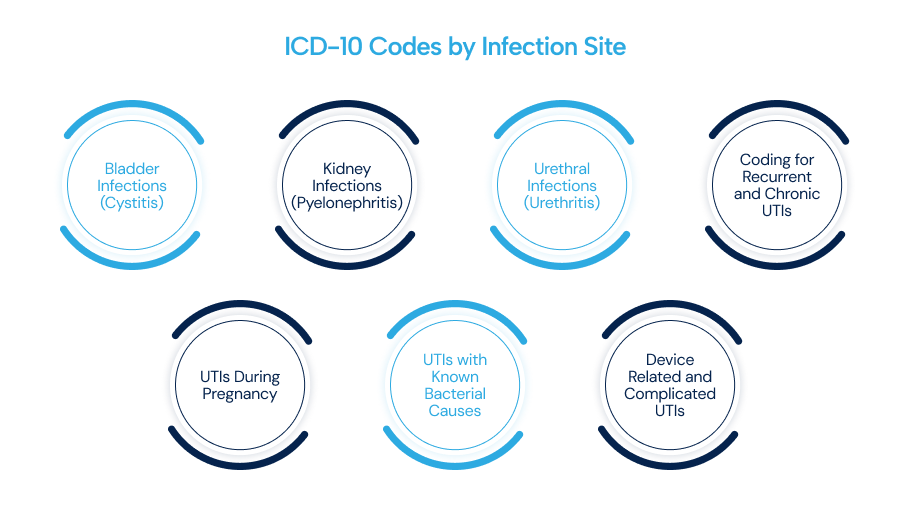
Urinary tract infections can occur in different parts of the urinary system. Correct coding depends on identifying where the infection starts. The three most common sites are the bladder, kidneys, and urethra. Each has its own set of ICD-10 codes that describe the location and condition of the infection. Accurate site-specific coding helps ensure proper reimbursement and reduces the chance of claim denials.
Cystitis is an infection of the bladder. It may be acute, chronic, or unspecified and can occur with or without blood in the urine.
Common ICD-10 codes include:
A kidney infection, also called pyelonephritis, is a more serious type of UTI. It often causes fever and flank pain and may lead to hospitalization. Coding for pyelonephritis should indicate whether the infection is acute or chronic.
Common ICD-10 coding includes:
Urethritis is an infection or inflammation of the urethra, the tube that carries urine from the bladder out of the body. It can occur by itself or along with other urinary infections.
Common codes include:
Recurrent urinary tract infections (UTIs) are defined as two or more acute infections within six months or at least three within a year. These infections are more common in women and can significantly impact quality of life.
When coding for recurrent or chronic UTIs, it is important to document whether the infection is ongoing, recurring, or part of the patient’s medical history. Lab results, previous treatment notes, and symptom patterns all help coders assign the correct ICD-10 code.
Common ICD-10 codes for recurrent and chronic UTIs include:
UTIs are common during pregnancy. Hormonal and physical changes make it easier for bacteria to grow in the urinary tract.
General Code
O23.0 Infection of the genitourinary tract in pregnancy
Trimester Codes
Site Specific Codes
Sometimes lab results identify the bacteria responsible for a urinary tract infection. When that happens, an additional code should be used to show the specific organism. Adding this code improves the accuracy of the record and supports the treatment plan. It also helps ensure the claim matches the diagnosis and the antibiotics prescribed.
Common ICD-10 coding for bacterial causes includes:
These codes are reported along with the main UTI diagnosis code to show the bacterial cause of infection. This helps improve accuracy, supports the treatment plan, and strengthens claim approval.
Some urinary tract infections happen because of catheters or other medical devices. These are considered device-related or complicated UTIs. When coding these cases, include both the UTI diagnosis code and a complication code that shows the infection is linked to the device.
For example,T83.5XXA infection due to an indwelling urinary catheter is used to identify infections caused by catheter use. This code should be reported with the primary UTI code, such as N39.0, to indicate that the infection is related to the catheter.
Accurate coding for device-related UTIs supports compliance, proper reimbursement, and efficient urology medical billing services.
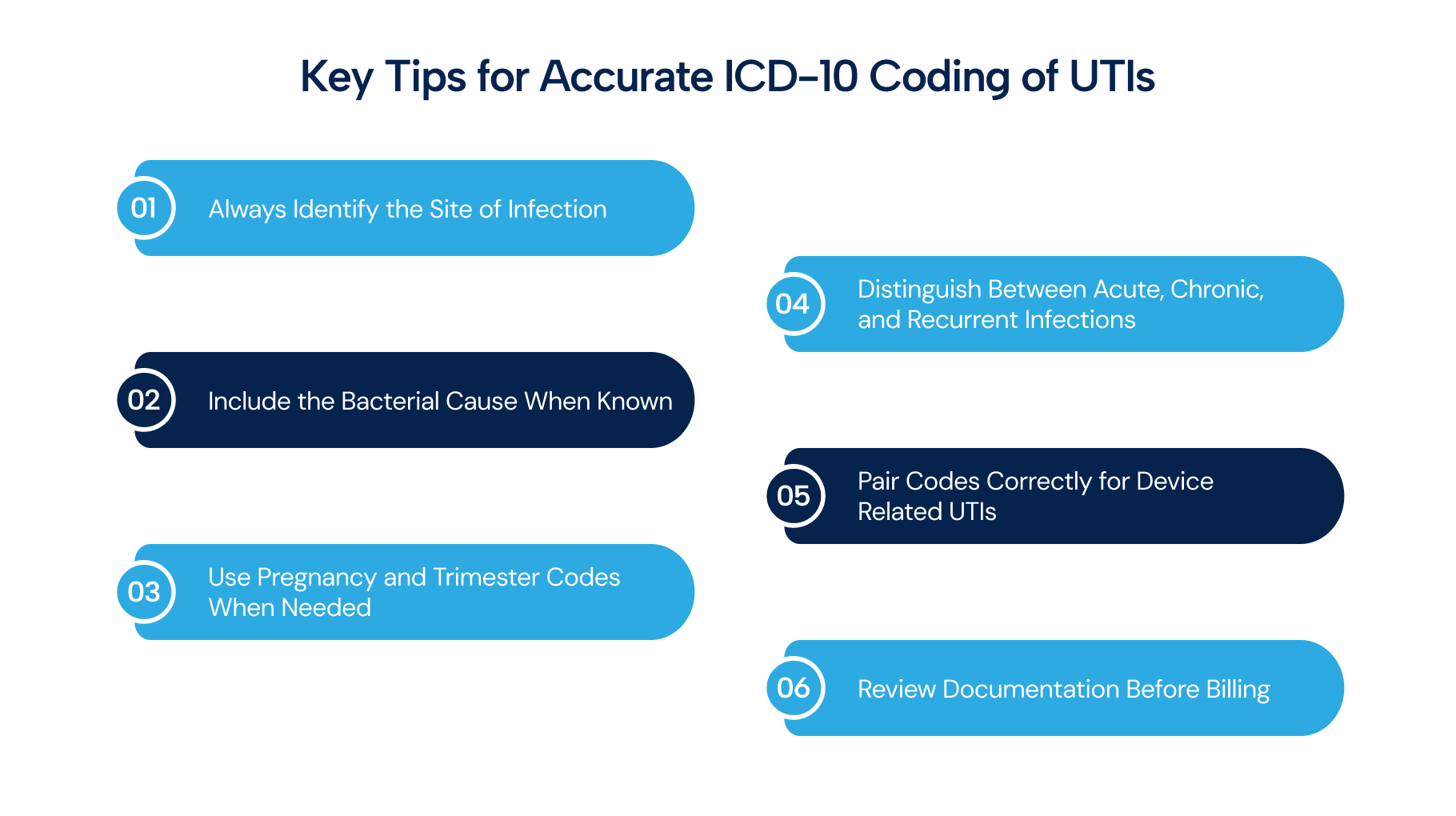
Accurate ICD-10 coding for urinary tract infections is important for clean claims and proper reimbursement. Small documentation errors can lead to denials or payment delays. These tips can help you code UTIs correctly and keep billing compliant.
Document whether the infection is in the bladder, kidney, or urethra. Avoid using N39.0 unless the site is truly unknown. Site-specific codes make the claim stronger and more precise.
If the lab report identifies a specific organism, add the corresponding B96 code. This connects the infection to its cause and supports the treatment plan.
For pregnant patients, select the correct O23 code and include the trimester. This ensures compliance and avoids rejected claims related to maternal care.
Make sure the provider states whether the infection is new, long-term, or recurring. Use the correct code that matches the documentation.
When an infection is linked to a catheter, use T83.5XXA with the UTI code. This combination makes it clear that the infection is device-associated.
Check that all key details, such as site, cause, chronicity, and related conditions, are in the record before submitting the claim. Small documentation gaps often lead to denials or delayed payment.
Accurate documentation and coding are essential for clean claims. Working with expert urology billing services helps maintain compliance, improve accuracy, and ensure smooth reimbursement for UTI-related care.
In urology practices, small mistakes in ICD-10 coding can cause claim delays and denials. Clear documentation and careful review help prevent most of these issues. Here are a few common problems that affect urology billing services and how to avoid them.
Understanding real-world coding examples makes it easier to assign the correct ICD-10-CM code and avoid claim denials. Below are some common urinary tract infection scenarios that coders and billers encounter in daily practice.
Provider Documentation
"Patient presents with dysuria, urinary frequency, and positive urinalysis. Diagnosis: Urinary tract infection."
Correct ICD-10 Code
N39.0 – Urinary tract infection, site not specified
Why This Code?
The provider confirmed a urinary tract infection but did not document the specific site of infection. Since there is no mention of cystitis, pyelonephritis, or urethritis, N39.0 is the appropriate diagnosis code.
Provider Documentation
"Patient diagnosed with acute cystitis. No blood found in the urine."
Correct ICD-10 Code
N30.0 – Acute cystitis without hematuria
Why This Code?
Because the provider clearly documented the infection as acute cystitis without hematuria, a more specific ICD-10-CM code should be reported instead of N39.0.
Provider Documentation
"Urine culture positive for Escherichia coli. Diagnosis: Urinary tract infection."
Correct ICD-10 Codes
Why These Codes?
When laboratory results identify the bacterial organism, report the primary UTI diagnosis along with the additional organism code to improve coding accuracy and support medical necessity.
Provider Documentation
"Pregnant patient in the second trimester diagnosed with urinary tract infection."
Correct ICD-10 Code
O23.02 – Infections of the genitourinary tract in pregnancy, second trimester
Why This Code?
Pregnancy-related urinary tract infections require trimester-specific ICD-10-CM codes. Avoid using general UTI codes when the infection occurs during pregnancy.
Provider Documentation
"Urinary tract infection due to indwelling urinary catheter."
Correct ICD-10 Codes
Why These Codes?
Device-related infections require both the complication code and the UTI diagnosis code to accurately describe the patient's condition and support reimbursement.
Accurate ICD-10 coding involves more than selecting a diagnosis code. Following coding best practices can significantly reduce claim denials and improve reimbursement.
Whenever documentation identifies the exact infection site, report the most specific ICD-10-CM code instead of using unspecified diagnosis codes.
Urine culture results may identify the bacterial organism responsible for the infection. Adding the appropriate organism code provides a more complete clinical picture.
Documentation should clearly indicate whether the infection is new, long-term, or recurring. This distinction directly affects code selection.
Pregnancy, diabetes, kidney disease, urinary obstruction, and indwelling catheters may require additional diagnosis codes for complete reporting.
Incomplete documentation is one of the leading causes of coding errors. Always review provider notes, laboratory findings, and treatment documentation before submitting claims.
Even simple urinary tract infection claims may be denied when documentation or coding is incomplete. Understanding these common issues helps improve first-pass claim acceptance.
Preventing these mistakes improves coding accuracy, reduces payment delays, and strengthens compliance with payer requirements.
What is the ICD-10 code for a urinary tract infection?
The general ICD-10 code for a urinary tract infection when the site is not specified is N39.0.
What ICD-10 code is used for a bladder infection?
For a bladder infection, use N30.0 for acute cystitis without hematuria or N30.01 when blood in the urine is present.
How should I code a UTI during pregnancy?
Use O23 series codes, such as O23.01 for the first trimester, and include both the trimester and infection site.
What code applies to a catheter-related UTI?
Report T83.5XXA with N39.0 to show the infection is linked to an indwelling urinary catheter.
Why is accurate ICD-10 coding important for UTIs?
Accurate coding ensures proper claim submission, prevents denials, and supports correct reimbursement in urology billing.
Accurate ICD-10 codes are important for proper billing and timely reimbursement. When documentation is clear and complete, it helps prevent claim denials and keeps patient records accurate. Identifying the infection site, bacterial cause, and related conditions makes coding more precise. Good communication between providers and billing teams also improves claim accuracy. Using the correct codes ensures compliance, faster processing, and better financial outcomes while supporting efficient care for patients.
Optimize billing, claims and collections with expert RCM support let our professionals handle the process so you can focus on patient care.