In Medical Billing, accurate drug reporting is essential for proper reimbursement and compliance. Healthcare providers regularly administer injectable medications, chemotherapy drugs, biologics, and infusions that cannot be billed using standard CPT procedure codes alone. This is where J-codes in medical billing become important.
These codes allow providers to report non oral, provider administered drugs correctly within the healthcare reimbursement process. Understanding how J-codes work helps reduce claim denials, improve insurance claim documentation, and maintain healthcare billing compliance.
Whether you manage billing in a small clinic or a large specialty practice, knowing how drug coding works ensures cleaner claims and faster payments.
This guide explains J-codes in medical billing, what they mean, how they are used, real world examples, common challenges, and why accurate reporting is essential for proper reimbursement and compliance.
J-codes are alphanumeric HCPCS Level II codes used to bill for medications and drugs administered in a healthcare setting, typically injectables, chemotherapy, and intravenous infusions. They ensure standardized billing when a patient receives a clinical treatment they cannot easily self-administer at home.
If you are wondering “what is a J-code”, the simple answer is this:
A J-code identifies a specific injectable or infused medication given to a patient under a provider's supervision.
These codes usually begin with the letter “J” followed by four numeric digits (for example, J-1100).
J-codes primarily cover:
Injectable drugs
Chemotherapy medications
Immunotherapy agents
Certain vaccines
Biological drugs
They are essential for outpatient settings such as physician offices, infusion centers, oncology clinics, and hospital outpatient departments.
To fully understand J-codes in medical billing, it helps to know where they fit within the coding system.
There are two major procedural coding systems:
Used to describe medical billing services and procedures.
Used to report supplies, equipment, and certain medications not included in CPT.
J-codes fall under HCPCS Level II. While CPT describes the service performed (for example, an injection procedure), the J-code identifies the actual drug administered.
For Example:
CPT code: Describes the administration of an injection
J-code: Identifies the specific medication injected
Both codes must typically be billed together for proper reimbursement.
J-codes allow insurance companies to:
Identify the exact medication administered
Determine appropriate payment rates
Verify dosage and medical necessity
Ensure compliance with payer guidelines
Because many injectable drugs are high-cost medications, payers require precise coding. Incorrect J-code reporting can result in denials, audits, or underpayments.
To make this clearer, here are a few examples:
| J-Code | Medication Type | Example Use |
| J1100 | Dexamethasone injection | Anti-inflammatory treatment |
| J2405 | Ondansetron injection | Anti-nausea medication |
| J9312 | Rituximab | Immunotherapy medication |
| J9035 | Bevacizumab | Chemotherapy drug |
Each J-code represents a specific dosage unit. That means billing staff must calculate and report the correct number of units administered.
For Example:
If a drug is billed per 10 mg and the patient receives 30 mg, three units must be reported. Incorrect unit reporting is a common cause of denials.
The billing workflow typically follows these steps:
The provider administers a non-oral drug.
Documentation records drug name, dosage, route, and medical necessity.
The correct J-code is selected from HCPCS Level II.
Units are calculated based on the dosage administered.
The administration CPT code and J-code are billed together.
The claim is submitted for payer review.
This coordination between accurate medical coding and documentation ensures proper healthcare billing compliance.
Drug billing is one of the highest audit-risk areas in healthcare. Even minor coding errors can create financial and compliance issues.
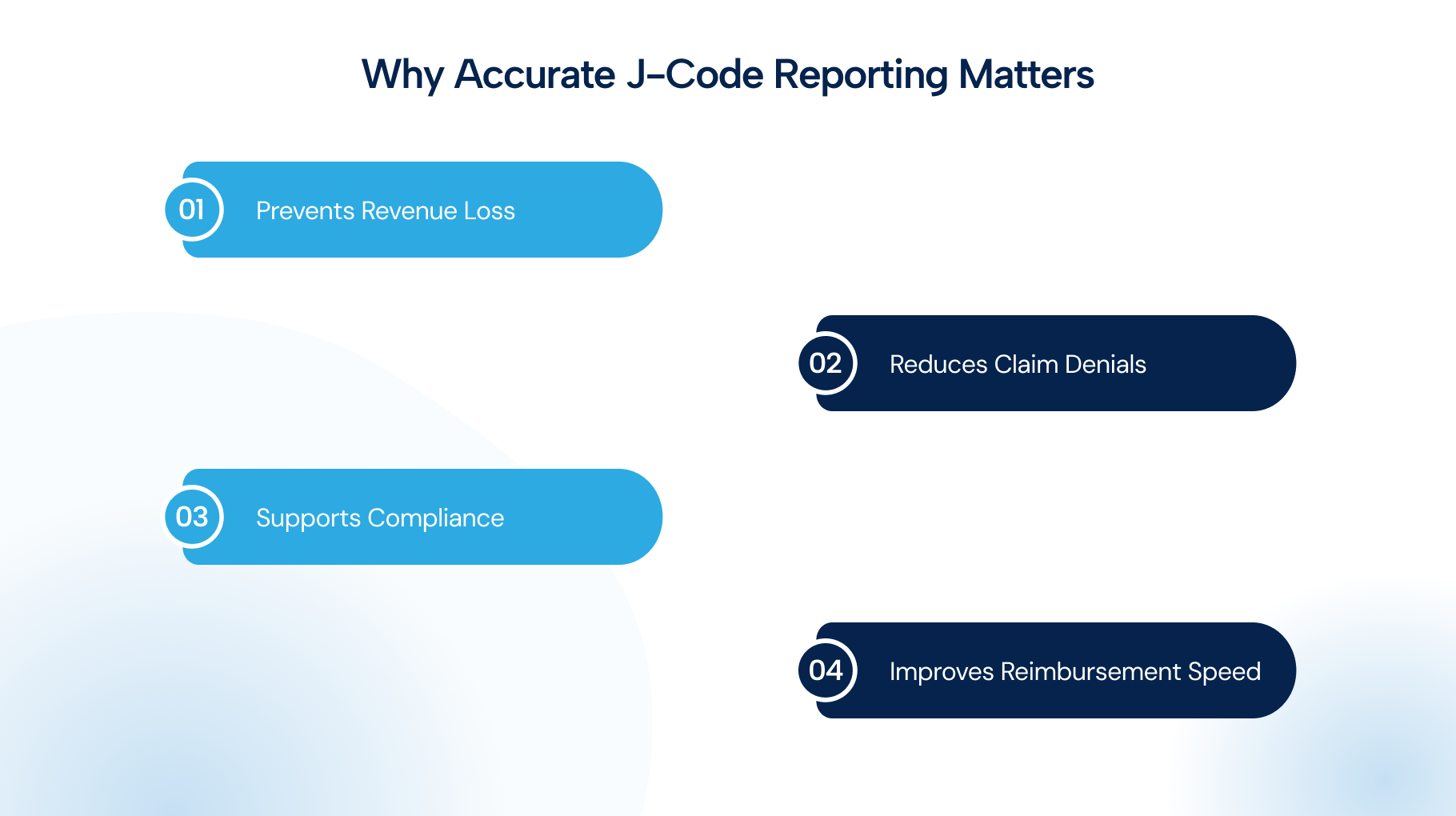
Here’s why precision matters:
Incorrect units or wrong J-codes may lead to underpayments. High-cost drugs mean small mistakes can significantly impact revenue.
Many insurers require National Drug Code (NDC) numbers alongside J-codes. Missing information often results in automatic rejections.
Discover a few simple steps that can help reduce claim denials and improve your medical practice’s billing accuracy.
Regulatory bodies closely monitor injectable drug billing. Clear documentation aligned with billing and coding guidelines protects practices from audit risk.
Clean claims with properly reported J-codes move through the Healthcare reimbursement process faster.
Even though J-codes streamline billing for injectable and provider-administered drugs, they also introduce complexity. Because they are unit-based and frequently updated, even small mistakes can lead to denials, underpayments, or compliance risks. Understanding the most common challenges helps billing teams reduce errors and protect reimbursement.
Because J-codes are unit-based, billing teams must carefully convert administered dosages into billable units. Even small calculation mistakes can result in underpayment, overbilling, or claim denials.
Different insurers may require prior authorization, specific modifiers, or additional documentation when billing injectable drugs. Failure to follow payer-specific billing guidelines often leads to rejections or delayed payments.
HCPCS Level II codes, including J-codes, are updated each year. If billing systems are not updated promptly, outdated codes may be used, increasing the risk of denials.
Some payers require National Drug Code (NDC) numbers along with J-codes. Incomplete insurance claim documentation or missing drug details can delay reimbursement or trigger audits.
To improve billing accuracy and compliance, healthcare organizations should:
Ensure providers document the drug name, strength, and dosage clearly
Cross-check J-codes against updated HCPCS references annually
Verify payer rules for high-cost medications
Train billing staff on unit calculations
Audit drug claims regularly
Strong coordination between clinical documentation and billing teams reduces risk and improves reimbursement outcomes.
It’s important not to confuse J-codes with other drug-related identifiers.
For Example:
NDC (National Drug Code): Identifies manufacturer-specific drug packaging
CPT Codes: Identify procedures performed
J-Codes: Identify the administered medication itself
Remember that J-codes focus specifically on provider-administered, non-oral medications, not pharmacy dispensed prescriptions.
Understanding how J-codes in medical billing work reduces denials, improves compliance, and protects revenue. With proper documentation, accurate unit reporting, and alignment with billing guidelines, healthcare organizations can streamline reimbursement and reduce audit risk. In a healthcare environment where drug costs continue to rise, precision in J-code reporting is essential for financial stability and operational efficiency.
What are J-codes in medical billing used for?
They are used to report non-oral, provider-administered drugs such as injections, chemotherapy agents, and biologics.
What is a J-code in simple terms?
A J-code is an HCPCS Level II code that identifies a specific injectable or infused medication given in a clinical setting.
Do J-codes include oral medications?
No. J-codes are primarily for non-oral medications administered by healthcare professionals.
Why are J-codes important for reimbursement?
They allow insurance companies to calculate accurate payments for expensive injectable drugs.
Are J-codes updated regularly?
Yes. HCPCS Level II codes, including J-codes, are updated annually, so billing teams must stay informed.
Optimize billing, claims and collections with expert RCM support let our professionals handle the process so you can focus on patient care.