Dialysis claims get flagged for reasons that have nothing to do with patient care. A missing modifier, an outdated ICD-10 code, or a CPT selection that doesn't match the physician's note is often enough to trigger a denial that takes weeks to resolve. For dialysis centers, this happens often enough that it shapes how the entire revenue cycle runs. Nephrology Medical Billing and Coding carries a level of detail general billing teams rarely encounter, from staging chronic kidney disease correctly to tracking monthly ESRD codes. This guide walks through the codes, the workflow, and the documentation habits that keep reimbursement steady.
Coding translates a physician's documentation into standardized CPT and ICD-10 codes. Billing takes those codes and turns them into a claim a payer will pay. Nephrology billing depends on getting both parts right, and neither works well without the other.
What makes kidney care different is the density of recurring, monitored services. A dialysis center bills the same patient multiple times a month and has to justify medical necessity for treatments that continue indefinitely. That's a different kind of billing discipline.
The stakes are real. CMS raised the 2026 ESRD Prospective Payment System base rate to $281.71 per treatment, an increase of about 2.2% (CMS, 2025). Even a modest per-treatment change adds up fast across a full patient panel.
Nephrology medical billing touches several types of providers, from outpatient nephrologists billing evaluation visits and biopsies to dialysis centers billing recurring ESRD codes under strict monthly rules. A biller who only understands general E/M coding will miss details that matter here.
The cycle starts before the patient sees a clinician. Registration captures demographic and insurance details, and any error here follows the claim to the payer. Verification comes next, and for ESRD patients this gets complicated fast, since many carry both Medicare and a secondary plan with its own dialysis rules.
Documentation has to support what's billed. A nephrologist's note on a hemodialysis session needs to reflect the time, the patient's status, and any complications. Nephrology medical coding then converts that into CPT and ICD-10 codes matching the clinical picture.
From there, the claim goes out, and payment posting reconciles what came back against what was billed. Denials get routed to follow-up before the timely filing window closes. Some dialysis centers still track modality changes on paper logs even after switching to full EHR systems elsewhere, which says something about how deeply habit runs in this corner of healthcare.
Certain codes show up on nephrology claims more than others. The table below covers the dialysis and diagnostic imaging codes that appear most often.
|
CPT Code |
Procedure |
Category |
|
90935 |
Hemodialysis procedure |
Dialysis |
|
90937 |
Hemodialysis with repeated evaluation |
Dialysis |
|
90945 |
Dialysis other than hemodialysis |
Peritoneal Dialysis |
|
90947 |
Dialysis with repeated evaluation |
Peritoneal Dialysis |
|
90960 |
ESRD monthly services |
ESRD Management |
|
76770 |
Kidney ultrasound |
Diagnostic Imaging |
Code selection always depends on the service documented in the note. Two dialysis sessions can look identical on the surface and still require different codes if one included a physician re-evaluation and the other didn't.
|
ICD-10 Code |
Diagnosis |
|
N18.9 |
Chronic kidney disease (CKD), unspecified |
|
N18.6 |
End-stage renal disease (ESRD) |
|
N17.9 |
Acute kidney failure |
|
I12.9 |
Hypertensive CKD |
|
E11.22 |
Type 2 diabetes with diabetic CKD |
Diagnosis coding gets harder around post-procedure complications. A patient who develops bleeding after a renal biopsy needs an icd-10 diagnosis code for postoperative hematuria rather than a general CKD code, and missing that distinction is a common denial reason.
Every nephrology claim rests on two things working together: documentation that proves the service was necessary, and billing rules that dictate how that service gets paid. Getting one right without the other still leads to a denial, so both need attention at the same time rather than being treated as separate checklists.
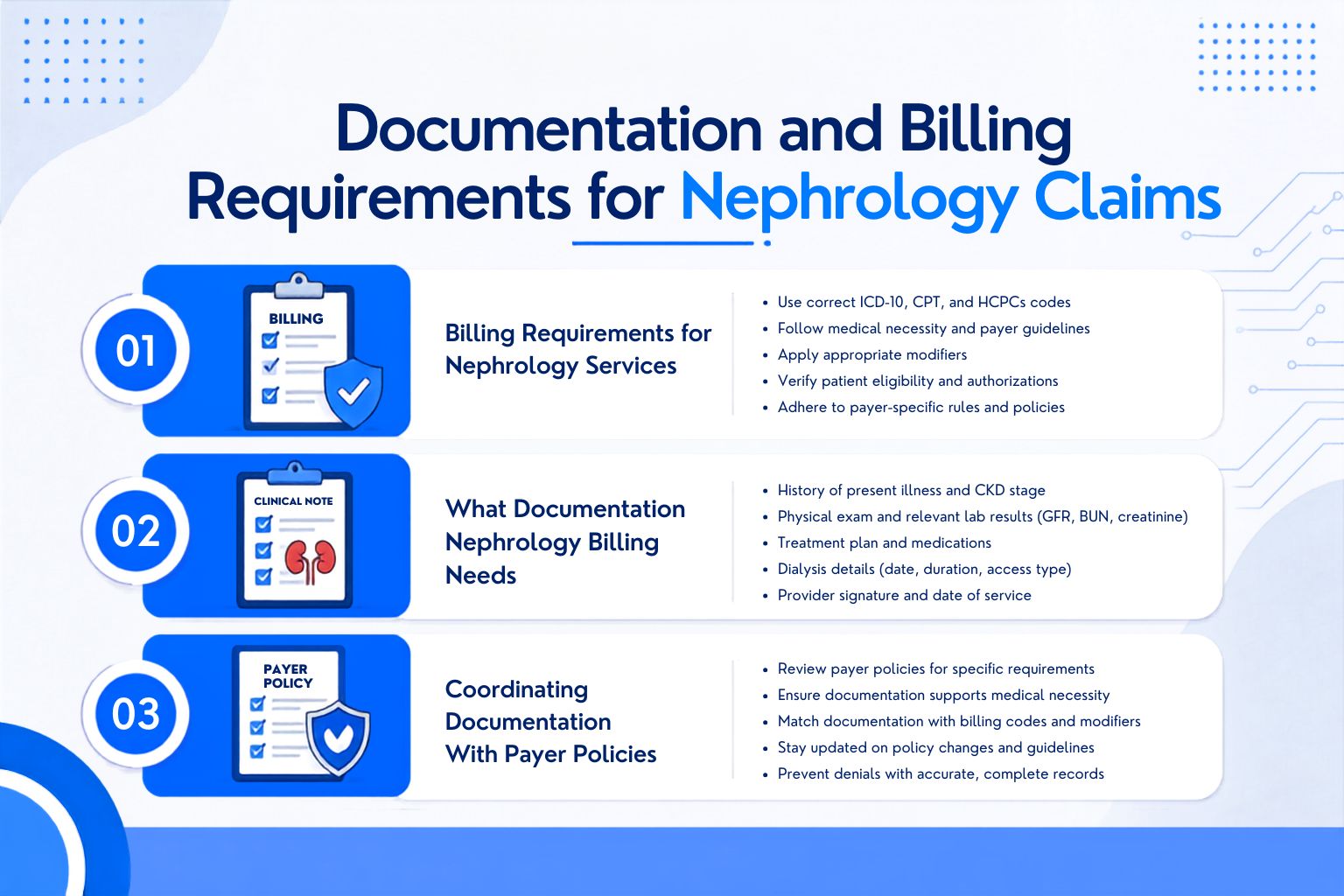
Medical necessity documentation has to justify why the service happened, not just that it happened. That's especially true for dialysis, where frequency limitations apply, and payers want visit counts to match approved treatment plans. Some nephrology services bundle into a single ESRD PPS payment, while others bill separately, and mixing these up causes underbilling or a denial for unbundling.
Nephrology revenue cycle management teams also have to track payer-specific coverage policies, since Medicare, Medicare Advantage, and commercial payers don't apply the same rules to the same CPT code.
Every claim needs a paper trail that backs up the code selected. CKD stage has to be documented explicitly, not implied, and lab results, imaging reports, and dialysis treatment records need to match what got billed.
Practices that confirm six things before a claim goes out tend to see fewer denials: CKD stage, a complete diagnosis, procedure detail, supporting lab results, a physician signature, and a medical necessity statement. None of these are complicated alone. The problem shows up when one gets skipped under time pressure.
Documentation requirements don't stay the same across payers. Medicare's local coverage determinations spell out what has to appear in the chart for certain nephrology services, while a commercial plan or Medicare Advantage plan might ask for something slightly different on the same CPT code. This is one of the areas where a single documentation template falls short, since what satisfies one payer's audit doesn't automatically satisfy another's.
Practices that keep a running reference of payer-specific requirements, updated as policies change, avoid a lot of the rework that comes from resubmitting claims with added documentation. It varies by payer and by plan type, and treating it as a fixed rule tends to backfire during an audit.
Most nephrology denials trace back to a small set of problems: incorrect CKD staging, missing documentation, mismatched CPT-ICD pairings, dialysis billing errors, and coding updates a team using last year's cheat sheet will eventually miss.
A few signals suggest it's time to outsource: claim volume that's outgrown the billing team's capacity, dialysis billing complexity that wears down even experienced billers, and denial rates that don't improve despite internal fixes. Practices at that point often turn to specialized nephrology billing services rather than building that expertise from scratch. RCM Matter's nephrology billing services team handles this exact type of coding and denial work for kidney care practices day to day.
Reimbursement in kidney care rests on details that are easy to overlook and expensive to get wrong. CPT selection, ICD-10 specificity, and supporting documentation all have to line up. Getting Nephrology Medical Billing and Coding right consistently, not just on the claims someone happens to double-check, is what separates practices with steady cash flow from ones chasing denials all week.
RCM Matter works through these details with nephrology practices every day, and getting the basics right early is worth more than fixing them after a denial arrives.
1. Why is nephrology billing more complex than general medical billing?
Recurring services are the main reason. A dialysis patient generates claims multiple times a month for months or years, and each one has to reflect CKD stage and treatment frequency accurately.
2. What CPT codes are commonly used in nephrology billing?
Three codes come up constantly: 90935, 90937, and 90960 cover dialysis and ESRD management. Diagnostic codes like 76770, for kidney ultrasound, show up often too.
3. Which ICD-10 codes are frequently reported in nephrology claims?
Because CKD staging drives so much of nephrology billing, N18.9 and its stage variants appear constantly, alongside N18.6 for ESRD and N17.9 for acute kidney failure. Which combination applies depends on the physician's documentation, and that's not always as clean as a reference table makes it look.
4. What documentation does nephrology billing require?
Complete documentation, or the claim doesn't hold up. That means CKD stage, medical necessity, lab results, and a physician signature, at minimum.
5. How can nephrology practices reduce claim denials?
For most practices, cutting denials comes down to habits, not new tools. Consistent documentation, routine coding audits, and current CPT and ICD-10 references handle the bulk of it, and a specialist billing partner covers the rest when in-house bandwidth runs short.
Optimize billing, claims and collections with expert RCM support let our professionals handle the process so you can focus on patient care.