The financial health of any medical practice depends heavily on how well it manages the business side of healthcare. While providers focus on patient care, practices often quietly lose revenue through denied claims, inaccurate coding, delayed documentation, and slow follow-ups.
According to the Centers for Medicare & Medicaid Services (CMS), roughly one in five medical claims is processed incorrectly, a major reason for preventable denials and lost revenue.
This is where revenue cycle management comes in. More than just billing, it's a structured, strategic process that gets your practice paid accurately, on time, and with minimal leakage. Below is a complete, easy-to-understand breakdown of what RCM actually is, how it works, and why successful healthcare organizations rely on it.
Revenue cycle management refers to the end-to-end process of overseeing all administrative and financial steps necessary to capture revenue. Think of it as the backbone of every financial interaction in your practice, a system that manages each step from the moment a patient books an appointment until the final payment is collected. The RCM framework includes patient scheduling, insurance checks, coding, charge capture, billing, claim submission, follow-up, collections, and reporting.
Medical billing today is complex. Payer rules change frequently, documentation demands are high, and reimbursement cuts continue to affect margins. RCM helps healthcare organizations stay compliant, reduce administrative workload, improve cash flow, and prevent costly mistakes.
Billing is just one piece of the puzzle. It’s the act of sending a claim out the door. Revenue cycle management, on the other hand, is the entire framework that makes sure the claim is correct, compliant, and supported long before it’s submitted.
Simple billing reacts to issues after they occur, while RCM works proactively to prevent them. It connects every department, from the front desk and clinical team to the coding, billing, and collections teams, into one coordinated system. This means a small error during patient intake, like a missing authorization or an incorrect insurance ID, doesn’t snowball into a costly denial weeks later.
RCM doesn’t just revolve around pushing claims through; it’s about building a predictable, audit-ready financial ecosystem where accuracy at each step protects revenue at the end.
Every successful revenue cycle rests on three stages: front-end, mid-cycle, and back-end. These components form the foundation of revenue cycle management services, ensuring accuracy, compliance, and timely reimbursement at every step. Below is a deeper look at what each stage includes and why each one protects your revenue.
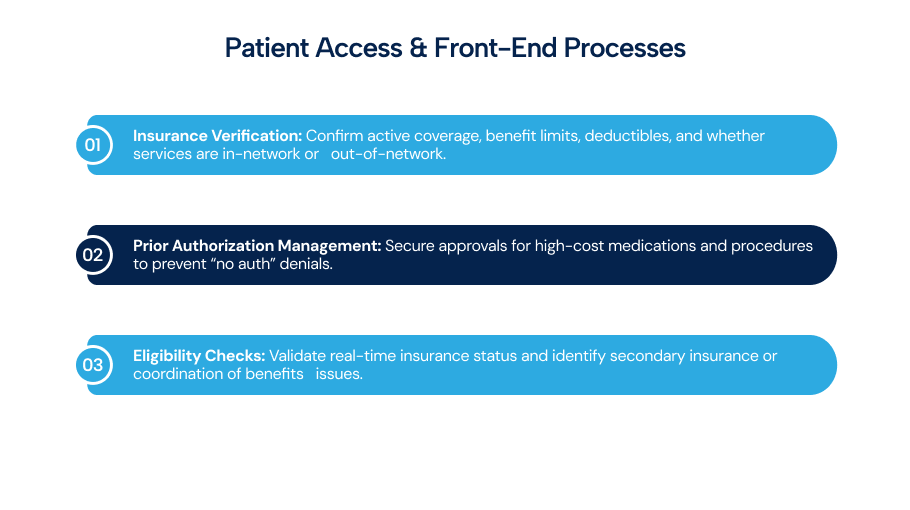
Front-end work is the first line of defense against denials. It sets the accuracy and completeness of every claim that comes afterward. Here are the key responsibilities at the front end:
Small mistakes at this stage, such as a wrong insurance ID, expired authorization, or outdated demographics, instantly cause rejections or denials. A clean front-end process prevents the majority of administrative denials and stops revenue leakage before it starts.
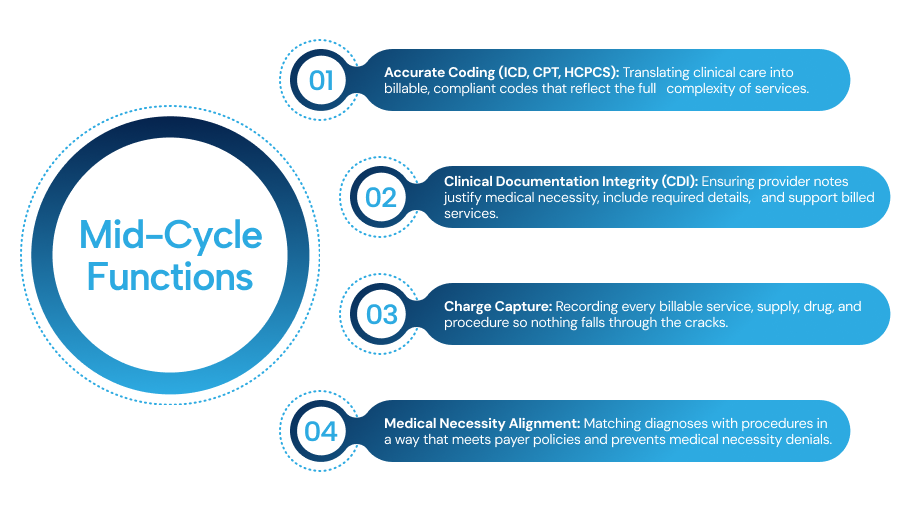
The mid-cycle is where clinical accuracy meets financial precision. Everything documented here directly impacts payer decisions, audit risk, and reimbursement.
Critical mid-cycle components include:
Even a minor coding error, such as a wrong modifier or missing diagnosis, can trigger denials, downcoding, or audits. A strong mid-cycle structure supports accuracy, compliance, and defensible billing.
Once documentation and coding are complete, the back-end handles the financial follow-through (the steps that actually turn services into revenue).
Essential revenue cycle management back-end functions include:
This stage determines whether your practice actually gets paid fully, correctly, and on time. Without strong back-end processes, even clean claims can stall or go uncollected, leading to significant financial losses.

Every healthcare organization loses revenue in small, avoidable ways. Strong RCM processes identify where these gaps happen and introduce systems that stop them from repeating. Below are the most common issues and how RCM actively fixes them.
Authorization and eligibility errors are the top reasons for preventable denials. They usually occur during scheduling or intake, long before a claim is sent out.
RCM fixes these issues through:
Incorrect coding or incomplete clinical documentation leads to denials, downcoding, and audit risk. Even minor discrepancies can stop payment.
RCM fixes this issue through:
Aging claims and slow follow-up are major contributors to lost revenue. Manual workflows allow claims to slip through cracks.
RCM fixes this through:
Professional RCM support goes far beyond billing. It brings together expert teams, structured processes, and technology that strengthen every stage of the revenue cycle.
An RCM partner manages front-end tasks like insurance checks and authorizations, mid-cycle work like coding and documentation review, and back-end processes like claims submission, payment posting, denial resolution, and AR follow-up. This eliminates fragmentation and ensures consistency.
With professional support, practices gain certified coders, AR specialists, denial experts, CDI consultants, and compliance teams who know how to prevent denials—not just react to them. This expertise is difficult and costly to maintain in-house.
RCM partners use automated eligibility tools, authorization platforms, scrubbers, denial prediction tools, and AR automation. These systems catch issues early and keep claims moving, reducing delays and unnecessary write-offs.
What is RCM in medical billing?
RCM stands for Revenue Cycle Management. It manages the financial workflow from patient registration to final payment, ensuring accuracy, compliance, and timely reimbursement.
Why is RCM important for healthcare providers?
Effective RCM reduces errors, minimizes claim denials, improves cash flow, and enables providers to focus on patient care rather than billing.
What are the main steps in RCM?
Patient registration, eligibility verification, coding, claims submission, denial management, payment posting, and reporting.
Can small clinics benefit from RCM services?
Yes, even small practices can improve revenue, reduce administrative burden, and ensure compliance by using RCM services.
How do RCM specialists help with complex claims?
Revenue cycle management specialists handle coding, payer rules, and denials for complex claims such as surgeries, oncology, or bundled payments, ensuring accuracy and timely reimbursement.
Revenue cycle management doesn’t just clean up billing; it keeps your workflows steady, your payments predictable, and your team free to focus on more important tasks. When the right people and processes are in place, everything feels easier and more organized. If you need support handling the day-to-day coding, claims, and payments, a revenue cycle management company, like RCM Matter can step in and manage the heavy lifting while you stay focused on your patients.
Optimize billing, claims and collections with expert RCM support let our professionals handle the process so you can focus on patient care.