A claim for three lumbar regions goes out under 98941, and two weeks later it comes back denied because the note only supports one region. That gap between what a chiropractor does and what the record proves is where most reimbursement problems start. Coding for spinal manipulation looks simple from the outside, four codes and a handful of modifiers. Chiropractic CPT codes carry more weight than their five digits suggest, since one wrong selection turns a paid claim into a denied one. This guide covers the codes that matter most in 2026 and the documentation behind them.
These chiropractic codes fall into four buckets: manipulation, evaluation, therapy, and modality. Every one of these common chiropractic cpt codes has to match what the documentation supports. Not what was likely performed. What's written down.
|
Item |
Details |
|
Specialty |
Chiropractic |
|
Code set |
CPT (Current Procedural Terminology) |
|
Updated |
2026 |
|
Common services |
CMT, therapeutic exercise, manual therapy, E/M services |
|
Primary users |
Chiropractors, medical coders, billing specialists |
CPT stands for Current Procedural Terminology, the code set the American Medical Association maintains for consistent claims processing. Chiropractic CPT codes are the slice built around spinal manipulation, extremity adjustments, therapy, and office visits. CPT codes describe what happened. ICD-10 codes describe why it was necessary, and a mismatch between the two is one of the fastest routes to a denial.
Practices that treat chiropractic cpt codes for billing as something the software handles automatically tend to watch denial rates climb without pinpointing why, and dedicated chiropractic billing services catch that drift early.
|
CPT code |
Procedure |
Typical use |
|
98940 |
CMT, 1-2 spinal regions |
Chiropractic adjustment |
|
98941 |
CMT, 3-4 spinal regions |
Chiropractic adjustment |
|
98942 |
CMT, 5 spinal regions |
Chiropractic adjustment |
|
98943 |
Extraspinal manipulation |
Extremity adjustments |
|
97110 |
Therapeutic exercise |
Strength and mobility |
|
97140 |
Manual therapy |
Soft tissue mobilization |
|
97530 |
Therapeutic activities |
Functional movement training |
|
99202-99205 |
New patient E/M |
Initial evaluation |
|
99212-99215 |
Established patient E/M |
Follow-up visits |
The AMA's CPT 2026 code set introduced 418 total changes, including 288 new codes, according to a 2025 American Medical Association announcement, which is why last year's cheat sheet is risky. The 98942 cpt code description covers all five spinal regions, the most extensive CMT code chiropractors report. The cpt code 98941 description applies to three or four regions, right where documentation gaps show up most. Cpt code 98943 handles joints outside the spine, like a shoulder or knee, and needs its own diagnosis.
Grouping the cpt chiropractic codes by function shows where documentation and payer rules diverge.
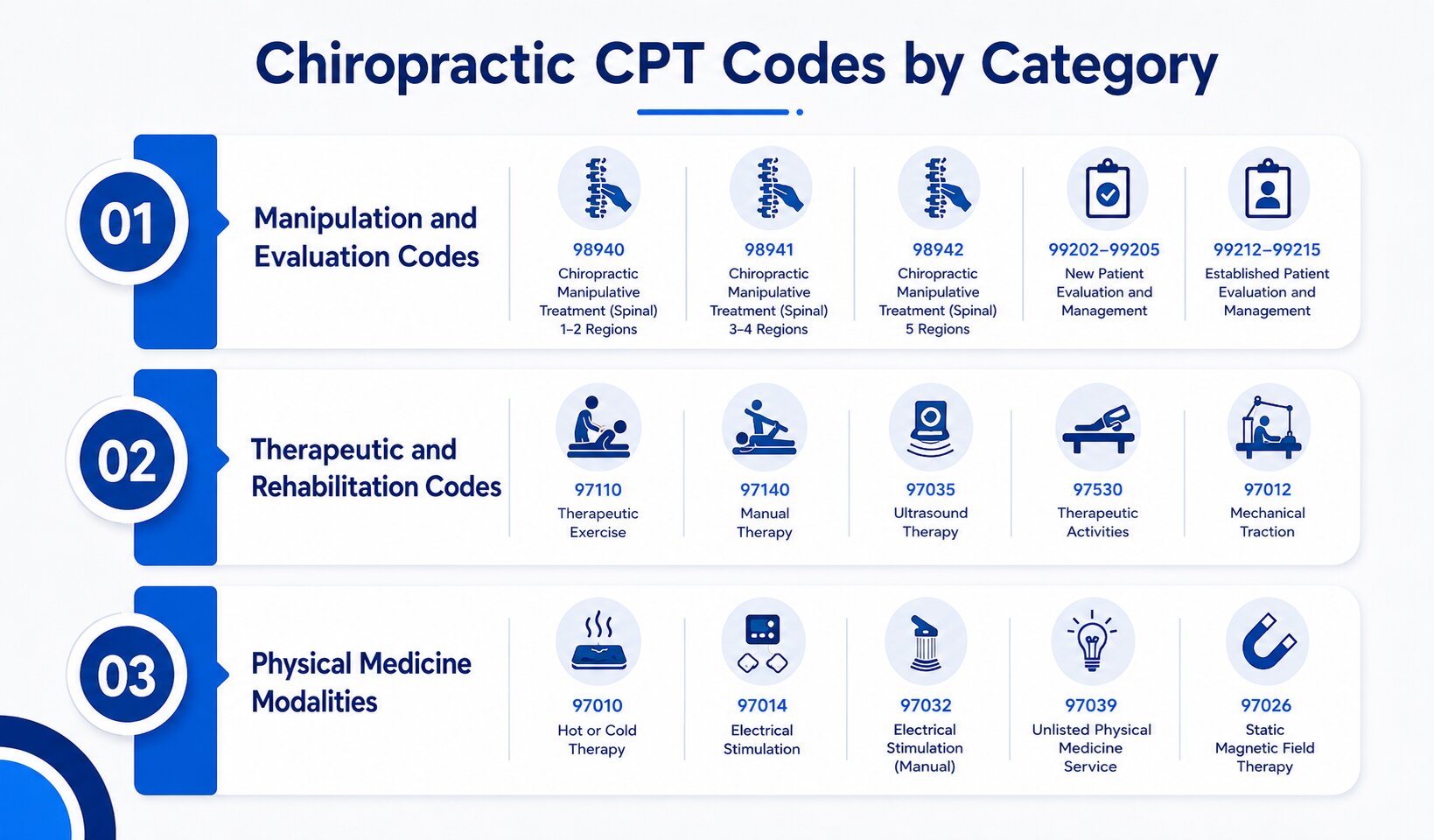
CMT codes are selected by spinal region count, not adjustment count. This chiropractic cpt code family, 98940 through 98943, sits alongside E/M codes documenting the exam behind ongoing care.
Therapeutic exercise, manual therapy, and functional activities need their own time-based documentation. Cpt for chiropractic care beyond adjustment, these chiropractic procedure codes, get denied more than CMT because time and units go unrecorded.
Heat, cold, and electrical stimulation round out the group. Chiropractic therapy cpt codes here pay little individually, and Medicare bundles several rather than paying them separately.
Every claim needs an initial exam, a stated treatment plan, and clear medical necessity. Cpt codes for chiropractic services are only as strong as the note behind them, and auditors check first whether billed regions match documented regions. The cpt codes chiropractic coders select depend on documentation updated as care continues, not written once and reused for months, and ongoing medical coding support tends to catch stale notes before they become a denial pattern.
Documentation checklist
A handful of modifiers appear repeatedly, and cpt code chiropractic billers need to apply with precision, not habit.
Chiropractor cpt codes get miscoded more than most providers realize, and the errors repeat in predictable ways.
Strong denial management tracks these patterns by code rather than treating each denial as a one-off.
|
ICD-10 code |
Diagnosis |
|
M54.50 |
Low back pain |
|
M54.2 |
Cervicalgia |
|
M99.01 |
Segmental dysfunction, cervical |
|
M99.03 |
Segmental dysfunction, lumbar |
|
M62.830 |
Muscle spasm |
Chiropractic medical billing codes pair with a diagnosis that reflects what the exam found, not a default pulled from a template. Diagnosis selection depends entirely on clinical documentation.
A patient presents with low back pain across three lumbar regions. The right choice is procedure code 98941, since it covers three to four regions and the note specifies which ones.
A new patient gets an evaluation and an adjustment the same visit. When the exam is separately identifiable from the manipulation, 99203 paired with 98940 can go out under modifier 25, and billing for chiropractic visits like this depends on the note drawing a clear line between the two.
A patient gets manual therapy on the shoulder in the same session as spinal manipulation. Since the shoulder is a separate region, chiropractic billing codes here pair 97140 with the CMT code, and modifier 59 may apply.
Staying current with annual CPT revisions matters, since a code deleted in January can still get billed in March by a team working off an old sheet. Every code needs documentation behind it, and practices that build cpt codes for chiropractic audits into a monthly routine keep clean claim rates higher than ones reacting only after a denial.
This chiropractic billing and coding guide covers the compliance side in more depth, and this primer on chiropractic CPT codes covers the basics.
Accurate chiropractic CPT codes are the foundation of a compliant claim, and getting them right depends less on memorizing digits than on documentation that supports the code selected. Correct spinal region counts, proper modifier use, and diagnosis codes that reflect real exam findings reduce denials and speed up reimbursement.
Staying current on medical billing codes for chiropractors as revisions roll out supports cleaner claims and a stronger revenue cycle. RCM Matter's chiropractic billing team reviews denial trends by code and modifier so practices don't add that work to a full front desk.
1. What are the most common chiropractic CPT codes?
98940, 98941, 98942, and 98943 cover manipulation, while 97110, 97140, and 97530 cover therapy. Add E/M codes for exams, and that short list handles most of what a chiro cpt code reference sheet needs.
2. What is CPT code 98940 used for?
Chiropractic manipulation of one to two spinal regions. Simple case, simple chiropractor cpt code, and usually the fastest CMT code to clear when documentation is clean.
3. What is the difference between CPT 98940, 98941, and 98942?
CPT 98940, 98941, and 98942 differ by spinal region count, not technique: one to two, three to four, and all five. The note has to state exactly which regions were treated, since these chiropractic codes cpt auditors check closely get flagged the moment the count doesn't match the code billed.
4. Which modifiers are commonly used in chiropractic billing?
Modifiers 25, 59, AT, and GA come up most, though which ones a payer expects can vary by plan type.
5. What documentation is required for chiropractic claims?
An initial exam, a stated treatment plan, clear medical necessity, and a record of exactly which spinal regions were treated. Progress notes and periodic re-evaluations need to back up every claim as care continues, not just the first visit.
6. How can chiropractors reduce claim denials?
Reducing denials starts with documentation that matches the code. Keeping a chiropractic billing cheat sheet current and reviewing denials by cause rather than guessing both move the needle.
Optimize billing, claims and collections with expert RCM support let our professionals handle the process so you can focus on patient care.