A cardiologist sees a patient for chest pain, runs an EKG during the same visit, and bills both. Two weeks later, the claim comes back denied, and nobody can say exactly why. This traces back to one small detail: the modifier attached, or missing, from the claim. Cardiology modifiers tell the payer what happened during a visit or procedure, and getting them wrong changes how much the practice gets paid, if it gets paid at all.
A 2025 HHS Office of Inspector General audit found documentation failed to support modifier 25 in 22 of 24 sampled claims, exposing Medicare to up to $124 million in improper payments.
That audit looked at eye injections, but the same standard applies wherever an E/M visit and a minor procedure land on one claim.
A modifier is a two-character code added to a CPT or HCPCS code, explaining a circumstance that changed the service without changing the procedure itself.
Cardiology medical billing and coding leans on modifiers more than most specialties, since so much of the work stacks services on one day: an office visit followed by an EKG, an echo read by one physician using another facility's equipment, a stress test repeated hours later for a different reason.
A modifier clarifies a service already on the claim rather than adding a new one. Skip it, or pick the wrong one, and the claims engine defaults to its most conservative read, usually a denial. Practices that check documentation against the right modifier before submission see fewer of these claims come back.
Nine modifiers cover most cardiology scenarios, each answering a different question about what happened.
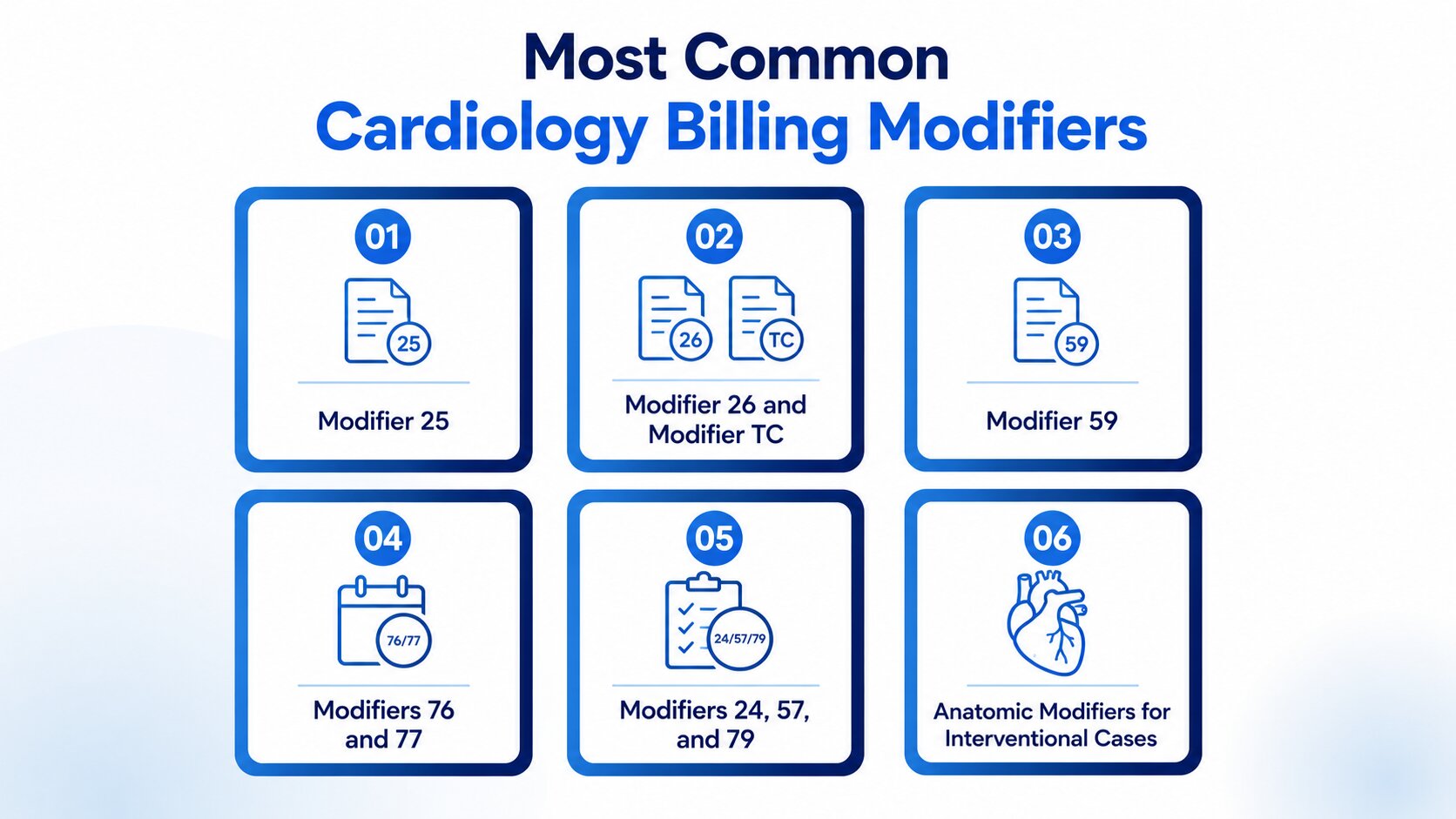
Goes on an E/M code when a significant, separately identifiable evaluation happens alongside a same-day minor procedure.
A patient comes in for a routine follow-up, and the cardiologist finds new symptoms warranting a workup beyond the planned EKG. The note has to show the E/M was distinct from the procedure, since auditors scrutinize this modifier hardest.
Modifier 26 marks the professional component, the physician's interpretation and report, when the technical work happened elsewhere.
Modifier TC covers equipment, staff, and supplies without interpretation. A cardiologist reading a hospital-performed echo bills 26; a practice that owns the machine but outsources reading bills TC.
Modifier 59 in medical billing marks a distinct procedural service, one that wouldn't normally be reported alongside another code but was medically necessary as a separate act or anatomic location.
Cardiology leans on it during catheterization cases involving multiple vessels. It should never be a fallback for unbundling a denied claim, since overuse is one of the fastest routes to a full claims review.
Both cover repeat procedures. Modifier 76 applies when the same physician repeats a procedure the same day, like a second EKG after the patient's condition changes. Modifier 77 applies when a different physician performs the repeat, common in group practices with rotating coverage.
These live inside the global surgical period, the window where follow-up care is normally bundled into the original payment. Modifier 24 marks an unrelated E/M visit. Modifier 57 marks the visit where the decision for surgery was made.
Modifier 79 marks an unrelated procedure during someone else's global period. A patient with a recent pacemaker who returns for an unrelated catheterization gets billed with 79, not 24, since it's a procedure rather than a visit.
Interventional cardiology adds a layer most billing guides skip. Treating multiple coronary vessels in one session calls for vessel-specific modifiers: LC for the left circumflex, RC for the right coronary, LM for the left main, and the LD modifier for the left anterior descending artery. A three-vessel angioplasty billed without these looks like a duplicate.
|
Modifier | Purpose | Cardiology example |
|
25 | Separate E/M same day as a minor procedure | Office visit plus same-day EKG |
|
26 | Professional component only | Interpretation of a hospital echo |
|
TC | Technical component only | Owned equipment, reading outsourced |
|
59 | Distinct procedural service | Multiple vessels, one catheterization |
|
76 | Repeat procedure, same physician | Second same-day EKG, condition changed |
|
77 | Repeat procedure, different physician | Repeat stress test, covering cardiologist |
|
24 | Unrelated E/M during a global period | New complaint after a recent stent |
|
57 | E/M deciding on surgery | Consult the day before a procedure |
|
79 | Unrelated procedure, global period | Catheterization weeks after a pacemaker |
None of these modifiers hold up without documentation behind them, and that's where otherwise well-run practices lose ground.
A modifier 25 claim needs language separating the E/M decision-making from the procedure, not a checklist mentioning both.
Catheterization notes need vessel-specific detail so 59 and the anatomic modifiers survive a records request.
A few patterns repeat often. Modifier 25 gets applied automatically to every E/M-plus-procedure visit, whether the note supports it or not, and that habit is exactly what OIG audits catch.
Modifier 59 becomes a blanket fix for anything bundled, instead of a tool reserved for genuinely distinct services.
Modifier 26 or TC gets left off when work splits between two entities, quietly causing an underpayment nobody notices until someone reviews the cardiology CPT code set.
Cardiology medical billing Modifiers don't behave identically across every payer. One Medicare Advantage plan may reduce a modifier-25 claim that Medicare pays in full. It genuinely varies by payer and plan type, so checking policy before submitting saves appeal time later.
Office visit plus EKG: A routine follow-up turns into an expanded evaluation once the patient mentions new shortness of breath. Modifier 25 goes on the E/M code, backed by a note separating the workup from the check-in.
Echocardiogram interpretation only: A cardiologist reads and reports on an echo performed at an outside center. The claim carries modifier 26, since the physician did none of the technical work.
Repeat EKG, same day: A patient's rhythm shifts mid-visit, prompting a second EKG hours later, read by the same physician. Modifier 76 applies.
Multi-vessel intervention: One catheterization treats both the right coronary and left anterior descending arteries. Modifier 59 separates the interventions, with RC and LD specifying the vessels.
Unrelated procedure in a global period: A patient who received a stent three weeks earlier returns needing an EP study for an unrelated arrhythmia. Modifier 79 applies, with documentation showing no connection to the stent.
Getting cardiology modifiers right isn't about memorizing a list. It's about matching what happened in the exam room or the cath lab to the code that describes it, then backing that with documentation strong enough to survive a payer review months later.
Practices that build this checking into their workflow spend less time on appeals. For those weighing whether that review works better in-house or through external support, RCM Matter's cardiology billing services can analyze recent denial trends and identify where modifier errors are affecting reimbursement.
1. What are cardiology billing modifiers?
Two-character additions to a CPT or HCPCS code that explain a circumstance affecting a service, without changing the underlying code itself.
2. Which modifier is most commonly used in cardiology?
Modifier 25, mostly because so many visits combine an evaluation with a same-day diagnostic test. It's also the one auditors scrutinize hardest.
3. What is the difference between modifier 25 and modifier 59?
Modifier 25 sits on an E/M code. Modifier 59 sits on procedure codes, marking two procedures as distinct rather than duplicates.
4. When should modifier 26 be used?
Any time the billing physician provided only the interpretation, not the technical work of performing the study.
5. Can multiple modifiers be used on one cardiology claim?
Yes. A multi-vessel procedure might carry modifier 59 alongside LC or LD on the same line.
6. Why are cardiology claims denied because of incorrect modifiers?
Usually the modifier doesn't match the documentation, or it's missing. Payers run automated edits first, and an unfamiliar combination gets flagged before a person looks at it.
Optimize billing, claims and collections with expert RCM support let our professionals handle the process so you can focus on patient care.