Medical billing is a high-stakes process. A single error can delay payment, trigger an audit, or result in a full claim denial. That is why experienced medical billing experts live by one guiding principle, often called the golden billing rule:
“If it was not documented, it was not done.”
This rule is not just a phrase. It is the foundation of every successful billing operation.
It connects clinical documentation to accurate medical coding, links both to healthcare billing compliance, and ultimately determines whether a practice gets paid or not.
Understanding this principle is essential for any provider, coder, or billing manager who wants to build a financially stable, audit-ready practice.
This principle dictates that you should never bill or code for a service that is not thoroughly and accurately recorded in the patient's medical file. Every procedure, test, and consultation must be clearly justified by contemporaneous clinical notes to prove medical necessity.
This blog breaks down what the rule means, how documentation drives billing success, and what healthcare organizations must do to stay compliant and profitable.
"In medical billing, documentation is not administrative paperwork. It is the legal and financial record of care delivered."
The golden billing rule establishes a direct link between clinical care and financial reimbursement.
If a provider delivers a service but fails to record it properly, payers have no basis for reimbursement. The documentation is the proof.
This applies at every level, from a routine office visit to a complex surgical procedure. Insurance companies, Medicare, and Medicaid all require documentation that supports the service billed. When that support is missing or incomplete, claims are denied, delayed, or downgraded.
Read more; Credentialing with medicaid and medicare
Beyond reimbursement, this rule also governs compliance. Billing a service without adequate documentation is not just a revenue problem. It can also constitute fraud.
That is how seriously regulators treat the link between records and billing.
Following medical documentation guidelines is not optional. CMS, the AMA, and private payers all publish standards that define what constitutes acceptable documentation.
These standards specify what elements must be present in each note type, how services must be described, and what level of detail is required to justify a given code.
Practices that align their workflows with medical record documentation requirements reduce their exposure to audits, recoupments, and compliance violations. Those who ignore them take on significant financial and legal risk.
Accurate medical coding depends entirely on the quality of the underlying record.
A coder cannot assign a specific diagnosis code if the provider only documents a vague symptom. They cannot bill for a complex procedure if the note does not describe the complexity.
This is where many practices lose revenue. They deliver high-quality care but fail to document it adequately, resulting in codes that underrepresent the service, a pattern known as undercoding.
On the other side, overcoding due to poor documentation is a compliance risk. Both outcomes are avoidable when the documentation is precise.
The healthcare reimbursement process is built on a simple exchange: payers reimburse documented, medically necessary care.
When documentation is strong, claims move through adjudication cleanly, and payments arrive on schedule. When it is weak, the entire revenue cycle slows down.
Denials, appeals, and resubmissions all consume staff time and delay cash flow. Practices with consistent documentation standards experience fewer of these disruptions, and that efficiency translates directly into financial stability.
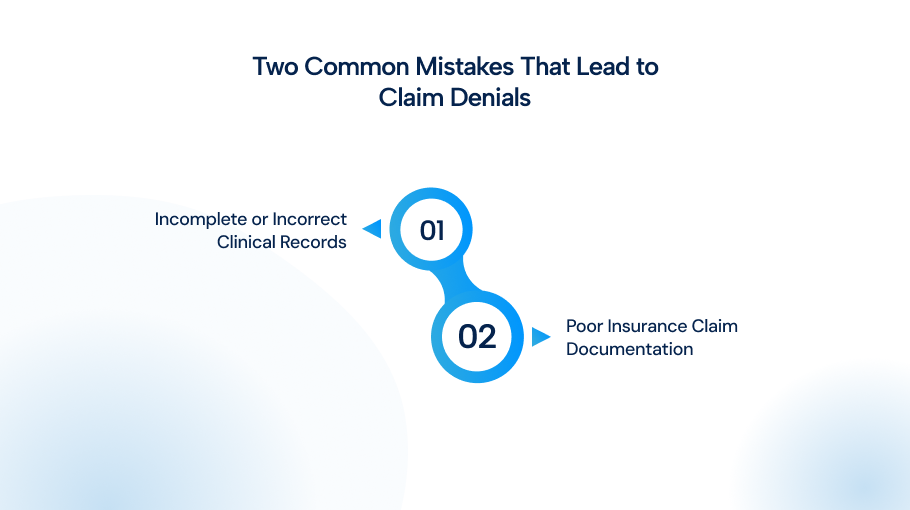
Even well-intentioned practices make documentation errors. Notes copied forward without updates, missing provider signatures, and diagnoses that do not match the codes submitted are among the most frequent issues.
Incomplete or generic clinical narratives, incorrect dates of service, missing modifiers, and failure to link a diagnosis to a procedure also appear regularly across billing audits.
Many of these errors stem from rushed documentation workflows rather than intentional negligence. But from a payer's perspective, the effect is the same, that the claim lacks sufficient support and gets denied.
Insurance claim documentation must tell a complete, consistent story. The clinical record, the diagnosis code, the procedure code, and the supporting notes must all align. When any piece is missing or contradictory, the payer has grounds to reject the claim.
Poor insurance claim documentation is one of the leading causes of claim denials across all payer types.
Read more; How do you get health insurance immediately
A diagnosis that does not justify the billed procedure, a note that lacks medical necessity language, or a missing referral authorization can each trigger a denial independently. Resubmitting with corrections costs the practice time, staff hours, and sometimes the payment window entirely.
Billing and coding guidelines define the minimum standard for a compliant, reimbursable claim. Every billing team should be fluent in these fundamentals:
Medical necessity must be documented. Every service billed must be clinically justified by the diagnosis and patient condition recorded in the note.
Specificity in diagnosis coding. ICD-10 codes must reflect the most specific diagnosis the documentation supports — not a general or unspecified code when a specific one is available.
Procedure codes must match the documented service. The CPT or HCPCS code must align precisely with what was performed and described in the clinical record.
Modifiers must be used correctly. Modifiers provide context that can affect reimbursement, and misusing or omitting them leads to denials or compliance flags.
Timely documentation. Notes should be completed as close to the time of service as possible. Delayed or reconstructed records carry lower credibility in audits.
Provider signatures and credentials. Every note must be authenticated by the treating provider in accordance with payer and regulatory requirements.
Linkage between diagnosis and procedure. Payers need to see that the diagnosis justifies the procedure billed, so this connection must be explicit in the record.
Records should be structured so that the information billers and coders need is easy to locate, such as diagnosis, treatment, provider signature, and date of service, without requiring them to search through unstructured notes.
Templates, standardized note formats, and defined documentation workflows all help ensure that medical records are organized in a way that supports timely and accurate billing.
Every record must identify the patient, the provider, the date of service, the clinical findings, the diagnosis, and the treatment or plan.
For higher-complexity services, documentation requirements go further, including time spent, medical decision-making detail, and in some cases, coordination of care notes.
Payers conduct post-payment audits regularly, and government programs like Medicare run the Comprehensive Error Rate Testing (CERT) program to identify billing patterns that suggest improper payments.
When documentation errors are discovered in an audit, practices may face repayment demands covering months or years of improperly supported claims. In cases of repeated or deliberate errors, penalties and exclusion from federal programs are possible outcomes.
Practices that invest in strong documentation systems get paid faster, face fewer denials, and carry lower audit risk.
Read more; Mastering cms audit preparation
Internal audits, regular coder education, and periodic documentation reviews are practical tools every practice should use to stay ahead of compliance risks before an external auditor identifies them first.
The golden billing rule “document everything, code what is documented, and bill what is coded” is not just best practice.
It is the operational standard that separates financially healthy practices from those that struggle with denials, audits, and revenue shortfalls.
The healthcare reimbursement process works as intended when medical documentation is written and coded as per the guidelines and organized for clarity and compliance. Providers get paid accurately and on time.
What is the golden rule in medical billing?
The golden rule in medical billing is: If it isn’t documented, it wasn’t done. Accurate, complete, and timely documentation must support every service billed to ensure proper reimbursement and compliance.
Why is documentation so important in medical billing?
Documentation supports accurate medical coding and justifies medical necessity. Without clear records, claims may be denied, underpaid, or flagged during audits.
How does the golden rule impact the healthcare reimbursement process?
When documentation aligns with billing and coding guidelines, claims are processed faster and with fewer denials. This directly improves cash flow and reduces administrative rework.
Can poor documentation lead to compliance issues?
Yes. Incomplete or inconsistent records can violate medical documentation guidelines and increase the risk of audits, penalties, or repayment demands.
How can practices follow the golden billing principle effectively?
Practices should ensure timely chart completion, proper code selection, regular internal audits, and strong coordination between clinical and billing teams to maintain healthcare billing compliance.
Optimize billing, claims and collections with expert RCM support let our professionals handle the process so you can focus on patient care.