A hospice biller submits a clean claim for a patient's ongoing pain management, confident the paperwork is right, and it comes back denied anyway. Nothing was wrong with the diagnosis or the documentation. The problem was a single two-letter code that told Medicare the wrong story about who was treating the patient and why. This mix-up happens constantly in hospice billing, and it almost always comes down to the gv vs gw modifier decision. Get it wrong and the claim stalls for weeks while your team chases a resubmission that should have gone through the first time.
Knowing exactly when each modifier applies is one hospice billing decision where there's no room to guess.
|
Feature |
GV modifier |
GW modifier |
|
Description |
Attending physician not employed or paid by the hospice |
Service unrelated to the patient's terminal condition |
|
Applies to |
Services related to the terminal illness |
Services unrelated to the terminal illness |
|
Who uses it |
The designated attending physician |
Any eligible provider treating an unrelated condition |
|
Primary payer |
Medicare hospice benefit |
Medicare hospice benefit |
|
Purpose |
Identifies the attending physician relationship |
Identifies unrelated medical services |
The gv and gw modifier difference comes down to relationship, not severity. GV tells Medicare who is managing the terminal diagnosis. GW tells Medicare a service has nothing to do with it.
That mix-up carries real financial weight. According to CMS's Medicare Learning Network guidance, the improper payment rate for non-hospital-based hospice services was 6.8% in the 2024 Medicare Fee-for-Service Supplemental Improper Payment Data, tied to a projected $1.6 billion in improper payments, and missing or mismatched modifiers are named directly as a contributing cause.
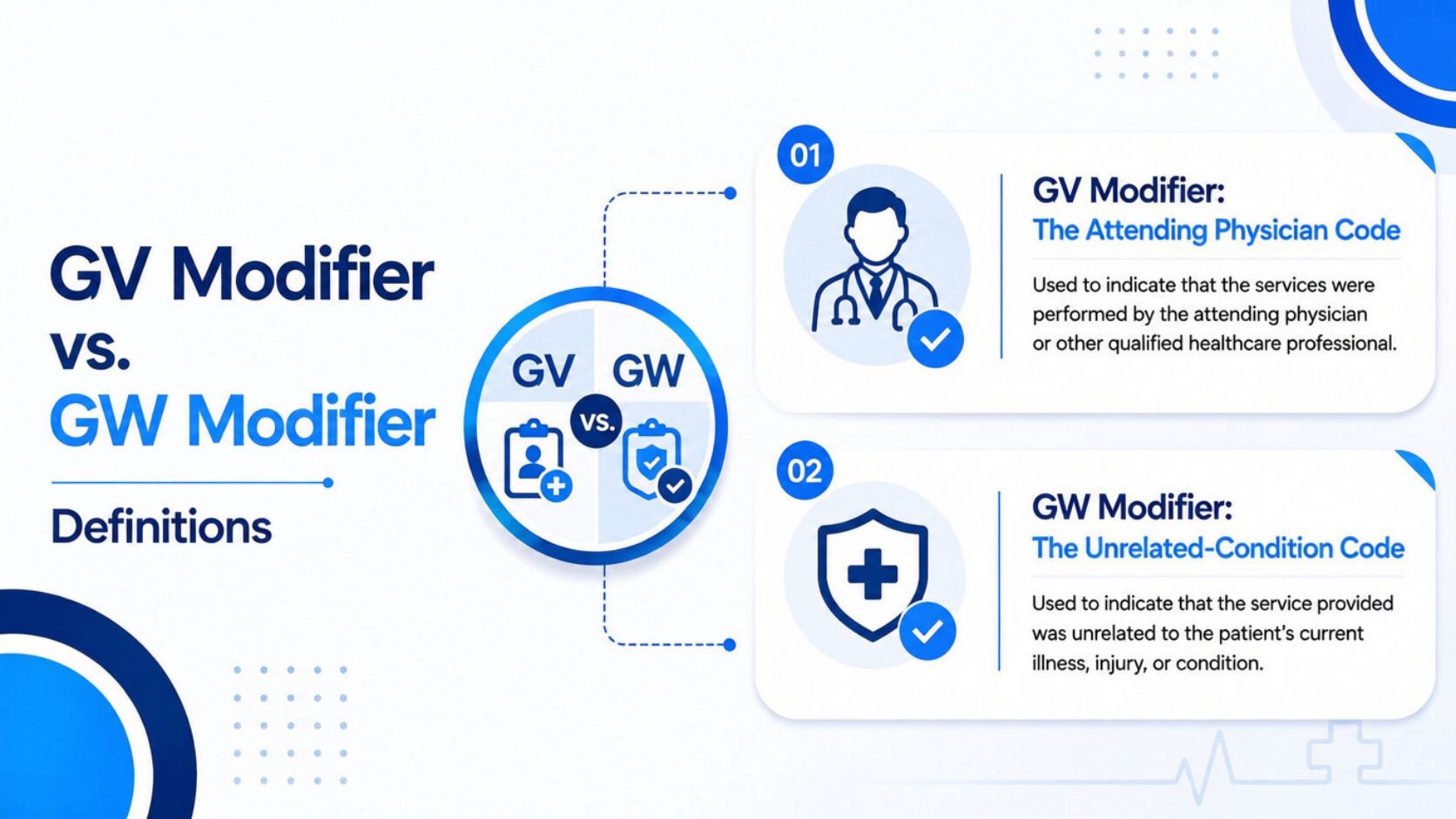
What is the GV modifier? It's the code attached when a hospice patient's designated attending physician, someone not employed or paid by the hospice, provides a service related to the terminal illness.
Picture a patient's longtime oncologist who keeps managing symptoms after hospice election. That physician isn't on the hospice payroll, but the care still ties directly to the terminal diagnosis.
Eligibility hinges on documentation: the patient needs a formal hospice election on file, and the physician needs to be named as attending of record, not just someone who happened to see the patient that day.
What is gw modifier used for, then? It marks a service with no connection to the terminal illness at all. A hospice patient treated for a broken wrist, or the urinary tract infection example above, falls under GW.
Any provider treating the unrelated condition can report it, and doesn't need to be the designated attending the way GV requires. Medicare draws this line because hospice care is bundled, so unrelated care still gets billed separately under standard Medicare rules.
Working through the decision in order clears up most confusion.
The gw vs gv modifier choice is mechanical once relationship and provider are isolated. Confirming hospice status before a claim reaches coding, similar to how eligibility verification works across other specialties, catches a large share of these errors early.
Documentation is where gv and gw modifiers either hold up under review or fall apart. Reviewers want hospice enrollment confirmed, physician designation on record, and a note explaining the relationship, or lack of one, to the terminal illness.
The modifier communicates the relationship; the chart still has to justify the service on its own. Keeping this consistent across coders, ideally as part of a broader medical coding compliance process, prevents the kind of one-off judgment calls that create inconsistent billing patterns.
Most hospice modifier gv and gw errors repeat across coders. Using GW when GV applies is the most frequent, usually from assuming any outside physician means "unrelated" without checking attending status, which is why confirming physician designation through proper credentialing records matters more than it gets credit for. The reverse, applying GV to something unrelated, happens less often but draws more scrutiny.
A hospice patient sees their attending physician for ongoing heart failure management, the terminal diagnosis, and that claim gets GV. The same patient later needs treatment for an unrelated urinary tract infection from a different provider, and that claim gets GW.
Apply GV to the UTI visit just because the patient is enrolled in hospice, and Medicare will likely deny it once documentation shows no connection, forcing a resubmission with the correct modifier gv and gw designation. A strong denial management process catches these before they turn into aged AR.
Not on the same line for the same service. GV and GW answer opposite questions, so a single service is either related or it isn't. When a claim includes multiple services on one date, some related and some not, each line gets its own modifier based on that specific service.
This is one area that genuinely isn't uniform everywhere. Some Medicare Administrative Contractors interpret partial-connection edge cases slightly differently, so check payer-specific guidance before assuming a borderline case gets handled the same way twice.
Getting this hospice modifier gw and gv distinction wrong on multi-service claims is a common reason hospice AR ages past sixty days.
Before submission, confirm hospice election is active, physician designation is documented, and notes match the modifier chosen. That review catches most of what would otherwise become a denial.
Choosing correctly between the gv vs gw modifier comes down to two questions: is the service connected to the terminal illness, and if so, is the person providing it the designated attending physician. Get those answers right, and the modifier selects itself. Documentation matters just as much, since reviewers weigh both together when deciding whether a hospice claim holds up.
Billing teams that build hospice election checks, physician designation review, and medical necessity documentation into their front-end process tend to see denial rates drop within a few billing cycles, which is the approach RCM Matter builds into its hospice and specialty billing workflows for providers who'd rather not relearn this lesson claim by claim. If GV and GW confusion keeps showing up in your denials, it might be worth auditing last quarter's hospice claims to see how many trace back to this exact issue.
1. What is the difference between GV and GW modifiers?
GV identifies a service related to the terminal illness provided by the designated attending physician. GW identifies a service unrelated to the terminal illness, and any eligible provider can report it.
2. When should the GV modifier be used?
Use it when the patient's designated attending physician, someone not employed by the hospice, provides care tied to the terminal diagnosis. The designation has to be documented, not assumed.
3. When should the GW modifier be used?
Whenever the service has no clinical connection to the terminal illness. It doesn't matter who provides it.
4. Can GV and GW modifiers be reported together on the same claim?
Not on the same line item. A claim with multiple services can carry both modifiers across different lines, just never on the same one.
5. What happens if the wrong modifier gets billed?
Denial, most of the time, and occasionally a recoupment if the error surfaces after payment. Correcting it means resubmitting with documentation showing the true relationship between the service and the terminal illness, which costs your billing team time it could spend elsewhere.
Optimize billing, claims and collections with expert RCM support let our professionals handle the process so you can focus on patient care.