A cardiology practice submits a claim for a diagnostic catheterization, and three weeks later it comes back denied. Not because the procedure wasn't medically necessary, but because a modifier was missing and a prior authorization number didn't match what the payer had on file. The biller reworks it, resubmits, and waits again. Multiply that across dozens of claims a week, and it's easy to see why so many cardiology practices start asking whether outsourcing cardiology medical billing makes more sense than trying to keep pace in-house.
According to the AMA's 2025 Prior Authorization Physician Survey, physicians and their staff spend an average of 13 hours a week just completing prior authorization requests, and 89% say the process contributes to burnout.
For a specialty where nuclear stress tests, advanced echocardiograms, and device implants routinely require authorization before a claim can even be filed, that number lands differently.
Cardiology sits in an unusual spot. It combines high-dollar procedures with some of the densest CPT and ICD-10 coding in medicine, and the margin for error is thin.
A single interventional case might involve diagnostic catheterization, angioplasty, and stent placement in one visit, each requiring its own code, its own modifier, and its own documentation trail.
Modifiers get used constantly, and getting them wrong (26 versus TC, for instance, on a technical-versus-professional split) is one of the most common ways a clean claim turns into a denied one.
Medicare and commercial payers don't always agree on documentation requirements either. What satisfies one plan's local coverage determination might fall short for another.
Add frequent CPT updates for ablation and electrophysiology codes, and it's not hard to see why generalist billing teams struggle here in a way they don't with, say, routine primary care claims.
Outsourcing typically covers the full billing cycle: coding review, claim submission, payment posting, denial follow-up, and patient billing support through comprehensive medical billing services. Some practices outsource everything.
Others keep front-desk and scheduling functions in-house and hand off only the claims and coding side, which is where cardiology-specific expertise matters most.
The core difference from in-house billing isn't really about who touches the keyboard. It's about specialization.
An in-house biller at a mid-sized cardiology practice is usually handling everything from eligibility checks to appeals, with no one person deeply fluent in cardiology-specific payer rules.
A dedicated outsource cardiology billing services partner, by contrast, structures its team around exactly that niche, often with staff who've coded nothing but cardiology claims for years.
Practices that make the switch usually notice a few things first. Claim accuracy tends to improve because coders who specialize in cardiology catch modifier and bundling errors a generalist might miss.
Reimbursements often move faster too, since experienced teams know which payers slow-walk cardiology claims and plan around it.
There's also a real-time dividend. Physicians and administrative staff spend less time chasing down denials and more time on patient care, which is the reason most practices got into cardiology in the first place.
Compliance tends to hold up better as well, since specialized vendors track payer policy changes as part of their job rather than as an afterthought squeezed between other duties.
Specialty experience should come first. A vendor that handles cardiology alongside a dozen other specialties isn't the same as one built around it.
Ask specifically about their experience with interventional and electrophysiology coding, not just general familiarity with the specialty.
Transparent reporting matters more than it sounds. Practices should expect regular, detailed visibility into claim status and denial trends, not a monthly summary that raises more questions than it answers.
HIPAA compliance and technology integration go hand in hand here too. The vendor's systems need to talk to the practice's EHR without creating extra manual work, and their security practices should hold up to direct questioning. Performance metrics and references round it out.
A vendor confident in its results will share clean claim rates and denial percentages without hesitation, and speaking to current clients tends to reveal more than any sales pitch will.
This is also where cardiology revenue cycle management performance really shows itself, in the numbers a vendor is willing to put in front of a prospective client.
Practices weighing this decision often start by reviewing how cardiology billing and coding differs from general medical billing, since the coding complexity is usually what drives the outsourcing conversation in the first place.
For practices researching modifier use specifically, a closer look at cardiology coding essentials is a useful next step before selecting a vendor.
RCM Matter's cardiology billing services team works directly with practices on this evaluation, focusing on denial prevention and coding accuracy from the first claim onward.
None of this means outsourcing is automatically the right call. Handing off billing means giving up a degree of direct control, and for practices used to walking down the hall to ask a biller a question, that adjustment takes getting used to.
Vendor selection is where a lot of practices stumble. Not every billing company that claims cardiology experience actually has it, and a mismatch here can cost more in cleanup than it saves in convenience.
Communication expectations need to be set early too. If a practice expects daily updates and the vendor reports monthly, friction builds fast regardless of how good the underlying work is.
Data security deserves more attention than it usually gets. Patient financial and clinical data moving to a third party raises real HIPAA questions, and a lot of competitor content treats this with a single line of reassurance.
It's worth asking directly about business associate agreements, encryption standards, and where staff handling the data are actually located.
|
Factor | In-house billing | Outsourced billing |
|
Cost | Fixed salary, benefits, and overhead regardless of claim volume | Typically a percentage of collections, scaling with revenue |
|
Expertise | Depends on individual staff training and turnover | Access to coders with dedicated cardiology experience |
|
Staffing | Vulnerable to absences, turnover, and hiring gaps | Backed by a full team, reducing single points of failure |
|
Scalability | Requires hiring ahead of growth | Adjusts more easily to volume changes |
|
Technology | Practice bears the cost of billing software and updates | Vendor typically provides and maintains the platform |
|
Compliance | Relies on internal tracking of payer policy changes | Often built into the vendor's standard process |
Not every practice needs to make this change, but a few situations tend to tip the decision.
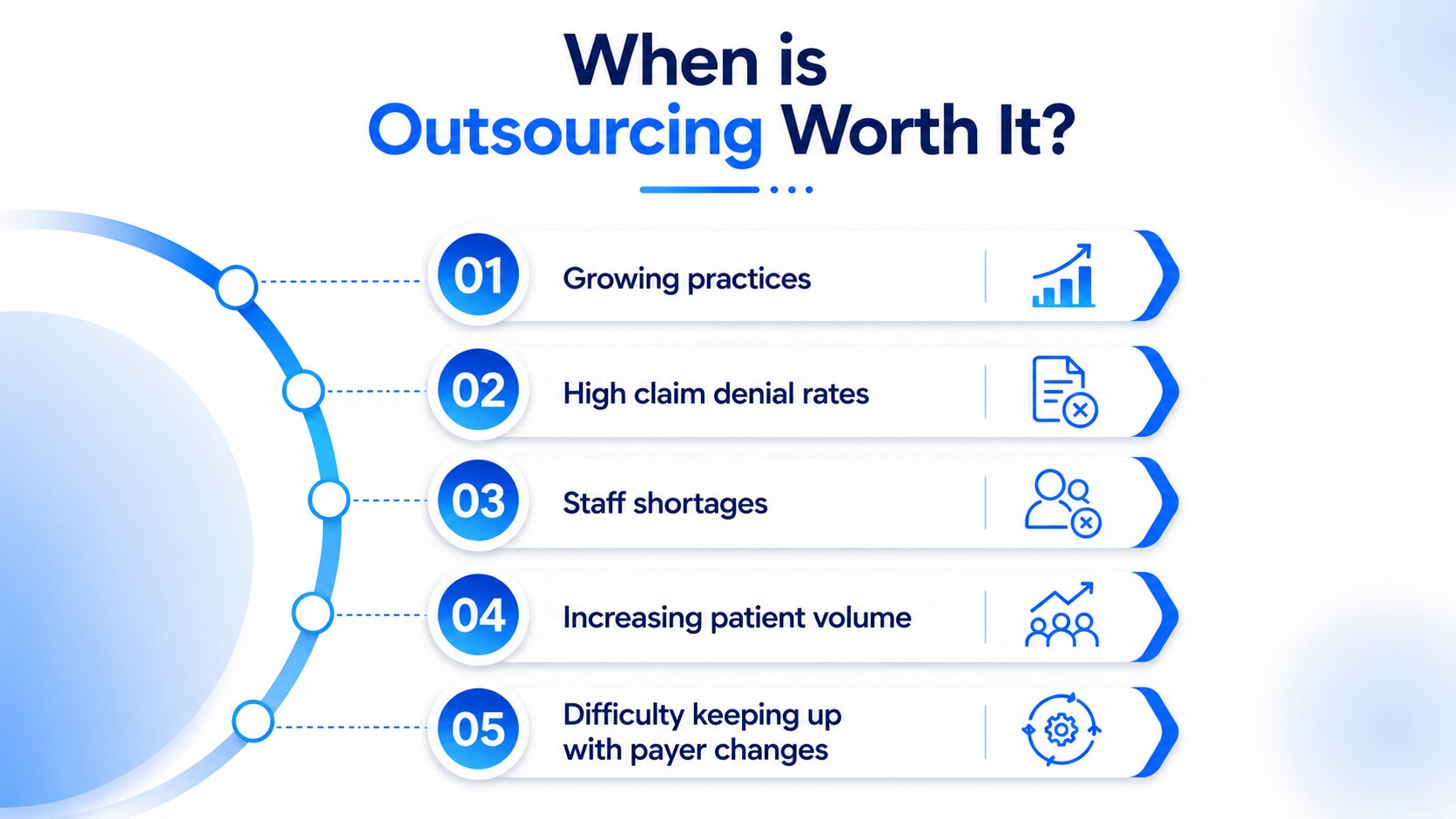
Growing practices: As patient volume climbs, in-house teams that were adequate at a smaller scale start falling behind, and claims backlogs grow quietly until they're impossible to ignore.
High claim denial rates: If denials are climbing and no one has the bandwidth to dig into why, that's usually a sign the current setup has hit its ceiling.
Staff shortages: Billing is one of the harder roles to hire and retain for, and a single vacancy can stall an entire revenue cycle for weeks.
Increasing patient volume: More patients means more claims, more prior authorizations, and more chances for something to slip through.
Difficulty keeping up with payer changes: When policy updates arrive faster than staff can absorb them, errors creep in even with an experienced team.
Outsourcing isn't the right move for every practice, and any honest look at the decision has to say so. A stable, well-staffed in-house team with strong denial rates may have little to gain from switching. But for practices facing rising claim complexity, staffing gaps, or growth that's outpacing their current billing setup, outsourcing cardiology medical billing services tends to deliver real operational and financial relief.
The practices that get the most out of it are the ones that treat vendor selection as seriously as they'd treat a new physician hire, asking direct questions about cardiology experience, reporting transparency, and data security before making the switch. Reach out to a specialty billing partner at RCM Matter and ask to see their cardiology-specific claim metrics before deciding either way.
1. Is outsourcing cardiology billing cost-effective?
For most growing practices, yes. Outsourced billing usually runs on a percentage of collections rather than fixed salary and overhead costs, which means the expense scales with revenue instead of sitting there regardless of claim volume.
2. What services are included in outsourced cardiology billing?
Coding review, claim submission, payment posting, denial management, and patient billing support are the standard package, though the exact scope varies by vendor and by what a practice chooses to keep in-house.
3. How do I choose the right billing company?
Look past the sales pitch. Ask for cardiology-specific experience, request clean claim and denial rate metrics, and talk to at least one current client before signing anything.
4. Can small cardiology practices benefit from outsourcing?
Often, and sometimes more than larger ones. A small practice usually can't justify a full in-house billing team with cardiology-specific expertise, so outsourcing gives access to that specialization without the overhead of hiring for it directly.
5. Is outsourcing HIPAA compliant?
It can be, but that depends entirely on the vendor. This isn't a fixed guarantee across the industry. Ask directly about business associate agreements, data encryption, and where the staff handling patient information are located, since practices vary widely on all three.
Optimize billing, claims and collections with expert RCM support let our professionals handle the process so you can focus on patient care.