A practice can complete the visit, document the care, and submit a claim yet still collect less than it should. Revenue can disappear when an encounter never becomes a charge, a claim sits in a rejection queue, a payer applies the wrong contracted rate, a valid denial is never worked, or an adjustment is posted without review.
Revenue leakage in medical billing is the preventable loss of collectible revenue for properly documented, billable services. Preventing it does not mean billing every possible code or treating every difference between charges and payments as a loss. It means connecting patient access, documentation, coding, claims, remittance, A/R, and patient balances well enough to find exceptions, resolve supported balances, and prevent the same failures from recurring.
This guide explains where medical billing revenue loss occurs, how to identify revenue leakage through a repeatable audit, how to reconcile expected and actual reimbursement, and which metrics should prompt further investigation.
Revenue leakage in medical billing occurs when a practice does not collect an amount it was entitled to receive because of a preventable breakdown in the revenue cycle. Examples include an unbilled encounter, an eligible claim that misses a filing deadline, a supported service omitted from a claim, an uncorrected payment-posting error, or a contractual underpayment that is not identified and pursued.
The amount billed is not the same as collectible revenue. A submitted charge may be reduced by a contracted allowed amount, coverage rules, coordination of benefits, or valid patient responsibility. Leakage should therefore be measured against the amount supported by the record and payable under the applicable contract, fee schedule, benefit plan, and payer policy, not against gross charges alone.
Suppose a practice records 100 completed visits in one week but finds charges for only 96. Review shows that three missing encounters are fully documented and billable, with estimated collectible reimbursement of $125 each. The fourth record remains incomplete and is not counted as revenue until the documentation and billing status are resolved.
The same review finds five paid claims with expected payer payments of $160 but actual payer payments of $145, creating a suspected $15 variance per claim. The initial estimate of potentially recoverable revenue is therefore $450: $375 for three supported missing encounters plus $75 in suspected payment variances.
That $450 is an estimate, not a recovery. After investigation, two missing claims pay at the expected $125 each, one remains pending at an estimated $125, four underpayments are corrected for $60, and the fifth $15 difference is confirmed as a valid adjustment. The practice has $310 in confirmed recoveries, $125 unresolved, and $15 that is not leakage. This separation prevents the practice from presenting gross charges or suspected variances as collected revenue.
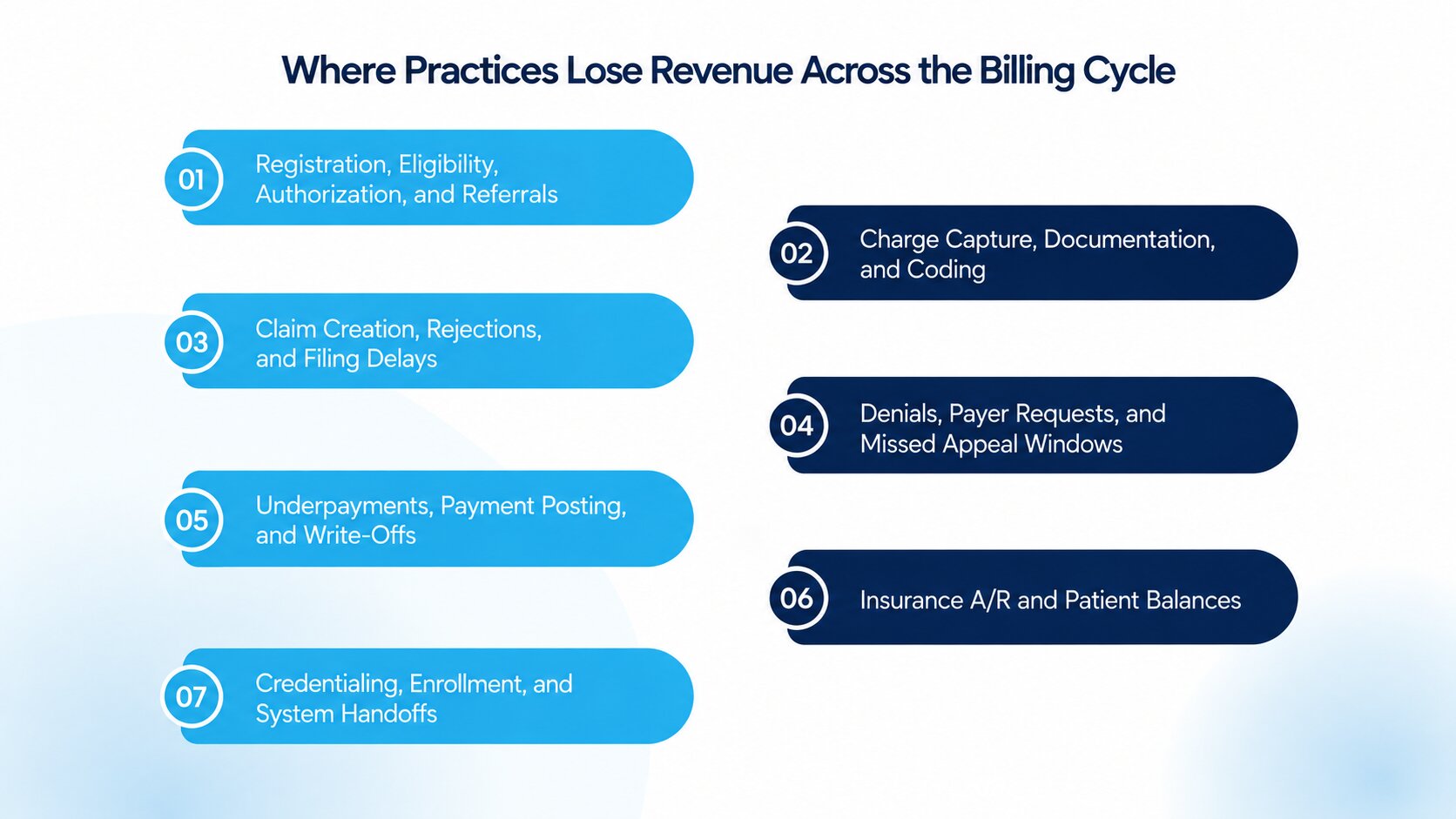
Incorrect patient, subscriber, plan, payer, provider, or location information can cause a claim to reject or adjudicate incorrectly. Active eligibility alone does not establish coverage for every service. The plan may still require a referral, prior authorization, network participation, a specific site of service, or other conditions.
A common leakage chain starts when coverage changes but the record is not updated. The claim goes to the wrong payer, the rejection is not worked, and the correct payer's filing deadline passes. A separate front-end failure occurs when authorization is obtained for the wrong code, date range, unit count, provider, or location. These cases require plan-specific review rather than an assumption that an eligibility response guarantees payment.
Charge capture connects the care recorded in the electronic health record (EHR) with the billable record in the practice management or billing system. Leakage occurs when a completed encounter remains open, an interface fails to transmit the charge, a documented procedure or supply is omitted, or the quantity entered does not match the supported units.
Coding and documentation failures, whether in-house or handled through medical coding services, can also reduce appropriate reimbursement or create denial and compliance risk. Examples include selecting a code before the note is complete, omitting a modifier when the documented circumstances and applicable rules support it, using a modifier that the record does not support, or submitting a service without required documentation. The Centers for Medicare & Medicaid Services (CMS) explains that medical records must support Medicare coverage, coding, and billing requirements in its medical record documentation guidance. CMS also cautions that modifiers used to bypass National Correct Coding Initiative edits are appropriate only when the clinical circumstances support them; see the Medicare NCCI FAQ Library. Coding decisions should follow the record, current code-set instructions, payer policy, and qualified review, never a desired payment amount.
A charge does not produce revenue until it becomes a complete claim, reaches the correct payer, and moves through adjudication. Missing identifiers, invalid payer data, formatting problems, enrollment mismatches, or claim-edit failures can leave a claim in a clearinghouse or payer rejection queue. A clearinghouse acceptance report confirms a transaction step; it does not confirm payment.
Monitor both charge lag and claim-submission lag. An old unbilled charge may have no claim number to follow, while a rejected claim may appear "submitted" in the billing system even though the payer never accepted it for adjudication. Filing limits vary by payer, plan, contract, and claim type. As one specific example, CMS requires most Medicare claims to reach the correct Medicare Administrative Contractor within one calendar year of the date of service, subject to limited exceptions. Practices should maintain payer-specific filing and corrected-claim rules instead of applying the Medicare period to every claim.
Denials may involve eligibility, authorization, coding, documentation, medical necessity, coordination of benefits, duplicate billing, enrollment, or payer processing. A denial becomes preventable leakage when a supported claim is never corrected, requested records are not sent, the wrong action is taken, or an appeal deadline expires.
A denial queue should show the reason, payer, balance, date received, filing or appeal deadline, documentation needed, owner, next action, and current status. Separate claims that need a corrected submission from claims that warrant a supported appeal, claims awaiting payer action, and denials that are valid. That distinction prevents indiscriminate appeals and makes root-cause reporting more reliable.
An underpayment is not the gap between the billed charge and the check. It is a confirmed shortfall between the amount the payer should have paid under the applicable contract or fee schedule and the amount actually paid after valid patient responsibility, coordination of benefits, bundling or payment rules, prior payments, recoupments, and other authorized adjustments are considered.
The payment-posting process should capture the allowed amount, payer payment, patient responsibility, adjustment group and reason codes, and any provider-level adjustment. CMS notes that an electronic remittance advice (ERA) reports adjustment reasons and values at the line, claim, or provider level; its guidance on health care payment and remittance advice explains the roles of group codes, Claim Adjustment Reason Codes, and Remittance Advice Remark Codes. An ERA should also reconcile to the related electronic funds transfer or check so that posted claim payments and deposited funds agree.
Leakage occurs when contract rates are not loaded correctly, a valid adjustment is posted to the wrong category, a payment is applied to the wrong claim, an unexplained zero payment is closed, or staff write off a balance without documented authority. Variances should be reviewed by payer, plan, code, modifier, provider, and date range because a repeated rate error can affect many claims.
Accounts receivable (A/R) can contain unpaid claims, pending claims, denied claims, patient balances, unapplied cash, credits, and balances awaiting information. An aging report alone does not explain which action is needed. Each material balance should have a status, last action, next action date, responsible owner, and relevant deadline.
Prioritization should consider time risk first, then support and recoverability, financial value, recurrence, and effort. A moderate balance near a filing or appeal deadline may deserve attention before a larger claim that is already being processed. Payer requests for records, medical-review responses, coordination-of-benefits issues, and claims with no documented follow-up should be visible in separate work queues.
Patient balances require their own controls. Before billing the patient, confirm that payer processing and secondary coverage are complete, the responsibility was assigned correctly, and prior payments or financial assistance were applied. Inaccurate statements, slow statement cycles, unposted payments, or unauthorized write-offs can create both revenue loss and patient frustration.
Credentialing verifies qualifications, while payer enrollment connects a provider or organization to the payer's reimbursement process. Contracting and effective dates are related but distinct. A provider can be clinically ready to see patients while an enrollment, reassignment, location, or payer-file update is still incomplete.
CMS advises Medicare providers and suppliers to keep enrollment information current to protect billing privileges; its Medicare enrollment guidance identifies reportable changes and the Provider Enrollment, Chain, and Ownership System (PECOS) process. Commercial and Medicaid requirements vary. Practices should track submissions, requests, effective dates, revalidations, provider-location-plan combinations, and the claims affected by an enrollment gap.
Disconnected systems create another form of leakage. A visit may be marked complete in the EHR but never released to the practice management system, an ERA may import without a matching payment, or a payer-table change may route claims incorrectly. Interface logs and exception queues need assigned owners; a successful batch process should not be assumed merely because no one reported an error.
No single metric proves revenue leakage. These patterns should trigger a focused review of the underlying encounters, claims, remittances, and balances:
A useful medical billing audit traces the same population from completed encounter through final account disposition. Define the period, locations, providers, payer groups, and data sources before starting. Keep a control total for encounters, charges, claims, expected reimbursement, payments, adjustments, patient responsibility, and open balances so records do not disappear between reports.
Export completed encounters from the EHR and match them to charge records and claim identifiers in the practice management or billing system. Investigate completed visits with no charge, charges held beyond the normal lag, and charges with no submitted claim. Record a supported no-charge reason when an encounter is legitimately not billable; otherwise, the absence of a charge can be mistaken for leakage or ignored as an unexplained exception.
For targeted samples and high-risk exceptions, compare the clinical record, orders, procedure logs, medication or supply records where relevant, charge detail, and submitted claim. Look for omitted supported services or units, incomplete notes, incorrect dates or locations, unsupported or missing modifiers, and code selection that does not match the record. Route uncertain coding questions to a qualified coding professional and apply current official code-set and payer guidance.
Confirm that each billable charge became a claim, passed clearinghouse edits, reached the correct payer, and received a payer response. Build exception reports for unsubmitted charges, rejected claims, pending claims, and outstanding payer requests. Include original filing, corrected-claim, record-response, and appeal deadlines where applicable.
Start with the applicable contract, fee schedule, or payment methodology. Determine the expected allowed amount, then calculate the expected payer payment after valid patient responsibility, other payer amounts, and authorized payment rules or adjustments. Compare that result with the actual payer payment and the posted transaction.
A practical working formula is: expected payer payment = expected allowed amount minus valid patient responsibility, other payer amounts, and authorized adjustments. Suspected payment variance = expected payer payment minus actual payer payment. The formula must be adapted to the contract and claim. A positive variance is an investigation lead, not proof of underpayment.
Read the ERA or explanation of benefits at the line level when available. Confirm whether each denial or adjustment is valid, correctable, appealable, pending information, or contractual. Review write-off reason codes, approval history, user activity, and supporting notes. Reopen balances that were closed incorrectly, and do not transfer amounts to patients unless payer processing, law, contract, and policy support patient responsibility.
First protect claims approaching a filing, corrected-claim, appeal, or record-response deadline. Next prioritize supported, recoverable balances with significant value or a recurring issue that may affect a larger claim population. Separate claims awaiting payer action from claims that need practice action. Document why an account is deferred, escalated, appealed, corrected, adjusted, or closed.
Every material finding should have an owner, due date, claim-level action, root cause, preventive control, financial status, and verification date. Track estimated opportunity, confirmed recovery, valid non-leakage adjustment, unresolved supported balance, and unrecoverable amount separately. Re-run the relevant report after the control is implemented to confirm that the exception rate falls and that old items were actually resolved.
The U.S. Department of Health and Human Services Office of Inspector General describes auditing, monitoring, and corrective action as elements of voluntary health care compliance guidance. The OIG General Compliance Program Guidance is not binding, but it provides a useful reminder that revenue recovery and billing compliance should be managed together.
|
Audit area |
Compare |
Common discrepancy |
Next action |
|
Encounter to charge |
Completed EHR encounters vs. charge records |
Unbilled visit; open encounter; omitted supported service |
Validate documentation; release or document no-charge reason |
|
Charge to claim |
Charges vs. claim IDs and acknowledgments |
Held charge; missing claim; clearinghouse rejection |
Correct data; submit or resubmit before deadline |
|
Claim to status |
Submitted claims vs. payer status and requests |
Pending claim; unworked denial; missing records |
Assign owner, due date, and correct action path |
|
Expected to actual |
Contract/fee schedule vs. ERA, payment, and posting |
Rate variance; wrong responsibility; misposted adjustment |
Validate terms; correct posting; pursue supported variance |
|
A/R to work history |
Aging report vs. notes, next action, and deadlines |
No follow-up; stale status; deadline risk |
Prioritize by time risk, support, value, and recurrence |
|
Finding to closure |
Audit log vs. corrected claim, payment, or control evidence |
Issue marked closed without resolution; repeat error |
Verify outcome; fix root cause; re-audit |
The prevention plan should turn each audit finding into a control at the earliest practical point in the workflow.
Metrics are screening tools, not diagnoses. Define the numerator, denominator, status point, and reporting period before comparing results. Use matched cohorts when possible, and investigate movement against the practice's own baseline by payer, plan, provider, location, and service type. Do not apply a universal target without confirming that the definition and comparison population are relevant.
|
Metric |
Working definition or formula |
What a change should trigger |
|
Initial claim denial rate |
Initially denied claims ÷ total claims adjudicated in the same cohort × 100. State whether measured by claim count or dollars. |
Review reason, payer, authorization, coding, documentation, enrollment, and data-entry patterns. |
|
Clean claim rate |
Claims accepted and processed without correction or preventable manual rework ÷ total claims submitted × 100. Document the practice's exact definition. |
Trace rejections and edits to registration, coding, claim creation, or payer-table causes. |
|
Days in A/R |
Ending A/R ÷ average daily net patient service revenue for a defined period. |
Separate volume or revenue shifts from claim lag, payer delay, posting backlog, denials, or weak follow-up. |
|
Net collection rate |
Payments ÷ (charges minus approved contractual adjustments) × 100 for a matched cohort. Document treatment of refunds, bad debt, and other adjustments. |
Review underpayments, patient balances, write-offs, aging, payer mix, and period matching. |
|
Underpayment value or rate |
Sum of validated expected-payer-payment shortfalls; optionally divide by expected payer payments for the same reviewed population. |
Validate contract terms, payment rules, posting, adjustment codes, and repeat payer or code patterns. |
|
Aged A/R percentage |
A/R older than the selected threshold ÷ total A/R × 100, reported separately for insurance and patient balances. |
Review no-action accounts, pending requests, unresolved denials, deadline exposure, and posting errors. |
|
Charge capture accuracy |
Completed encounters with a reconciled, supported charge or documented no-charge disposition ÷ completed encounters reviewed × 100. |
Investigate open encounters, missing charges, interface failures, omitted units or supplies, and weak reconciliation. |
Supplement these measures with charge lag, claim-submission lag, payment-posting lag, denial aging, and write-off trends when those measures answer a specific workflow question. More dashboards do not replace claim-level validation.
Revenue cycle management (RCM) connects the administrative and financial steps from patient access through final account resolution. Its value in preventing revenue leakage comes from linking exceptions across stages rather than optimizing each department in isolation.
The connection matters. If denial reporting shows repeated authorization failures, the durable fix belongs in scheduling and patient access, not only in the appeals queue. If underpayments are clustered by one payer and code, the response may require contract validation and payment-reconciliation work rather than more claim scrubbing.
External medical billing services or RCM support may be useful when a practice has persistent staffing gaps, growing unworked A/R, weak contract-to-payment reconciliation, recurring denials, a payment-posting backlog, or limited visibility into claim status and deadlines. Outsourcing does not transfer all accountability. The practice still needs accurate source records, defined responsibilities, access controls, reporting, escalation paths, and performance review.
Before selecting a provider, confirm the exact scope: patient access tasks, charge entry, coding, claim submission, rejection work, denial correction and appeals, record requests, payment posting, underpayment review, insurance A/R, patient statements, enrollment, reporting, and responsibility for old balances. Also review implementation, system access, data security, communication cadence, pricing, termination terms, and how work in progress will transfer.
A practice can use the audit framework above to identify which functions require help, then confirm with RCM Matter, a revenue cycle management company, which tasks, payer populations, systems, reports, turnaround expectations, and escalation responsibilities are included in the proposed engagement. The goal is a closed-loop process: record supported services, submit complete claims, interpret payer responses, reconcile payments and adjustments, advance open balances, and feed recurring errors back to the team that can prevent them.
Start with one defined review period. Reconcile completed encounters to charges and claims, compare expected reimbursement with posted results, protect the nearest deadlines, and assign every material exception to an owner. That sequence produces a defensible view of potential revenue leakage without confusing estimates, gross charges, or legitimate adjustments with cash actually recovered.
Optimize billing, claims and collections with expert RCM support let our professionals handle the process so you can focus on patient care.