In medical billing, authorization is an insurer's formal approval granted to a healthcare provider before a service, procedure, or prescription is delivered. Also known as prior authorization or pre-certification, it guarantees the treatment is covered and medically necessary, protecting both provider and patient from unexpected claim denials.
When a claim gets denied, one of the first questions anyone asks is: "Did we get authorization?" That question alone tells you how much weight authorization in medical billing carries. It sits at the front of the revenue cycle, before the patient gets treated and before anyone submits a claim. When a team misses it or handles it poorly, the damage shows up weeks later as denied claims, delayed payments, and patients stuck in the middle, wondering why their coverage didn't kick in.
This guide breaks down what authorization actually means in practice, the different forms it takes, how the process works step by step, and where things tend to go wrong.
Authorization in medical billing is the approval a healthcare provider gets from an insurance company before delivering a specific service, procedure, or medication. The insurer uses it to confirm two things: the service is medically necessary, and it falls within what the patient's plan covers.
Once the insurer grants approval, they issue an authorization code. That code goes on the claim, and without it, most payers won't process the claim at all. This is one reason why many practices are now outsourcing medical billing, as experienced billing teams can handle authorizations accurately and reduce claim denials.
A lot of people confuse authorization with a referral, so it helps to separate them. A referral is a clinical decision in which a primary care physician directs a patient to a specialist. Authorization in healthcare is a financial step. It means the insurer agrees to pay for what the provider ordered. Both can apply to the same appointment, but they serve different purposes and come from different places.
Not every authorization request looks the same. The timing, the service type, and the payer all shape what kind of approval is needed.
Here's how the main types of authorization in medical billing break down:
| Type | When It Happens | Common Use Cases |
| Prior Authorization | Before the service | Surgeries, MRIs, CT scans, specialty drugs |
| Concurrent Authorization | During an ongoing stay or treatment | Inpatient admissions, extended hospital stays |
| Retrospective Authorization | After the service | Emergency care where prior approval wasn't possible |
| Referral Authorization | Before a specialist visit | PCP-to-specialist referrals in HMO plans |
| Precertification | Before admission or high-cost procedures | Elective surgeries, inpatient hospital stays |
Prior authorization is by far the most common. It covers most planned procedures, advanced imaging, and specialty medications, basically anything an insurer considers high cost or high utilization.
Concurrent authorization is less talked about but just as important for inpatient settings. If a patient's hospital stay extends beyond what was originally approved, the provider needs to go back to the insurer to justify continued care. Miss that window, and the extra days may not get paid.
Retrospective authorization is the exception, not the rule. Payers grant it for genuine emergencies, but the documentation requirements are stringent, and approval is not guaranteed.
What is pre authorization in medical billing in practice? It's more layered than most patients realize, and more coordination-heavy than many providers expect when they first set up a billing workflow.
The process begins when a provider orders a service for which the payer requires pre-approval. The billing or administrative team verifies the patient's insurance and checks whether that specific service needs authorization under that particular plan. This step requires current knowledge of each payer's rules, which shift regularly. What Aetna requires for an MRI today isn't what BlueCross requires, and what either required last year may no longer apply.
Read more; Insurance eligibility verification
Once the team confirms authorization is necessary, they submit a request to the insurer. A complete request usually includes:
Patient demographics and insurance details
The ordering provider's NPI (National Provider Identifier)
CPT and ICD-10 diagnosis codes for the service
Clinical notes that establish medical necessity
Results from relevant prior tests or treatments attempted
The insurer reviews the request against its internal criteria. They approve it, ask for more documentation, or deny it. Response times vary a lot. Some automated systems return approvals the same day. Manual clinical reviews can take 7 to 14 business days.
After the insurer approves the request, the provider documents the authorization number in the patient's record and attaches it to the claim. That number is the proof, and it has an expiration date. If the procedure gets rescheduled past that date and no one catches it, the claim goes out without valid authorization.
Denials happen, and providers can appeal them. According to the American Medical Association's 2024 survey, the average practice handles 39 prior authorization requests per physician per week. Among the denials that providers appeal, more than 81% get fully or partially overturned. That number is worth sitting with.
It means most initial denials aren't the final word. It also means a significant amount of staff time goes into fighting decisions that probably shouldn't have been denied in the first place.
Authorization protects revenue. Most people in healthcare know that much. But treating it purely as a billing checkbox leaves out the part that actually affects patients.
When a provider renders a service without required authorization, the insurer refuses to pay. The provider absorbs the cost or tries to bill the patient, neither of which ends well.
The patient side is harder to quantify but easier to see. A 2024 AMA survey found that 94% of physicians reported prior authorization delays access to necessary care, and 93% said it has a negative impact on patient clinical outcomes.
For a more detailed look at how types of authorization in healthcare fit into the broader revenue cycle, understanding how eligibility verification and authorization work together is the logical next step. These are the two processes that prevent the majority of preventable denials when aligned correctly.
Most authorization problems aren't random. They cluster around a handful of recurring issues.
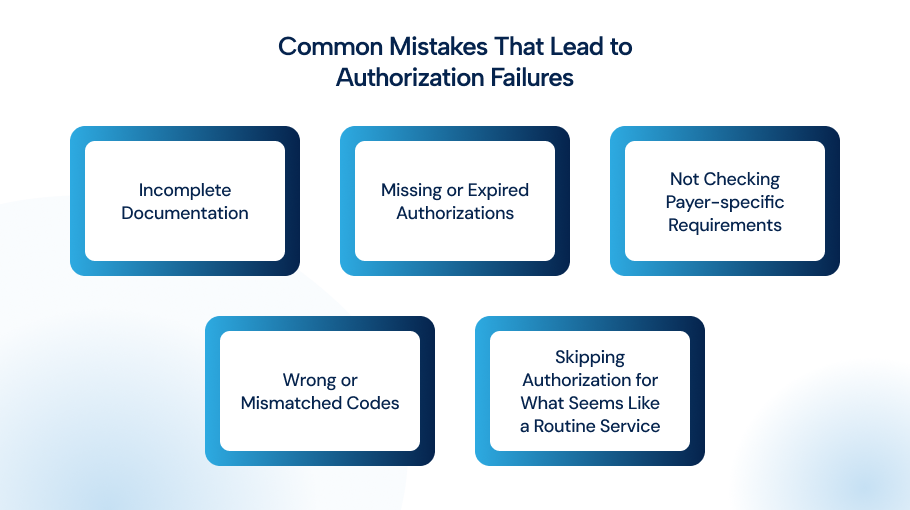
This is the most common reason for denial. Insurers require proof that the service is medically necessary, including clinical notes, prior treatment history, and test results. If those records are vague, outdated, or missing, the insurer has no basis to approve.
Missed or expired authorization causes a surprising number of denials that could have been avoided. Authorization numbers have expiration dates. If a procedure gets rescheduled past that date and nobody catches it, the claim goes out without valid authorization.
Ignoring payer-specific requirements is another consistent problem. Each insurer maintains its own list of services requiring prior approval, and those lists change. A service that didn't need authorization last year might require it now. Staff who rely on memory rather than current payer guidelines get caught out by these updates.
Adding wrong codes creates problems even when authorization was obtained. If the CPT code on the claim doesn't match what was authorized, payers can deny on that basis alone.
Some services look routine, but still require payer approval depending on the plan. Verifying requirements before scheduling, not after, is the only reliable safeguard.
Authorization in medical billing isn't a formality. It's a process with real consequences on both sides of the equation for practice revenue and for patient access to care. Understanding the different types of authorization, knowing what each payer requires, and building a workflow that catches issues before claims go out are what separate practices with clean revenue cycles from those constantly chasing denials.
If authorization-related denials are a recurring problem in your practice, it may be worth talking to a specialist. RCM Matter works with practices to audit billing gaps, identify where authorizations break down, and reduce denial rates without adding to your team's workload.
What is authorization in medical billing, and is it always required?
Authorization in medical billing is the process of obtaining insurer approval before delivering certain medical services. It's not required for every service. Usually, routine office visits and basic lab work don't need it. But advanced imaging, planned surgeries, specialty medications, and inpatient admissions almost always do.
What is the difference between prior authorization and precertification?
The terms are often used interchangeably, but some payers draw a distinction. Prior authorization generally applies to outpatient procedures and medications. Precertification is more commonly associated with inpatient hospital admissions and high-cost elective procedures. In practice, both involve submitting clinical documentation and waiting for insurer approval before the service happens.
What happens if you don't get authorization before a service?
If a service requires authorization and none was obtained, the insurer will likely deny the claim. The provider may not be reimbursed, and depending on the plan, the patient could be billed, creating unexpected costs and potential complaints.
How long does prior authorization take?
It depends on the payer and the complexity of the request. Some electronic prior authorizations (ePA) are approved within minutes through automated payer portals. More complex requests, or those requiring manual clinical review, can take 7 to 14 business days. Urgent or expedited requests are usually processed faster, often within 72 hours.
What are the most common reasons authorization requests get denied?
The top reasons include insufficient proof of medical necessity, missing or incomplete clinical documentation, failure to meet the payer's step therapy requirements (where a cheaper treatment must be tried first), and using incorrect diagnosis or procedure codes.
Optimize billing, claims and collections with expert RCM support let our professionals handle the process so you can focus on patient care.