A new physician joins a practice, malpractice insurance is current, the NPI is active, and the offer letter is signed. Then payer enrollment stalls for months, sometimes past the provider's start date, because one shared credentialing profile was never finished. That profile is the piece most practices underestimate. CAQH credentialing sits behind almost every commercial payer contract in the country, and getting it wrong quietly delays the day a new provider can bill for care.
This guide walks through what the CAQH Provider Data Portal does, how to set one up correctly, and where practices tend to lose weeks they didn't need to lose.
Before getting into the mechanics, here's the shorthand version of what CAQH involves and who touches it.
|
Item |
Details |
|
Full form |
Council for Affordable Quality Healthcare (CAQH) |
|
Primary platform |
CAQH Provider Data Portal |
|
Purpose |
Centralized provider credentialing information |
|
Used by |
Physicians, dentists, NPs, PAs, behavioral health providers, healthcare organizations |
|
Primary users |
Insurance companies, credentialing specialists, healthcare practices |
|
Benefits |
Faster credentialing, fewer duplicate applications, streamlined provider enrollment |
One thing worth knowing heading into the rest of 2026: CAQH rebranded as DataSpring, powered by CAQH, in June of that year. The portal, the login, and the underlying data didn't change, so most providers won't notice a difference beyond a new logo on the login screen.
What is CAQH at its most basic? It's a data-sharing platform, now operated by DataSpring, where a provider enters credentialing information once and then authorizes specific payers to pull that information instead of filling out a fresh application for each one.
The difference from payer-specific credentialing shows up fast. A traditional application asks for the same license numbers and work history a provider already typed into a different payer's portal last month. CAQH removes that duplication.
Most commercial insurers, along with a growing number of Medicaid managed care plans, now expect a completed profile before they'll open a credentialing file at all.
The workflow follows six steps, and skipping any one of them is usually what causes an application to sit in limbo.
Providers start by creating an account and setting up their CAQH provider log in, the permanent gateway to the profile. From there, they complete the practice, education, and work history sections, upload the required documents, and review everything before attesting that the information is accurate.
That review isn't optional. Payers reject profiles regularly because a provider rushed the attestation step and left a gap in employment history unexplained. Once attested, the provider authorizes each participating payer to view the profile. Then the real work begins: keeping it current every time a license renews or a malpractice policy changes.
Before assembling paperwork, it helps to know what does CAQH stand for: Council for Affordable Quality Healthcare, the organization that built the standard most payers now rely on.
A complete profile usually needs:
Practices that outsource this collection process, sometimes through dedicated provider credentialing services, tend to catch gaps before a payer ever sees them.
A common question sounds almost circular: what is a CAQH account replacing, exactly? Mostly the repetitive paperwork, not the payer's own review. The table below lays out the practical difference.
|
CAQH credentialing |
Traditional credentialing |
|
One centralized provider profile |
Separate application for each payer |
|
Information shared with multiple payers |
Duplicate paperwork |
|
Easier profile maintenance |
Multiple updates required |
|
Supports provider enrollment |
Manual submission process |
Type the platform's name quickly, and it often comes out as cqah in search bars and internal notes. That's harmless as a typo. It's not harmless as a mistake inside the profile itself, and five mistakes account for most of the delays practices run into.
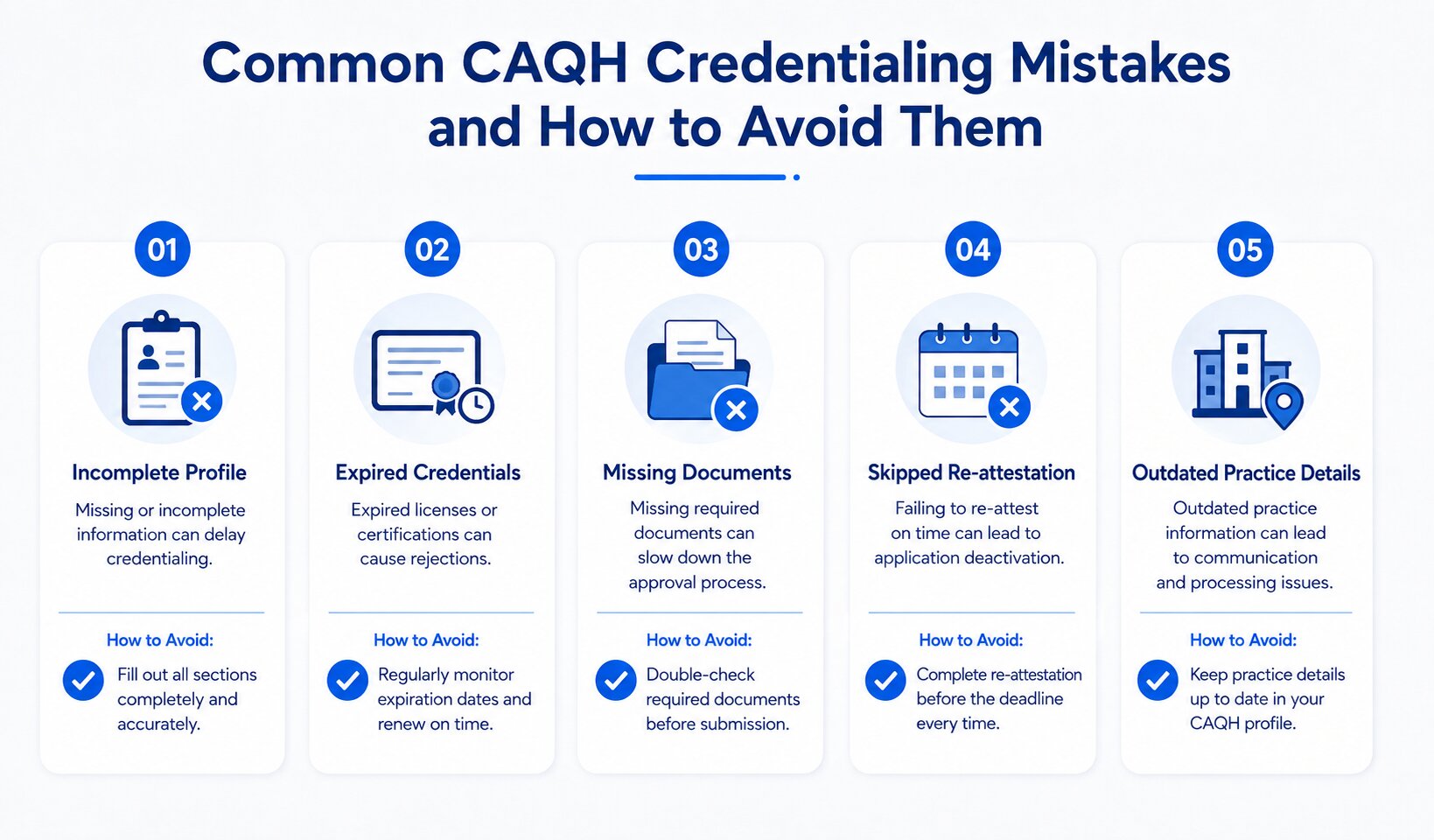
Some administrative staff still type it as cachq when setting calendar reminders, and that's fine as long as the reminder itself gets set. Re-attesting on schedule, updating licenses the same week they renew, and confirming malpractice coverage before it lapses will prevent most of the mistakes above.
Building these into a recurring task, rather than something remembered only when a payer sends a notice, tends to work better than relying on memory.
An accurate CAQH credentialing profile shortens the distance between a signed offer letter and a provider's first billable claim. Payers pull directly from the profile during enrollment, so fewer manual data requests mean fewer delays.
Search engines still return plenty of results for chqh alongside the correct spelling, which says more about how often people mistype the name than about the process itself. The billing impact is where most practices feel this hardest.
A provider credentialed correctly and on time starts generating clean claims immediately, instead of racking up services that need retroactive billing or get written off entirely.
Practices that pair credentialing accuracy with dedicated medical billing services tend to see fewer enrollment-related denials and steadier reimbursement during a new provider's first several months.
Coordinating credentialing timelines with denial management workflows also catches problems, like a payer that never activated a provider ID, before they turn into a stack of rejected claims.
Enrollment delays cost real money while they last. According to a survey covered by MGMA, credential verification and payer approval alone can take between 90 and 180 days from the date a provider's application is submitted.
A completed, current CAQH profile doesn't guarantee fast payer enrollment, but a neglected one guarantees delays. The providers who avoid credentialing headaches aren't the ones with fewer payers to manage.
They're the ones who treat CAQH credentialing as an ongoing task instead of a one-time form. That distinction shows up directly in the billing cycle, since a provider credentialed on time starts generating clean, payable claims from day one instead of a backlog that needs correcting months later.
RCM Matter works through exactly this handoff for practices every day, coordinating credentialing accuracy with the billing side so a new provider's first claims don't get caught in an enrollment gap. If a provider's CAQH profile hasn't been checked in the last 120 days, that's worth doing before the next payer notice arrives.
1. What is CAQH credentialing?
It's the process of entering a provider's credentialing information once into the CAQH Provider Data Portal and authorizing payers to pull it instead of filling out separate applications for each one.
2. Is CAQH mandatory for provider credentialing?
Not by law, but in practice, close to it for anyone billing commercial insurance. Most major payers won't open a credentialing file without a completed profile, so treating it as mandatory is the safer approach.
3. Which insurance companies use CAQH?
Nearly all of them. UnitedHealthcare, Aetna, Cigna, Blue Cross Blue Shield plans, and most Medicaid managed care organizations pull from CAQH, and a provider who assumes a smaller regional payer skips it is usually wrong.
4. How often should providers update their CAQH profile?
The re-attestation cycle runs every 120 days, and that's the minimum, not the goal. Anytime a license renews, a malpractice policy changes, or a practice address moves, the profile should get updated that same week rather than waiting for the next scheduled attestation. Payers check dates automatically, and a profile that's technically attested but quietly outdated in one section still causes denials. It varies a little by payer how strictly this gets enforced, but treating every change as an immediate update avoids the guesswork.
5. What happens if a CAQH profile expires?
Claims processing can pause almost overnight once a profile lapses, since payers lose the ability to verify anything on file until it's reactivated and re-attested.
Optimize billing, claims and collections with expert RCM support let our professionals handle the process so you can focus on patient care.