Every patient encounter begins with a financial obligation, and the copay is typically the first one that gets settled. Copay in medical billing refers to the fixed dollar amount a patient pays for a covered service at the time of the visit, regardless of what that service actually costs. It's one of the most common forms of patient cost sharing in the U.S. health system, and it touches the revenue cycle from the moment an appointment is scheduled.
For billing staff and front desk teams, copays aren't just a patient-facing concept. They're a collection event, a posting task, and a daily revenue checkpoint.
According to the Kaiser Family Foundation’s 2023 Employer Health Benefits Survey, 68% of covered workers in employer-sponsored plans pay a copay for primary care visits, with average copays around $26.
That figure repeats across millions of patient encounters every year.
Copays are structured by the insurance plan and tied to specific service categories. The amount owed at check-in depends on the plan type, the service received, and whether the provider is in-network.
Understanding those variables is what separates accurate collection from repeated verification errors.
Plans define copay obligations in the Summary of Benefits and Coverage document. What is a copay in that document is a flat charge tied to a service category, such as primary care, specialist visits, or urgent care.
While amounts vary by plan, surveys like KFF report averages around $26 for primary care visits. For covered, in-network services, the patient pays this fixed amount regardless of the total billed charge.
PPO, HMO, and high-deductible health plans structure copays differently. What is copayment in medical insurance under a standard PPO is a predictable per-visit charge that applies as soon as covered care is delivered.
Under a high-deductible health plan, the patient typically pays the full allowed amount until the deductible is met, and the traditional copay structure may not apply until after that threshold is crossed.
Not every service triggers a copay, and assuming otherwise leads to collection errors and patient refund requests. Common exemptions include:
Under the Affordable Care Act, most health plans are required to cover a defined set of preventive services at no cost to the patient when delivered by an in-network provider, meaning no copay, coinsurance, or deductible applies
Services subject to the deductible only, such as certain lab and imaging orders
Bundled or global surgical package services
These exemptions vary by plan and by payer, so verifying benefits before every visit is the only reliable safeguard.
These three terms describe different ways copayment insurance structures shift costs to patients, and they apply at different points in the billing cycle. Treating them as variations of the same mechanism leads to incorrect collections, patient disputes, and reconciliation problems that are entirely preventable.
| Cost-sharing type | How it's calculated | When it applies | Example |
| Copay | Fixed dollar amount | At the time of service, per visit | $30 per specialist visit |
| Coinsurance | Percentage of allowed amount | After the deductible is met | 20% of a $400 allowed amount = $80 |
| Deductible | Accumulates toward the annual limit | Before most coverage activates | First $1,500 before plan pays |
A copay is always the same amount and collected at check-in. Coinsurance can't be finalized until the claim is adjudicated and the explanation of benefits reflects the allowed amount. Billing teams need to treat each one differently at every stage of the cycle, because the collection timing and patient conversation are not the same.
Collecting and posting copays correctly is where the revenue cycle either holds or leaks. A well-run process gets the right amount at the right time and posts it accurately before the claim goes out.
When that process breaks down, the consequences appear as write-offs, patient disputes, and reconciliation work that didn't need to happen.
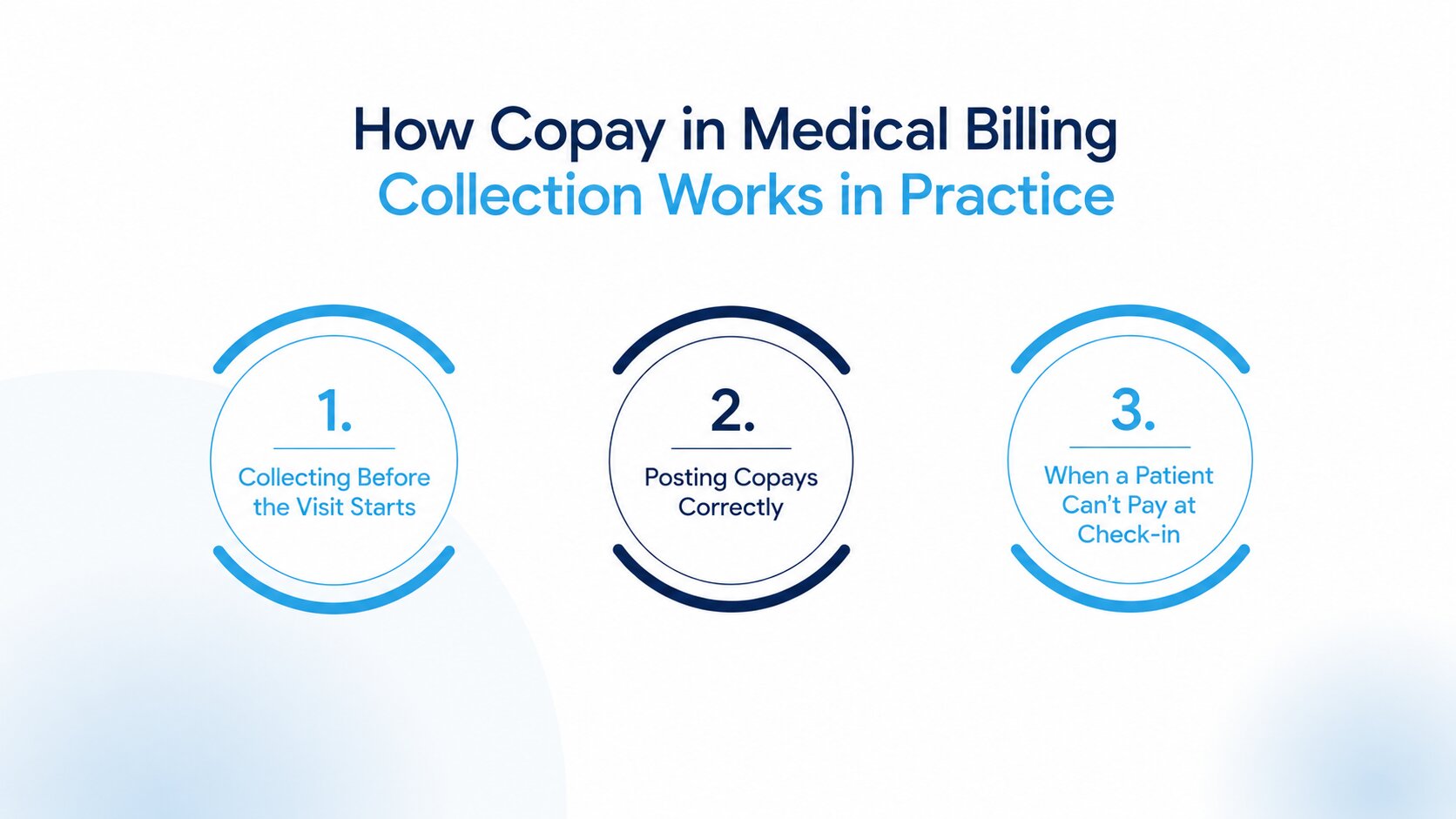
The question do you have to pay a copay upfront has a clear answer in most cases: yes. Copays are designed for point-of-service collection, and most payer contracts permit or require it.
Practices that defer collection to avoid slowing down check-in carry significantly higher patient bad debt as a result. That revenue gap builds quietly over months and rarely becomes visible until it's already substantial.
A co payment in medical billing at the posting stage is a patient payment that must be matched to the correct date of service before the claim goes out.
A copay posted to the wrong date shows as a credit on one account and an outstanding balance on another. Sorting these errors before submission takes minutes.
Correcting them after adjudication takes significantly longer, and patients who receive an unexpected balance notice aren't forgiving about it.
Most practices handle this through a formal financial hardship policy that defines when deferral or reduced payment is acceptable.
Routine waiver without documentation violates most commercial payer contracts, and for Medicare or Medicaid patients, it creates compliance exposure under federal anti-kickback statutes.
A written policy with consistent criteria is what separates defensible decisions from practices that create liability without realizing it.
Copay errors are rarely dramatic. They surface as small discrepancies, slightly off balance, and patient complaints that seem isolated until the pattern becomes obvious. Four errors account for most of the damage:
Collecting the wrong amount. Plan year changes take effect January 1, and a copay from last fall may be different today. Benefits need to be verified before every visit, not once per enrollment.
Posting to the wrong date of service. The mismatch surfaces when the EOB arrives, and the claim doesn't reconcile as expected. Daily reconciliation between posted payments and submitted claims is the cleanest fix.
Applying a copay to a deductible-only service. The patient pays at check-in, then receives a balance when the deductible applies to the same claim. That double-collection perception generates disputes and erodes trust.
Deferring collection with no follow-up process. Collection rates on small patient balances fall sharply when billed retroactively. Once a patient walks out without paying, recovery becomes a disproportionately expensive effort.
Copay errors may look administrative on the surface, but they often create downstream claim and payment complications. In many practices, these front-end breakdowns eventually surface as avoidable rework tied to denial management in rcm, particularly when eligibility and patient responsibility are not verified accurately from the start.
One thing worth noting here:
“Patients who pay a copay often think that's the full amount they'll owe for the visit. A brief explanation at check-in that additional balances may follow after adjudication prevents a much longer call later.”
Patient cost sharing begins at the front desk, and every copay is a revenue cycle event that connects verification, collection, and compliance into one chain. Copay in medical billing isn't a minor administrative detail.
It's where revenue either gets captured cleanly or starts leaking in amounts small enough to ignore individually and significant enough to matter at month-end.
Practices noticing unexplained patient balance issues or rising small-dollar write-offs should review the copay workflow end-to-end, from eligibility verification through posting and reconciliation.
In most cases, the issue isn’t isolated but embedded in the process itself. This is exactly where RCM Matter helps practices tighten visibility across the revenue cycle, ensuring that front-end accuracy translates into clean, predictable collections downstream.
What is a copay in medical billing?
A copay is a fixed dollar amount a patient pays for a covered service at the time of the visit. It's set by the insurance plan and doesn't change based on the actual cost of the service. It's typically collected at check-in, before care begins.
Should the copay be collected before the appointment begins?
In most cases, yes. Payer contracts generally allow or require providers to collect the copay at or before the time care is delivered. Collecting at check-in protects cash flow and avoids the harder process of billing for small balances after the patient has left.
How is a copay different from coinsurance?
The clearest distinction is how the amount is calculated. A copay is always a fixed dollar figure set by the plan, regardless of service cost. Coinsurance is a percentage of the allowed amount and cannot be determined until the claim is processed and the EOB is issued.
Can a provider waive a patient's copay?
Occasional waivers with proper documentation are generally permissible under a formal written financial hardship policy. Routine waiver without documentation violates most commercial payer contracts, and for Medicare or Medicaid patients, it raises concerns under federal anti-kickback statutes.
What happens if a copay is posted to the wrong account?
It creates a credit on one record and an outstanding balance on another, and the discrepancy typically surfaces when the EOB doesn't match posted payments. Daily reconciliation between payments posted and claims submitted is the most reliable safeguard against this.
Optimize billing, claims and collections with expert RCM support let our professionals handle the process so you can focus on patient care.