Every biller who has worked a denial report long enough starts noticing patterns. Unspecified bronchitis diagnoses are one of the stubborn ones. Getting the icd 10 for acute bronchitis right on the first submission matters more in 2026 than it did two years ago, because payers keep tightening how they scrutinize respiratory claims. Antibiotic prescribing for conditions like acute bronchitis remains common even though clinical guidelines discourage it, according to the CDC's 2025 antibiotic stewardship update, and that gap between guidance and practice puts extra weight on documentation to justify medical necessity.
The distinction between a billable unspecified code and a more specific alternative isn't always obvious, and getting it wrong can quietly cost more than a single denied claim.
J20.9 is the code providers report when a patient has acute bronchitis and the specific organism causing it hasn't been identified or documented. It sits in the respiratory chapter of ICD-10-CM, and it's billable on its own. Family medicine, internal medicine, pediatrics, and urgent care all report it regularly, since most icd 10 bronchitis acute diagnoses never get lab confirmation of the organism involved. That's not a gap in care. It reflects how bronchitis gets diagnosed in most outpatient settings, where testing rarely changes the treatment plan.
|
Item | Value |
|
ICD-10-CM code | J20.9 |
|
Description | Acute bronchitis, unspecified |
|
Billable | Yes |
|
Effective date | FY2026, effective October 1, 2025 |
|
Chapter | Diseases of the respiratory system (J00-J99) |
|
Common specialty | Family medicine, internal medicine, pulmonology, pediatrics |
An unspecified code isn't a weaker choice when the clinical picture genuinely calls for it. The problem shows up when coders default to it out of habit rather than checking whether the chart supports something more precise.
A patient walks in with a week of productive cough, some wheezing, and chest discomfort, and the provider documents acute bronchitis without running or waiting on a culture. That's the textbook scenario for reporting acute viral bronchitis icd 10 coding under J20.9, since most cases are viral and self-limited, and testing to pin down the exact organism rarely changes how the patient gets treated.
Medical necessity for J20.9 rests on documentation that ties symptoms to the diagnosis. The note should reflect the acute onset, the relevant respiratory symptoms such as cough or chest congestion, and physical exam findings that support a bronchitis diagnosis rather than something else entirely. If the provider ordered a chest X-ray to rule out pneumonia, that result belongs in the note too, even if it comes back clear.
Here's the honest caveat: whether a payer expects lab confirmation before accepting J20.9 varies by plan, so what passes with one payer might get flagged by another. Providers don't need to identify the causative organism to bill J20.9. The code exists for cases where that information isn't available, which describes most outpatient bronchitis visits.
A claim coded correctly the first time moves through a payer's system without the back-and-forth of a resubmission. That sounds obvious, but it's easy to underestimate how much staff time gets absorbed by claims that get kicked back over a coding detail this small. Getting J20.9 right on the first pass isn't just a compliance checkbox. It protects the timeline for actually getting paid.
J20.9 stops being the right choice the moment documentation identifies a specific cause. If lab testing confirms Mycoplasma pneumoniae, streptococcus, or Haemophilus influenzae, one of the organism-specific codes takes priority, and billing J20.9 anyway no longer matches what the chart shows. Chronic bronchitis is a separate condition entirely, coded under J42, and it should never be reported using an acute bronchitis code just because a patient has had recurring episodes.
|
ICD-10 Code | Description | When to use it |
|
J20.0 | Acute bronchitis due to Mycoplasma pneumoniae | Lab-confirmed Mycoplasma infection |
|
J20.1 | Acute bronchitis due to Haemophilus influenzae | Confirmed H. influenzae infection |
|
J20.2 | Acute bronchitis due to streptococcus | Documented streptococcal infection |
|
J20.8 | Acute bronchitis due to other specified organisms | Another organism identified |
|
J20.9 | Acute bronchitis, unspecified | Organism unknown or undocumented |
|
J42 | Unspecified chronic bronchitis | Chronic, not acute, presentation |
Bronchitis linked to COPD needs its own combination coding rather than J20.9, and pneumonia gets coded under its own category once imaging or exam findings confirm it. A related but less common presentation, sometimes documented as acute rhinobronchitis icd 10, still typically resolves to J20.9 unless the note specifies an organism or a chronic course. Rhinobronchitis simply describes bronchitis with accompanying nasal symptoms rather than a distinct diagnosis, which trips up newer coders more often than anyone expects.
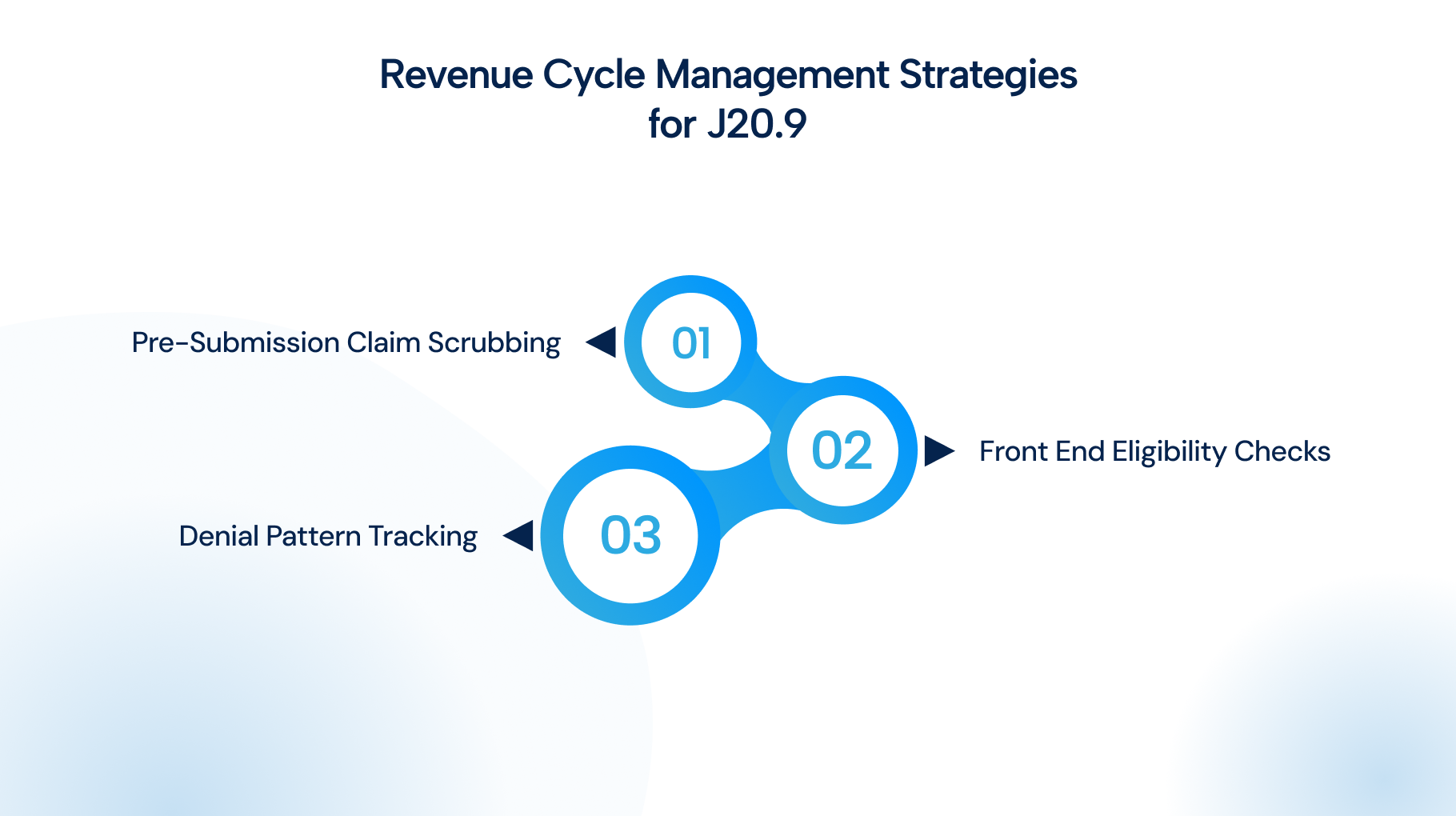
Most denials tied to J20.9 trace back to a handful of repeat issues. Fixing these tends to clear up a noticeable share of respiratory claim rejections.
A patient presents with a productive cough, wheezing, and chest discomfort lasting one week, and the provider diagnoses acute bronchitis without identifying a causative organism. J20.9 is correct here. The diagnosis matches the documentation, and no organism-specific code applies.
Lab testing confirms Mycoplasma pneumoniae, but the claim still gets submitted with J20.9 anyway, maybe because the coder didn't catch the lab result before the claim went out. J20.0 is the correct code once that confirmation exists in the chart, and resubmitting with the specific code is usually straightforward if caught early.
Errors like these rarely come from one bad coder having a bad day. They come from a small internal team stretched across too many specialties and too many payer rulebooks to catch every nuance. This is part of why medical billing outsourcing has become a common fix for practices that keep seeing the same denial patterns repeat, since a dedicated coding team is reviewing documentation like this against payer rules all day, every day, instead of squeezing it in between other responsibilities.
Providers typically pair J20.9 with an evaluation and management code, and sometimes with additional procedure codes depending on what happened during the visit.
|
CPT code | Description |
|
99202-99205 | New patient office or outpatient E/M services |
|
99212-99215 | Established patient office or outpatient E/M services |
|
94640 | Inhalation treatment, pressurized or non-pressurized |
|
71046 | Chest X-ray, two views |
CPT selection depends entirely on what the provider performed and documented, not on what's typical for the diagnosis. A visit involving acute tracheobronchitis icd 10 coding follows the same CPT logic, since procedure codes track the treatment given, not the bronchitis variant on the diagnosis line. A breathing treatment needs to show up in both the note and the code choice, or the claim risks a mismatch between what's billed and what's supported. Pairing diagnosis and procedure codes correctly is part of what separates clean claims from denied ones.
Getting the icd 10 for acute bronchitis right isn't about memorizing a single code. It's about reading the chart closely enough to know whether J20.9 fits, or whether a more specific alternative belongs there instead. Practices that build this check into their workflow tend to see fewer respiratory claim denials over time. RCM Matter's coding team reviews respiratory claims like this one daily, and a quick second look at your denial patterns might reveal more than one fixable habit.
Is J20.9 a billable code?
Yes. As one of the standard icd 10 bronchitis unspecified codes, J20.9 stands on its own and doesn't require a secondary code to support a claim, as long as the documentation backs up the diagnosis.
Is J20.9 valid for FY2026?
It is. The code became effective October 1, 2025, under the FY2026 ICD-10-CM update, and it remains an active, billable code within the respiratory chapter.
When should J20.9 not be used?
Skip it once documentation identifies a specific organism, once the presentation is chronic rather than acute, or once the diagnosis is really pneumonia or a COPD exacerbation instead of straightforward bronchitis. Each of those has its own, more accurate code.
Can J20.9 be reported as the primary diagnosis?
In most cases, yes, assuming bronchitis was the actual reason for the visit and the treatment provided. If another condition drove the encounter, say a patient came in for something unrelated, and bronchitis was noted incidentally, that condition usually needs to lead instead. A handful of payers also want the visit note to spell out why bronchitis, specifically, justified the level of service billed, and that expectation isn't universal, so it's worth checking payer policy before assuming the same rule applies everywhere.
What's the real difference between J20.9 and J42?
Duration and course. J20.9 covers a single acute episode without an identified organism, while J42 applies to chronic bronchitis, a persistent condition that shows up repeatedly over time rather than as one isolated illness. Mixing the two up is a common source of downstream coding errors, and it's one that auditors catch fairly quickly.
Optimize billing, claims and collections with expert RCM support let our professionals handle the process so you can focus on patient care.