Every 5 seconds, someone in the world is diagnosed with diabetes. That number makes accurate medical documentation not just a billing task but a core foundation of good patient care, clinical responsibility, and financial health for healthcare practices.
For medical coders, billers, and healthcare administrators, few diagnoses appear as often on claim forms as Type 2 Diabetes Mellitus. And yet, it remains one of the most commonly miscoded conditions in clinical settings. The ICD-10 code E11 is the starting point for classifying this condition, but getting it right demands understanding far more than just the code itself.
Whether you are reviewing a physician's documentation, submitting a claim, or checking coding accuracy, this guide covers everything you need to know about ICD-10 code E11. We will look at its subcategories, documentation needs, common errors, and practical tips to build a better understanding.
Type 2 Diabetes Mellitus is a long-term condition where the body stops using insulin properly. This causes blood sugar to rise and stay high over time. It is the most common form of diabetes, making up about 90 to 95% of all cases worldwide.
According to the International Diabetes Federation (IDF) Diabetes Atlas, around 3.4 million deaths occurred in 2024, making it 1 every 9 seconds. In the United States, the Centers for Disease Control and Prevention (CDC) estimates that about 98 million adults have prediabetes, which increases their risk of developing Type 2 diabetes, heart disease, and stroke.
For medical billers and coders, the key thing to know is that diabetes rarely appears alone in a patient's chart. It almost always comes with other health problems affecting the kidneys, eyes, nerves, or blood vessels. Every one of those problems has its own ICD-10 subcode that must be captured correctly.
Common Symptoms of Type 2 Diabetes
Knowing which symptoms to look for in a doctor's notes helps coders pick the right E11 subcode. The following symptoms often appear in patient records and should guide the coding process:
The doctor's notes must clearly connect these symptoms to diabetes. Coders should never assume a connection on their own. If the link is not written in the chart, ask the doctor before assigning a complication code.
ICD-10 code E11 is the main code used to record a diagnosis of Type 2 Diabetes Mellitus. It comes from the International Classification of Diseases, Tenth Revision, Clinical Modification, commonly known as ICD-10-CM. This code belongs to Chapter 4 of the ICD-10-CM system, which covers conditions related to hormones, nutrition, and metabolism. That chapter spans codes from E00 to E89.
In medical billing and coding, E11 works as the base code for a group of more detailed subcodes. These subcodes capture the full health picture of a patient's diabetic condition. Healthcare providers use E11 or one of its subcodes whenever a confirmed diagnosis of Type 2 Diabetes Mellitus appears in the medical record.
Mostly, the E11 code group is used when:
One important point: E11 by itself is often not accepted as a complete billable code. Most insurance companies and coding rules ask for a more specific subcode with extra characters. E11.9 is the most widely accepted billable version when no complications are present.
The E11 code group is large. It has many subcodes that match the wide range of health problems that can develop because of Type 2 Diabetes Mellitus. Coders must always pick the most specific code that matches what the doctor has written.
The table below shows the main E11 subcategories and what each one covers:
|
ICD-10 Code |
Description |
|
E11.0 |
Type 2 diabetes with hyperosmolarity (HHS), a serious condition where blood sugar becomes extremely high. |
|
E11.1 |
Type 2 diabetes with ketoacidosis (DKA), a complication caused by acid buildup in the blood. |
|
E11.2 |
Type 2 diabetes with kidney complications, including diabetic nephropathy and chronic kidney disease. |
|
E11.3 |
Type 2 diabetes with eye complications, such as diabetic retinopathy, macular edema, or cataracts. |
|
E11.4 |
Type 2 diabetes with nerve damage, including diabetic neuropathy and nerve pain. |
|
E11.5 |
Type 2 diabetes with circulatory complications, affecting blood vessels in the legs or feet, sometimes with gangrene. |
|
E11.6 |
Type 2 diabetes with other specified complications, such as skin problems, joint issues, or hypoglycemia. |
|
E11.8 |
Type 2 diabetes with unspecified complications when the complication is not clearly documented. |
|
E11.9 |
Type 2 diabetes without complications. |
Always choose the most specific code available. Using E11.9 when complications are clearly recorded in the chart is a coding error. It can lead to denied claims, billing reviews, and loss of payment.
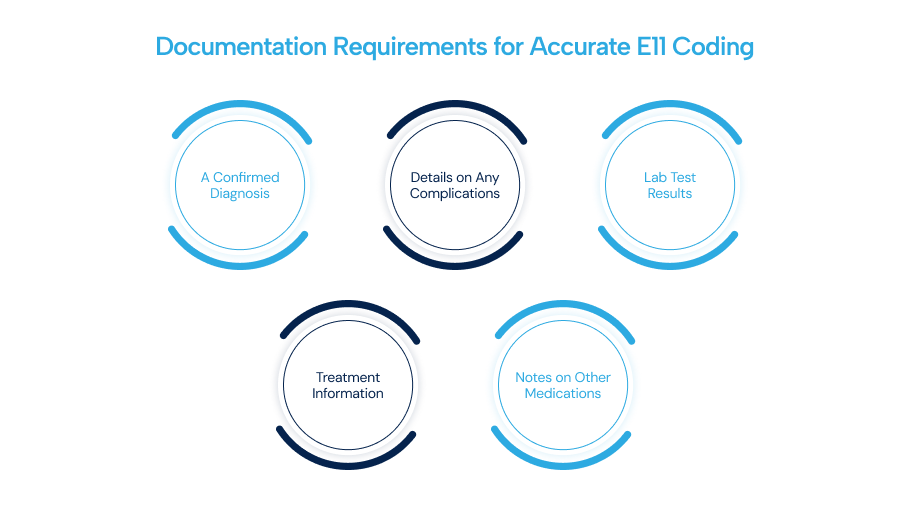
Good coding starts with good documentation. For E11 coding to be complete and correct, the patient record must follow proper documentation standards and include the following:
The doctor must clearly write Type 2 Diabetes Mellitus in the record. If the notes only say DM or diabetes without naming the type, ICD-10-CM rules treat it as Type 2 by default. Even so, having the type clearly stated is always the better approach.
Any health problem linked to diabetes, whether it involves the kidneys, eyes, nerves, or blood vessels, must be clearly written and connected to the diabetes diagnosis. Writing just a diabetic complication is not enough to assign a specific subcode.
Results such as HbA1c levels, fasting blood sugar, and blood sugar readings after meals give clear proof of how well blood sugar is being managed. These results may also support additional codes for high or low blood sugar.
The treatment plan must state whether the patient is being managed with diet changes, oral diabetes medications, or insulin. This determines whether any of the following extra codes are needed:
If the patient is taking steroids or other drugs that affect blood sugar, the coder may need to add extra codes alongside E11 to show that connection.
Even though Type 2 Diabetes Mellitus is one of the most often coded diagnoses, it is also one of the most often coded incorrectly. The table below lists common mistakes and explains why each one causes problems:
|
Common Mistake |
Why It’s a Problem |
|
Using E11.9 for all Type 2 diabetes cases |
Misses documented complications and may lead to incorrect billing. |
|
Confusing E10 and E11 codes |
E10 is Type 1 diabetes, while E11 is Type 2. Using the wrong code affects accuracy and payment. |
|
Not adding Z79.4 for insulin use |
Creates confusion about insulin therapy and may raise payer questions. |
|
Failing to code related complications |
Results in incomplete documentation and possible revenue loss. |
|
Using E11.8 when a specific code exists |
Vague codes reduce clarity and may trigger claim reviews. |
The world of diabetes care and medical coding is changing fast. More people are being diagnosed, technology is growing, and insurance rules are getting more detailed.
The IDF projects that the number of adults with diabetes will reach 853 million by 2050. This growing number of patients means more E11 coding work for healthcare teams across the country.
Correct chronic disease coding affects payments under programs like MSSP and Medicare Advantage. Missing or incomplete diabetes codes can cause significant revenue gaps.
Electronic Health Records simplify documentation but bring risks like copy-paste errors. AI coding tools suggest codes, but trained human coders are essential for accuracy.
ICD-10-CM codes are updated annually by CMS. Staying current with changes and regular training is critical for coding accuracy.
Good E11 coding takes practice, attention to detail, and a clear process. Here are practical steps every coding professional should follow:
Do not settle for E11.9 when complications are written in the chart. Go through the full clinical note, including notes from specialist visits, lab reports, and nurse assessments, and look for any mention of diabetic complications.
Do not just check the diagnosis section. Complications are often written in other parts of the note, such as the history of the visit, the physical exam findings, or the treatment plan.
The ICD-10-CM Official Guidelines for Coding and Reporting are updated each year. Section I.C.4 covers conditions related to hormones and metabolism, including diabetes. Keep this document close and refer to it often.
If the doctor writes diabetic neuropathy without saying what type, ask before you assign a code. Getting the right details protects the doctor, the practice, and the coder.
Always include Z79.4, Z79.84, or Z79.85 when they apply. These codes tell the insurance company how the patient's diabetes is being managed, and many payers require them.
Reviewing E11 codes every few months helps catch patterns of undercoding or overcoding before they turn into bigger problems. These checks also help identify gaps in doctor documentation.
Work with doctors and nurses to help them understand what information coders need. Even a short training session on diabetes documentation can reduce the number of questions sent back to the doctor and cut down on denied claims.
Sign up for updates from CMS, the American Medical Association (AMA), and coding organizations. This way, you will always know about changes to E11 subcodes before the new codes take effect in October.
Type 2 Diabetes Mellitus is one of the most commonly coded conditions, and ICD-10 code E11 is key for accurate documentation and billing. It’s not just one code; it includes different variations based on complications affecting organs like the kidneys, eyes, nerves, and blood vessels. Choosing the right code is important for both clinical accuracy and proper reimbursement.
Healthcare practices can improve this by strengthening documentation and coding processes through structured workflows and regular reviews. With the right support, like audits and guidance from RCM Matter, practices can maintain accuracy while keeping their revenue cycle running smoothly.
What is ICD-10 code E11 used for?
ICD-10 code E11 is used to record a diagnosis of Type 2 Diabetes Mellitus in a patient's medical record and on insurance claims. It covers the main diagnosis and, through its subcodes, also captures health problems linked to diabetes, including kidney disease, eye conditions, nerve damage, and blood vessel problems.
Is E11 a billable ICD-10 code?
E11 on its own is usually not accepted as a complete billable code. Most insurance companies ask for a more specific subcode with more characters. The most commonly billed version when no complications are present is E11.9, which stands for Type 2 Diabetes Mellitus without complications.
What is the difference between E10 and E11?
E10 is the code for Type 1 Diabetes Mellitus, a condition where the immune system attacks the cells that make insulin. It is usually diagnosed in children or young adults. E11 is for Type 2 Diabetes Mellitus, which is related to insulin resistance and is most common in adults. Using the wrong code can lead to a denied claim and payment problems.
What is ICD-10 code E11.9?
E11.9 is the code for Type 2 Diabetes Mellitus without complications. It is used when the doctor has confirmed the diagnosis, but there are no recorded complications in the patient's chart. This code is billable, but it should only be used when complications are truly absent, not just because the coder did not check for them.
When should additional codes be used with E11?
Additional codes should be added when the patient uses insulin (Z79.4), oral diabetes medications (Z79.84), or injected diabetes drugs that are not insulin (Z79.85). Extra codes are also needed for complications handled by outside specialists, for other health conditions the patient has at the same time, and for any drug reactions that affect blood sugar levels.
Optimize billing, claims and collections with expert RCM support let our professionals handle the process so you can focus on patient care.