A coder pulls up a chart that says "influenza A, confirmed" and nothing else. No mention of respiratory findings. No note on whether the strain was seasonal or something the lab flagged as unusual. That single line is enough to stall a claim for days. The icd 10 influenza a J09.X2 code exists for a narrow, specific situation, and using it outside that situation is one of the more common ways flu-season claims end up denied or downcoded.
CDC surveillance data shows just how much volume is riding on getting this right: cumulative influenza-associated hospitalization rates during the 2024-2025 season ranged from 117.8 to 218.3 per 100,000 population across U.S. regions, according to the CDC's 2025-2026 influenza activity summary. That's a lot of claims moving through payer systems, and a lot of room for a mismatched code to slow one down.
J09.X2 sits in a small, specific corner of the ICD-10-CM manual. It covers influenza caused by a confirmed, identified novel strain of influenza a virus icd 10 classification, one that isn't the seasonal H1N1 or H3N2 strains circulating through the general population every winter. Think avian or swine-origin strains, or any variant that public health authorities have flagged as newly identified. The code is billable and reportable, and it applies specifically to cases where the patient has respiratory manifestations beyond pneumonia, things like bronchitis, laryngitis, or upper respiratory inflammation tied directly to the infection.
The word "novel" is doing a lot of work here. It doesn't mean severe. It means the strain itself is new or unusual enough that public health tracking treats it differently from routine seasonal flu.
|
Item |
Value |
|
ICD-10-CM code |
J09.X2 |
|
Description |
Influenza due to identified novel influenza A virus with other respiratory manifestations |
|
Billable |
Yes |
|
Effective date |
FY 2026 |
|
Chapter |
Diseases of the respiratory system (J00 to J99) |
|
Applicable setting |
Office, urgent care, emergency department, hospital |
|
Common specialty |
Family medicine, internal medicine, emergency medicine, infectious disease |
Coders don't get to infer this code from a patient's symptoms alone. The provider has to document, clearly, that the influenza A strain was identified as novel, usually through lab confirmation or a direct statement in the chart tied to public health guidance on a specific outbreak strain.
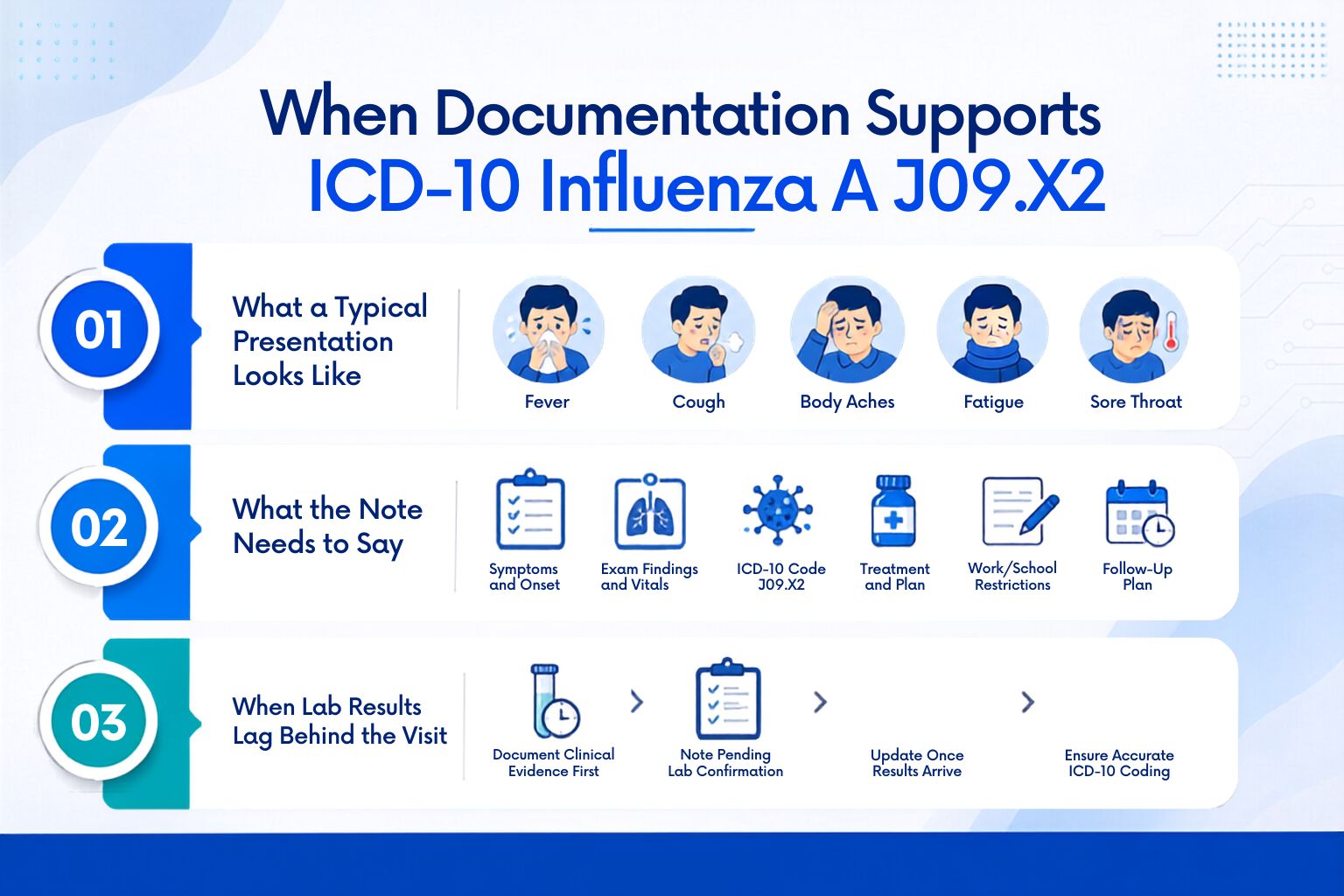
Patients coded to J09.X2 usually present with more than just a fever and body aches. There's a respiratory component that stands out: wheezing, bronchitis, or laryngeal involvement that the provider notes separately from the flu diagnosis itself. A patient walking in with vague flu-like symptoms icd 10 documentation and nothing more specific doesn't meet the bar for this code, no matter how sick they look in the exam room.
The chart needs a confirmed diagnosis, a description of the respiratory findings, and ideally lab results supporting the novel strain identification. Medical necessity has to be obvious from the documentation, not assumed from the visit type. When a note reads more like general flu like illness icd 10 language without the specificity, that's the signal to hold the claim and query the provider before submission.
Confirmation doesn't always land the same day as the office visit. A patient might be seen, treated presumptively, and only get a confirmed novel strain result back from the lab a day or two later. In that gap, coders shouldn't assign J09.X2 until the chart actually reflects the confirmed result, even if the provider strongly suspected a novel strain at the time of the visit. Coding ahead of the documentation, on the assumption that the lab will eventually back it up, is exactly the kind of shortcut that draws payer scrutiny later. If the final report never arrives before the claim deadline, the safer path is querying the provider directly rather than guessing at the subcategory.
This is where most of the actual billing errors happen, and it's rarely because coders don't know the rule. It's because the difference between adjacent codes comes down to a single documented detail.
|
ICD-10 code |
Description |
When to use |
|
J09.X1 |
Influenza due to identified novel influenza A virus with pneumonia |
Pneumonia documented |
|
J09.X2 |
Influenza due to identified novel influenza A virus with other respiratory manifestations |
Respiratory manifestations other than pneumonia |
|
J09.X3 |
Influenza due to identified novel influenza A virus with gastrointestinal manifestations |
GI symptoms documented |
|
J10.- |
Influenza due to other identified influenza virus |
Seasonal influenza virus identified |
|
J11.- |
Influenza, virus not identified |
Influenza diagnosed without virus identification |
Seasonal influenza, even when the strain is confirmed, belongs under J10, not J09. A patient with flu a icd 10 documentation showing a routine seasonal H3N2 result should never land on J09.X2, and reviewers catch this mismatch quickly because the lab result and the code simply don't line up. Unspecified influenza, where no virus is identified at all, falls under J11 instead, and that distinction matters because payers increasingly flag J11 claims for additional documentation before they'll pay them without question. If the documentation instead supports icd 10 code for influenza b, none of the J09 subcategories apply at all, since J09 is reserved specifically for novel influenza A.
Most denials tied to this code trace back to a handful of repeatable patterns. Fixing them doesn't require new software or a coding overhaul, just closer attention at a few specific points in the workflow.
Worth mentioning, and it's not really about coding at all: flu season volume tends to expose whatever weaknesses already existed in a practice's documentation habits the rest of the year. The codes just make it visible faster.
It's also worth noting this isn't a fixed, one-size-fits-all rule. Some payers apply stricter lab-confirmation standards for novel strain codes than others, and what satisfies one plan's medical review might get flagged by a different one. Checking payer policy before flu season peaks is a small step that avoids a lot of downstream appeals. Practices that already struggle with volume here often lean on Outsourced Medical Coding Services specifically during flu season, when the code mix gets more complicated fast.
Depending on the evaluation, testing, and treatment involved, providers typically report the following CPT codes alongside J09.X2.
|
CPT code |
Description |
|
87804 |
Infectious agent antigen detection by immunoassay (influenza) |
|
87631 |
Respiratory virus detection by nucleic acid testing |
|
99202-99215 |
Office or outpatient evaluation and management services |
|
71046 |
Chest X-ray (when medically necessary) |
Getting the CPT and ICD-10 pairing right matters as much as the diagnosis code itself. A confirmed icd 10 code for flu diagnosis paired with a mismatched E/M level, or missing the lab CPT that supports the confirmation, creates the same kind of denial risk as a wrong diagnosis code would. Coders working through flu syndrome icd 10 claims during a busy season benefit from a quick checklist tying the diagnosis, the lab confirmation, and the E/M level together before submission, rather than reviewing each in isolation.
Getting icd 10 influenza a J09.X2 right comes down to one habit: reading the documentation closely enough to confirm the strain, the respiratory findings, and the sequencing before the claim goes out the door. Practices that build this check into their flu-season workflow see fewer downcodes and faster payment, and it costs nothing beyond a few extra minutes per chart. RCM Matter works with practices on exactly this kind of flu-season coding review, and for those weighing whether the volume is worth handling in-house, a quick denial management review can show exactly where the current process is losing time.
1. Is ICD-10 code J09.X2 billable?
Yes. It's a billable, specific code that can be reported on its own without needing an additional subcategory.
2. When should J09.X2 be used?
It applies when a provider documents a confirmed, identified novel influenza A strain along with respiratory manifestations other than pneumonia, things like bronchitis or laryngeal involvement noted separately in the chart.
3. What is the difference between J09.X2 and J10?
J09.X2 is reserved for identified novel strains, the kind flagged by public health authorities as unusual. J10 covers seasonal influenza where the virus is confirmed through routine testing. Mixing these up is one of the most common denial triggers tied to flu coding.
4. What documentation supports J09.X2?
A confirmed diagnosis, documented respiratory findings beyond pneumonia, and supporting lab results where available. Vague chart notes referencing general icd 10 code for influenza language without specificity won't hold up under review.
5. Can J09.X2 be used as the primary diagnosis?
Generally yes, though coders should watch for sequencing conventions when a related manifestation code is also present on the claim. When in doubt, the coding guideline's use of additional and code-first notes settles the order.
6. What CPT codes are commonly reported with J09.X2?
Lab confirmation codes like 87804 or 87631, standard E/M codes in the 99202-99215 range, and a chest X-ray code such as 71046 when clinically warranted.
Optimize billing, claims and collections with expert RCM support let our professionals handle the process so you can focus on patient care.