A specimen leaves the collection site, the test runs, results are posted to the ordering physician, and three weeks later a denial letter shows up instead of a payment. The diagnosis code doesn't support the test that was ordered, and now someone on your staff has to figure out why. This scene repeats itself daily inside independent labs, hospital labs, and physician office labs alike. Laboratory billing carries its own set of rules, its own coding logic, and its own failure points, and treating it like general medical billing usually costs you money you didn't need to lose. This guide walks through how the process actually works, the codes that drive it, and the practices that keep your reimbursement moving instead of stuck in appeals.
Laboratory medical billing covers the coding, claim submission, and payment collection tied specifically to diagnostic testing, rather than to an office visit or a procedure. A blood panel, a urinalysis, or a pathology read all generate their own charges, their own CPT codes, and their own medical necessity requirements separate from whatever visit prompted the order.
That separation is what trips up practices trying to run lab claims through the same workflow as their evaluation and management billing.
General medical billing ties a diagnosis to a visit. Clinical laboratory billing ties a diagnosis to a specific test, and payers check that link closely, sometimes rejecting a claim over a single missing digit in an ICD-10 code.
Three types of organizations handle this work for you or on your behalf: independent reference labs processing specimens sent in from multiple practices, hospital-based labs running tests for inpatients and outpatients, and physician office labs performing simpler tests on site.
Each faces slightly different payer rules, though the coding principles underneath stay consistent.
Claim scrutiny is rising across the revenue cycle generally, and labs aren't immune. A June 2025 MGMA Stat poll found that many practice leaders now report a growing share of claims subject to at least one payer edit before payment goes out.
Your lab feels that pressure just as hard as any other specialty, sometimes harder, since test frequency limits and necessity edits stack on top of the usual claim review.
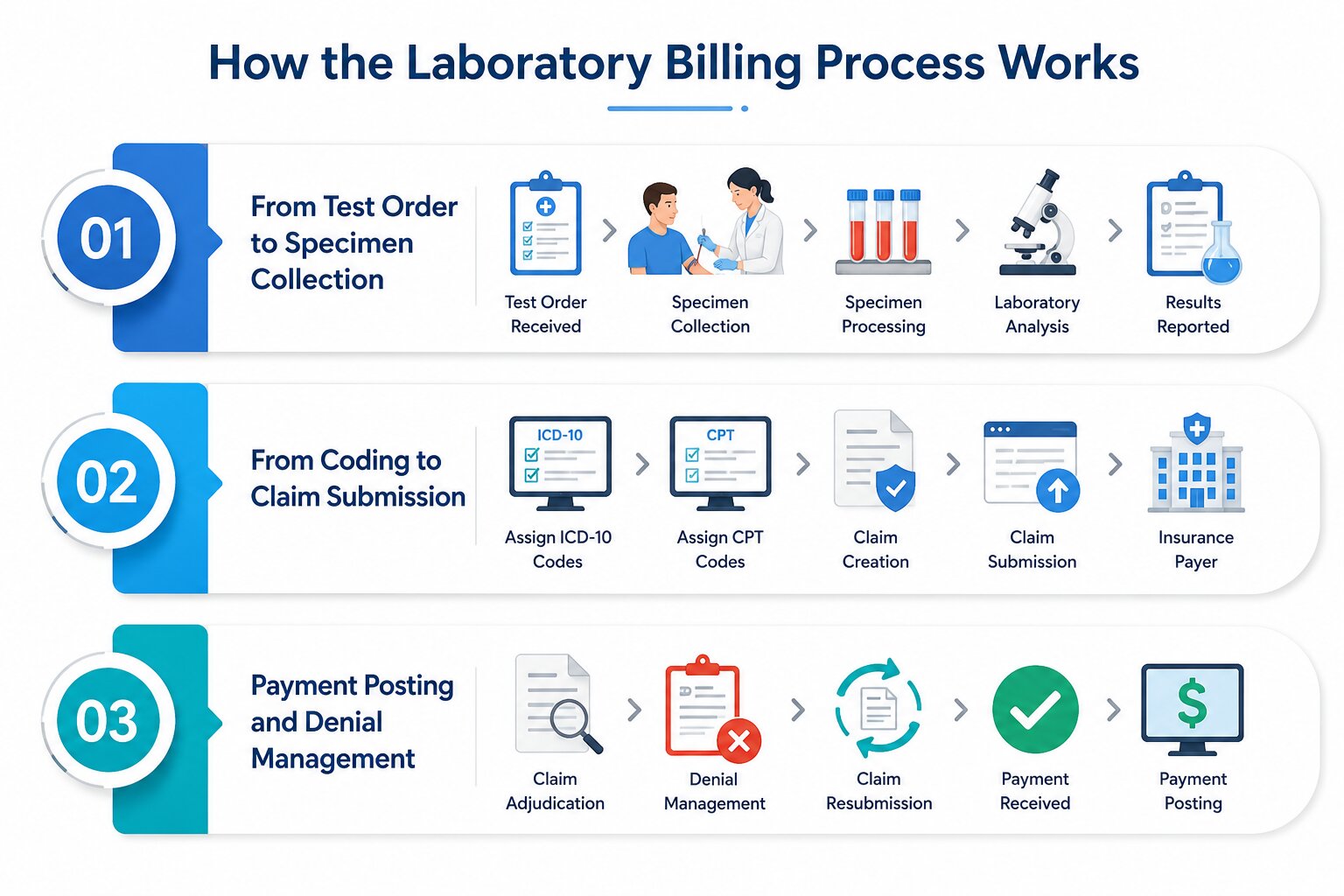
Everything starts when a physician orders a test, and that order needs to name the exact test along with a diagnosis or clinical indication that justifies it.
Your registration staff then confirm patient demographics and insurance details, because a single transposed policy number can hold up a claim for weeks.
Insurance verification follows, checking whether the plan covers the ordered test and whether it requires prior authorization first.
Once that's cleared, specimen collection happens at a phlebotomy station, a physician's office, or a patient's bedside, and the collection method itself sometimes generates its own billable code.
CPT and ICD-10 coding turns the completed test into a billable claim, matching each procedure code to a diagnosis code that supports medical necessity under that specific payer's rules.
The laboratory billing process only works when that pairing is accurate, because a mismatched code is one of the fastest routes to a denial you'll see.
Claim submission sends the coded claim electronically to the payer, and a well-built laboratory billing system flags errors before submission instead of after rejection.
Payment posting records what the payer actually paid against what was billed, and your team should review any gap between the two rather than assuming it will balance out on its own.
Denial management closes the loop, correcting and resubmitting rejected claims, ideally within days rather than months, since the longer a rejected claim sits untouched, the harder it gets to recover.
Every laboratory claim rides on a CPT code, and a handful of them account for most of the volume your lab sees in any given month.
|
CPT code |
Test |
Category |
|
80053 |
Comprehensive metabolic panel |
Chemistry |
|
80061 |
Lipid panel |
Chemistry |
|
85025 |
Complete blood count (CBC) |
Hematology |
|
81001 |
Urinalysis |
Urinalysis |
|
36415 |
Venipuncture |
Collection |
Hematology billing services built around CBC and coagulation panels tend to see fewer denials than chemistry-heavy operations, if only because the diagnosis pairings are more predictable.
That's a small mercy, and it doesn't excuse chemistry-heavy labs from tighter necessity checks, since more of their panels sit inside payer frequency caps.
CPT codes describe the test performed, but ICD-10 codes justify why it was needed, and payers deny claims constantly over a diagnosis that doesn't line up with the ordered test.
|
ICD-10 |
Diagnosis |
|
E11.9 |
Type 2 diabetes |
|
R79.9 |
Abnormal blood findings |
|
Z13.1 |
Diabetes screening |
|
D64.9 |
Anemia |
|
E78.5 |
Hyperlipidemia |
None of these codes work in isolation. Medical necessity depends on the specific test ordered, the patient's documented condition, and that payer's own coverage policy, which means a diagnosis code that supports a claim for one insurer might not satisfy another's local coverage determination.
Medical lab billing staff who keep a running list of payer-specific necessity pairings catch these mismatches before submission instead of after a denial lands on your desk.
Every clean claim traces back to paperwork that most billing staff never see rejected, and that's exactly the point.
A valid physician order needs to specify the test, the reason for it, and enough clinical context for a reviewer to understand why it was medically necessary.
Test results have to be documented and retrievable, patient demographics need to match what the payer has on file, and any lab performing testing on site needs CLIA certification appropriate to its test complexity, though CLIA requirements vary by test type and lab classification rather than following one universal standard.
Lab medical billing services built around a documentation checklist catch gaps before a claim leaves your building. The five items below cover most of what payers ask for when they request records.
Every specialty runs into billing problems eventually, but laboratory billing carries a distinct set of failure points because of how tightly diagnosis codes get policed against specific tests. Medical necessity denials remain your most common headache, usually because a diagnosis code technically exists but doesn't meet that payer's specific coverage policy for the test.
Missing physician orders come in a close second, particularly for reflex testing added after the original order was placed.
Incorrect CPT and ICD-10 pairing, duplicate billing when a test gets coded twice across departments, CLIA compliance gaps, and insurance eligibility problems that surface only after a specimen is already collected round out the list.
None of these problems are exotic. They're the same handful of issues showing up again, which is exactly why lab billing solutions built around root-cause tracking tend to outperform ones that just react to denials one at a time.
Labs generally land on one of two models to keep claims moving: buying and maintaining billing software in-house, or handing the work to a dedicated lab billing company. Software gives you more day-to-day control over your own data, but it also means someone on staff has to keep up with payer rule changes, coding updates, and system maintenance on top of running tests.
|
Billing software |
Outsourced billing |
|
Managed in-house |
Managed by billing experts |
|
Requires internal staff |
Reduces administrative workload |
|
Greater operational control |
Specialty billing expertise |
|
Software maintenance required |
Ongoing billing support |
The right choice depends on your claim volume and how much bandwidth your internal staff actually have left over after patient care and specimen handling, not on which option sounds more modern.
This decision mirrors a broader shift across healthcare. Medical billing outsourcing has become common well beyond laboratories, and the same tradeoffs, control versus capacity, apply just as much to a primary care practice as they do to a reference lab.
Accuracy starts before the specimen ever gets collected. Verifying insurance and confirming medical necessity ahead of testing prevents most denials before they happen, since a payer's coverage rules matter more than how well you perform the test itself.
Practices that rely on outside lab billing services for this ongoing maintenance often free up your internal staff to focus on specimen handling and patient service instead.
Outsourcing usually makes sense once your claim volume outpaces what an internal team can code and follow up on accurately, and that tipping point arrives faster than most lab administrators expect.
Staffing shortages compound the problem just as often. A single experienced coder leaving mid-year can stall your claims for weeks while a replacement gets trained on lab-specific rules that don't exist anywhere else in medical billing, and outsourced lab billing removes that single point of failure by spreading the work across a full team instead of one person's knowledge.
Frequent denials and increasingly complex payer requirements, especially around test frequency limits and prior authorization for costlier panels, push many labs toward a change in approach. Clinical lab billing carries enough specialized rules that a general billing hire often needs months to get fully up to speed, and that ramp-up time costs you real money in delayed claims.
Learn more in our service laboratory billing services, which covers how a dedicated team handles coding, claims, and denial follow-up for labs of every size.
For labs weighing the decision, your lab billing volume and current denial rate are usually the two clearest signals of whether outsourcing pays for itself.
Accurate laboratory billing rests on three things working together: correct coding, complete documentation, and a compliance process that keeps up with payer rule changes instead of reacting to them after a denial arrives. Labs that build a standardized workflow around test order, verification, coding, and denial follow-up see fewer rejected claims and faster reimbursement than ones handling each step as a one-off. RCM Matter works with labs on exactly this kind of workflow, handling coding accuracy and denial follow-up so internal staff aren't stuck chasing both. For labs looking to go deeper on any single piece of this, from CPT updates to payer-specific necessity rules, related guides on specialized billing topics are worth a look before your next denial cycle hits.
1. What is laboratory billing?
It's the coding, claims, and payment process built around diagnostic testing rather than a standard office visit. Lab medical billing applies its own CPT and ICD-10 pairing rules, since payers judge medical necessity test by test rather than visit by visit.
2. How does the laboratory billing process work?
Order, register, verify, collect, code, submit, post payment, manage denials. Each step feeds the next, and a mistake anywhere in that chain, a wrong policy number at registration or a mismatched diagnosis at coding, shows up later as a denial that takes far more time to fix than it would have taken to prevent.
3. What CPT codes are commonly used for laboratory billing?
Comprehensive metabolic panels (80053), lipid panels (80061), CBCs (85025), urinalysis (81001), and venipuncture (36415) account for a large share of claim volume across most labs. Laboratory medical billing services built around these high-frequency codes tend to catch coding errors faster, simply because staff see the same codes often enough to notice when something looks off.
4. Why are laboratory claims denied?
Mostly medical necessity. A diagnosis code that doesn't match the payer's coverage policy for a specific test is the single biggest cause, and it's not close. Missing physician orders, incorrect code pairing, and eligibility issues that surface after collection round out the rest.
5. What documentation is required for laboratory billing?
A valid physician order, a supporting diagnosis, documented test results, complete patient demographics, and CLIA compliance where your lab performs testing beyond waived complexity. Exactly which records a payer wants during an audit varies somewhat by plan and by state, so keeping more than the bare minimum on file tends to serve you better than keeping exactly what's required and nothing more.
6. Should laboratories outsource billing?
Depends on your lab. High claim volume, chronic denials, thin staffing, or billing for laboratory services that keeps growing more complex all point toward outsourcing, while a smaller lab with a stable, well-trained internal team may not need to change anything at all.
Optimize billing, claims and collections with expert RCM support let our professionals handle the process so you can focus on patient care.