Have you ever provided a service, submitted the claim, and then found out Medicare wouldn’t pay, and you couldn’t bill the patient either? That’s exactly the situation the Advance Beneficiary Notice (ABN) is designed to prevent. In medical billing, an ABN is a simple but powerful document that tells a patient in advance that Medicare may not cover a specific service and that they may be responsible for the cost if the claim is denied.
ABNs matter more than many providers realize. According to guidance from the Centers for Medicare & Medicaid Services (CMS), claims denied due to a lack of a valid ABN cannot be billed to the patient, which often results in lost revenue for providers. When used correctly, an ABN protects both sides, giving patients clarity about potential costs and allowing providers to legally bill the patient if Medicare denies payment.
Understanding how ABNs work is essential for compliance, clear communication, and the avoidance of preventable write-offs. So, without further ado, let’s have a look at what ABN is and how it works.
An Advance Beneficiary Notice (ABN) is a written notice given to a Medicare patient when a healthcare provider believes that Medicare may not pay for a specific service, test, or item. The purpose of an ABN is to inform the patient before the service is provided, so there are no surprises later. It clearly explains what service may be denied, why Medicare might not cover it, and what the estimated cost could be. By signing the ABN, the patient acknowledges this information and agrees to be financially responsible if Medicare ultimately denies the claim. This process protects both the patient and the provider by ensuring transparency and informed decision-making.
ABNs serve as a safeguard for both healthcare providers and patients by creating clarity about financial responsibility and reducing disputes over denied claims.
A valid ABN documents that the patient was informed ahead of time that Medicare might deny payment. This not only helps your practice comply with CMS rules but also allows you to bill the patient if Medicare refuses coverage. Without a proper ABN, your practice may lose that right. ABNs also reduce surprise billing disputes, strengthen patient trust, and support a smoother revenue cycle.
ABNs provide patients with advanced notice of potential out-of-pocket costs. Patients can choose to proceed with the service and bill Medicare, pay privately, or decline the service altogether. Importantly, an ABN does not guarantee Medicare will deny coverage. It simply indicates that there is a possibility of nonpayment.
Issuing an Advance Beneficiary Notice (ABN) in the right situations is an important part of accurate medical billing and strong revenue cycle management. It helps providers stay compliant, reduce financial risk, and clearly inform patients about possible out-of-pocket costs.
An ABN should be issued in the following situations:
If a service is usually covered by Medicare but may be denied due to a patient’s specific condition or circumstances, an ABN must be provided in advance. This ensures the patient is aware of the risk and protects the provider from unpaid claims.
Home health agencies should issue an ABN when a patient does not meet Medicare’s coverage requirements, such as not being homebound or not requiring intermittent skilled nursing care. This helps clarify financial responsibility if Medicare denies payment.
When physical, occupational, or speech therapy services exceed Medicare limits and do not qualify for an exception, an ABN should be issued. This notifies patients that coverage may be denied and that they may be responsible for the cost.
An ABN is required when Medicare criteria are not met, such as when a non-contract supplier is used or required documentation is missing. Proper ABN use in these cases helps protect the provider’s revenue and ensures compliant Medicare billing.
Using ABNs correctly in these scenarios is a key part of effective medical billing services in the U.S., helping healthcare practices reduce claim denials while maintaining transparency with patients.
Note: You do not need an ABN for services Medicare never covers, like many hearing aids or routine foot care. In these cases, you may use voluntary notice for non-covered Medicare services, but standard ABN rules do not apply.
To remain compliant and protect your practice, every ABN must include the following:
Patient Information: Full name, identification number, and date.
Description of Service: Clear explanation of the item or service that may not be covered.
Reason for Possible Denial: Specific explanation, for example, the service is not medically necessary.
Estimated Cost: Approximate amount the patient may owe.
Options Section: Patients must choose to bill Medicare, pay privately, or decline the service.
Signature and Date: Patient or authorized representative must sign before receiving the service.
Provider Information: Provider name, contact information, and signature if applicable.
Always use the official CMS R-131 form or an approved alternative. Generic or modified forms may miss required language or layout, making the ABN invalid. CMS updates guidance regularly, so check the latest version on the official CMS website. Including all these elements ensures your ABN stands up in audits and protects your practice from financial loss, and proper documentation further supports this by being a key part of medical billing services, helping practices stay compliant and transparent with their patients.
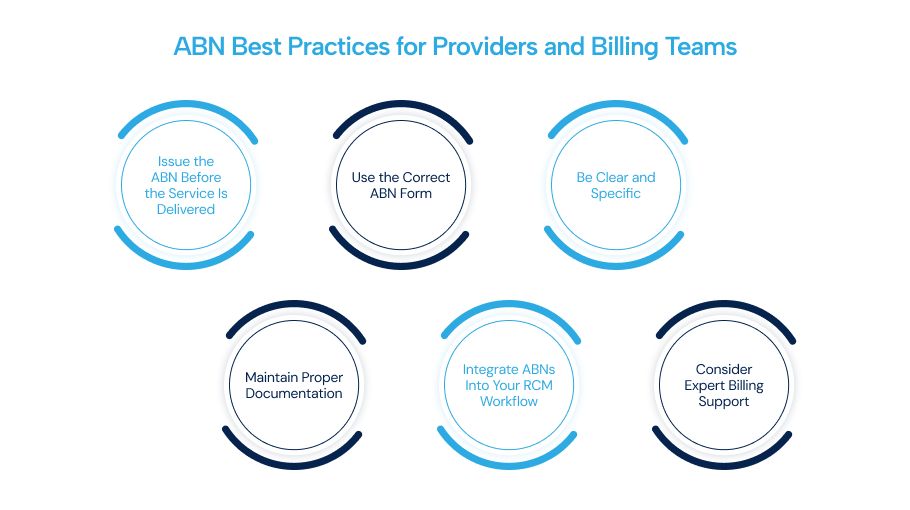
Managing Advance Beneficiary Notices (ABNs) correctly is an essential part of compliant medical billing and revenue cycle management. When handled properly, ABNs help reduce claim denials, prevent patient billing disputes, and protect a provider’s right to payment.
ABNs must be given before a service or item is provided. Since “advance” means prior, issuing an ABN after treatment or during an emergency does not protect the provider’s right to bill the patient if Medicare denies the claim.
Always use the official CMS Form R-131 or an approved equivalent. Using outdated or incorrect forms can result in compliance issues and denied claims.
Clearly describe the service and explain why Medicare may not cover it. Avoid vague language such as “Medicare may deny.” Specific, patient-focused explanations are required for the ABN to be valid.
Keep signed ABNs on file for at least five years. These documents may be requested by CMS or Medicare Administrative Contractors during audits or claim reviews, making organized record-keeping essential.
ABNs should be part of your daily revenue cycle management process. This includes identifying high-risk services, issuing ABNs in advance, tracking signed forms, and applying the correct claim modifiers such as GA, GX, GY, and GZ.
Working with an experienced medical billing service providers can help ensure ABNs are issued correctly and consistently. This reduces compliance risks, minimizes denials, and protects long-term revenue.
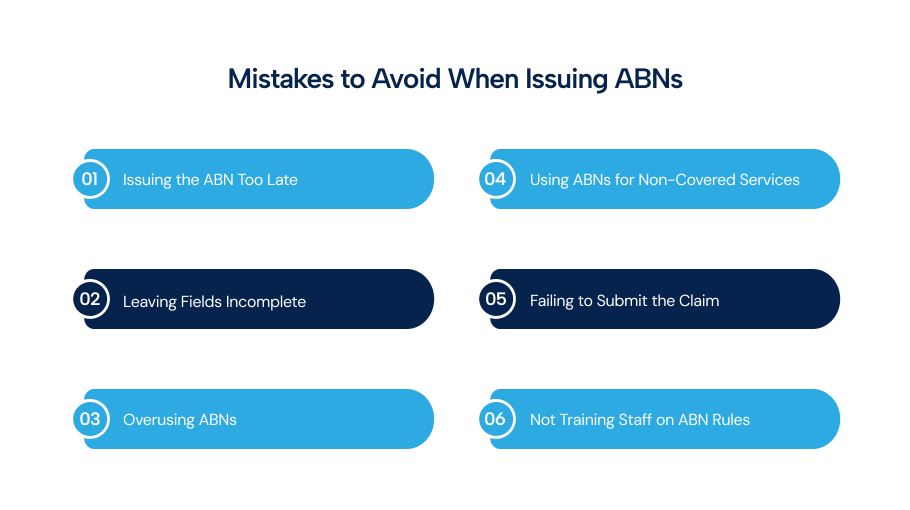
Even experienced billing teams can make errors when handling Advance Beneficiary Notices (ABNs). Whether you manage billing in-house or use medical billing outsourcing, avoiding these mistakes helps you stay compliant and maintain patient trust.
One of the most common mistakes is giving the ABN after the service or during an emergency visit. According to the Centers for Medicare & Medicaid Services (CMS), ABNs must be issued before the service is performed. If issued late, it becomes invalid, and the provider cannot bill the patient if Medicare denies payment.
Incomplete ABN forms are a common problem. If you leave fields blank or do not explain why Medicare might deny the service, the ABN can become invalid. Providers should give clear reasons, like 'service not medically necessary' or 'frequency exceeds coverage limit.' Working with medical billing experts can help make sure every form is filled out correctly. Proper documentation protects both the provider and the patient.
Some practices issue ABNs for every service “just in case,” but CMS warns against this. ABNs should only be used when there’s a real possibility that Medicare might deny coverage. Overuse can confuse patients, slow workflows, and cause compliance concerns during audits.
You don’t need an ABN for services Medicare never covers, like cosmetic surgery, hearing aids, or routine foot care. In these situations, a voluntary notice may be used, but the standard ABN rules don’t apply. Misusing ABNs this way can create unnecessary administrative work.
When a patient chooses Option 1 on the ABN, agreeing to have the service billed to Medicare, the provider must still file the claim. If you skip that step and Medicare denies payment, the patient loses appeal rights, and your practice loses financial protection.
Many ABN-related mistakes happen because billing teams aren’t trained on current CMS rules. Therefore, regular training and workflow audits are essential, and practices that outsource medical billing services can reduce errors and improve compliance.
ABNs affect your practice’s financials and workflow:
They flag a service as “at risk” of denial, so your claim system can add the correct modifier (for example, GA) and track the service.
If Medicare denies and you have a valid ABN, you are able to bill the patient according to CMS rules. If you don’t have one, you may be stuck absorbing the cost.
Proper ABN use supports smoother collections and fewer claim delays. Missed ABNs can lead to lost revenue and higher denial risk.
ABNs are essential for audits or revenue cycle reviews because having them properly documented proves your practice followed CMS rules and guidelines.
Many modern practices choose to adopt medical billing solutions that include ABN tracking to simplify this process.
Understanding ABNs is significant for both providers and patients. They clarify potential costs and protect providers if Medicare denies payment. Properly managing ABNs reduces claim denials, supports smooth collections, ensures compliance, and strengthens patient trust. Whether handled in-house or through professional medical billing services, having a clear ABN process safeguards your practice financially and operationally.
Do all Medicare services require an ABN?
No, only services that Medicare usually covers, but in your specific case, may not be covered. Services Medicare never covers don’t require an ABN.
What if a patient refuses to sign an ABN but still wants the service?
If they refuse to sign, you may decline the service. If you provide it without a valid ABN and Medicare denies payment, you may lose protection.
Can one ABN cover multiple treatments?
Yes, if each item/service and duration is clearly listed. Significant changes in service or treatment plan may require a new ABN.
How long should I keep signed ABNs on file?
Best practice is at least five years, especially for audit documentation.
Can ABNs be used for Medicare Advantage plans?
No, ABNs apply to Original Medicare (Parts A/B). Medicare Advantage plans use different procedures/notifications.
Optimize billing, claims and collections with expert RCM support let our professionals handle the process so you can focus on patient care.