Medical billing services act as an engine to keep practices performing financially healthy and stable. When claims are correct and payments arrive on time, operations run smoothly. However, when billing is problematic, revenues are slow, employee stress levels are high, and growth strategies are put on hold.
Over the past couple of years, practices have been experiencing an increase in denial rates, staff shortages, and stricter payer regulations. Due to this pressure, many providers are reconsidering whether to continue handling billing in-house or shift to outsourced medical billing.
Deciding between in-house medical billing and outsourcing depends on a practice’s size, budget, and need for control. While in-house billing offers direct oversight and immediate communication, outsourcing often helps reduce administrative costs and denial rates, allowing medical staff to focus more on patient care.
Let us break down both options clearly to help you decide confidently.
In-house billing means your practice builds and manages its own billing department. You employ billing experts who work in your office rather than relying on an external firm. Their job involves the entire billing process, which includes checking patient insurance information, filing claims, and following up on payments.
Instead of depending on an outside company, you hire billing specialists who work directly inside your office. They are responsible for the full billing cycle, starting from verifying patient insurance details to submitting claims and tracking payments.
The in-house team typically handles:
Insurance eligibility verification before the patient visit
Charge entry based on provider documentation
Claim submission to insurance companies
Payment posting once reimbursements are received
In-house billing also provides practices with a greater sense of control and direct oversight. As the billing group works in your organization, you have the opportunity to monitor processes and make changes on the fly when necessary.
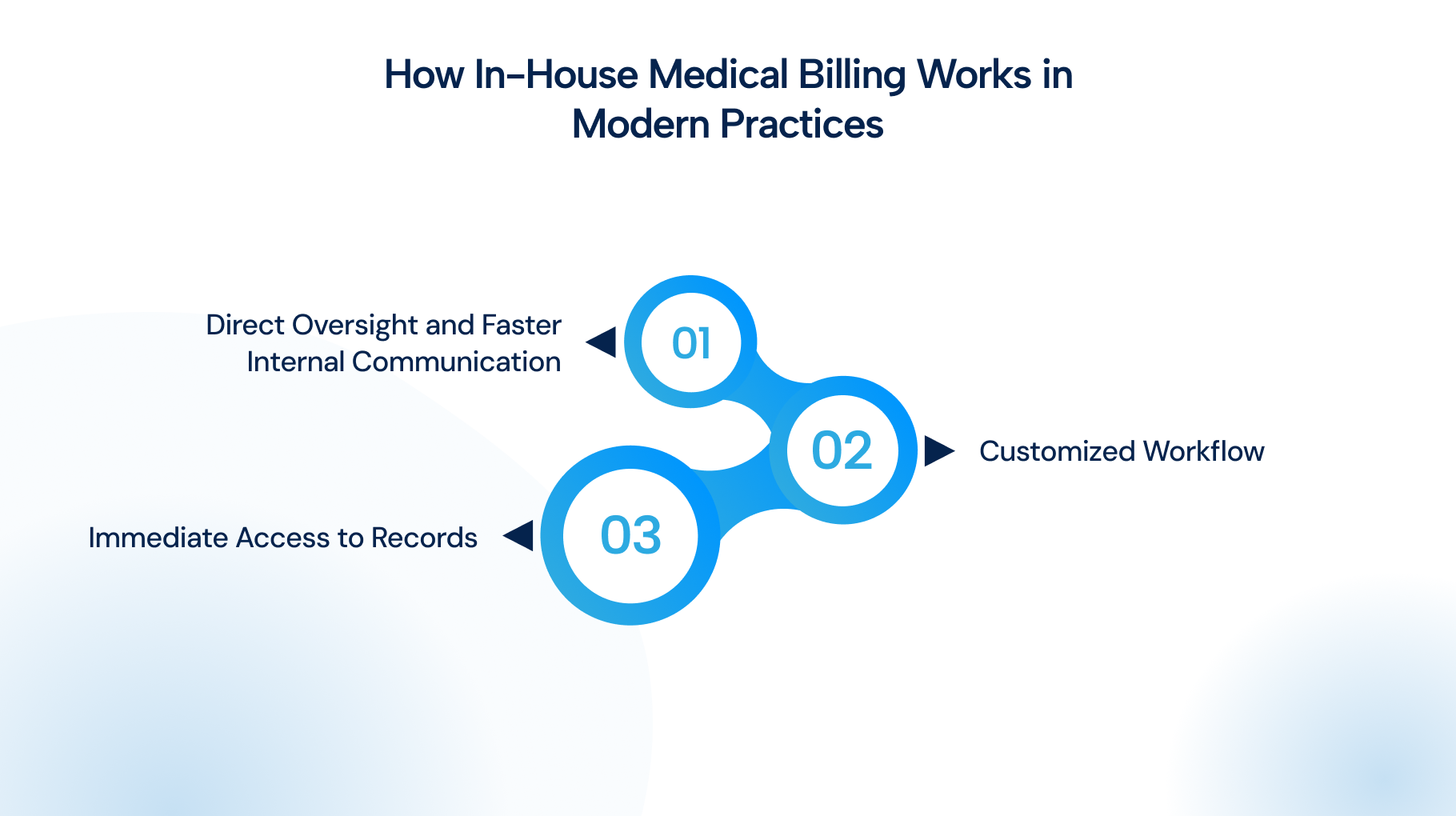
As billing personnel will be seated in your clinic, providers will have the opportunity to resolve documentation problems quickly. This can minimize the time lag due to lost notes or unfinished information.
You are in charge of processing claims, fielding follow-ups, and structuring statements for patients. This can be useful in the event that your specialty has specific needs.
Since billing and clinical teams collaborate, it may be faster and easier to access patient charts to correct them.
On the one hand, in-house billing provides you with direct control; however, on the other hand, it is accompanied by financial and operational difficulties. As your practice becomes larger, managing the billing process is possible to be more challenging and resource-intensive.
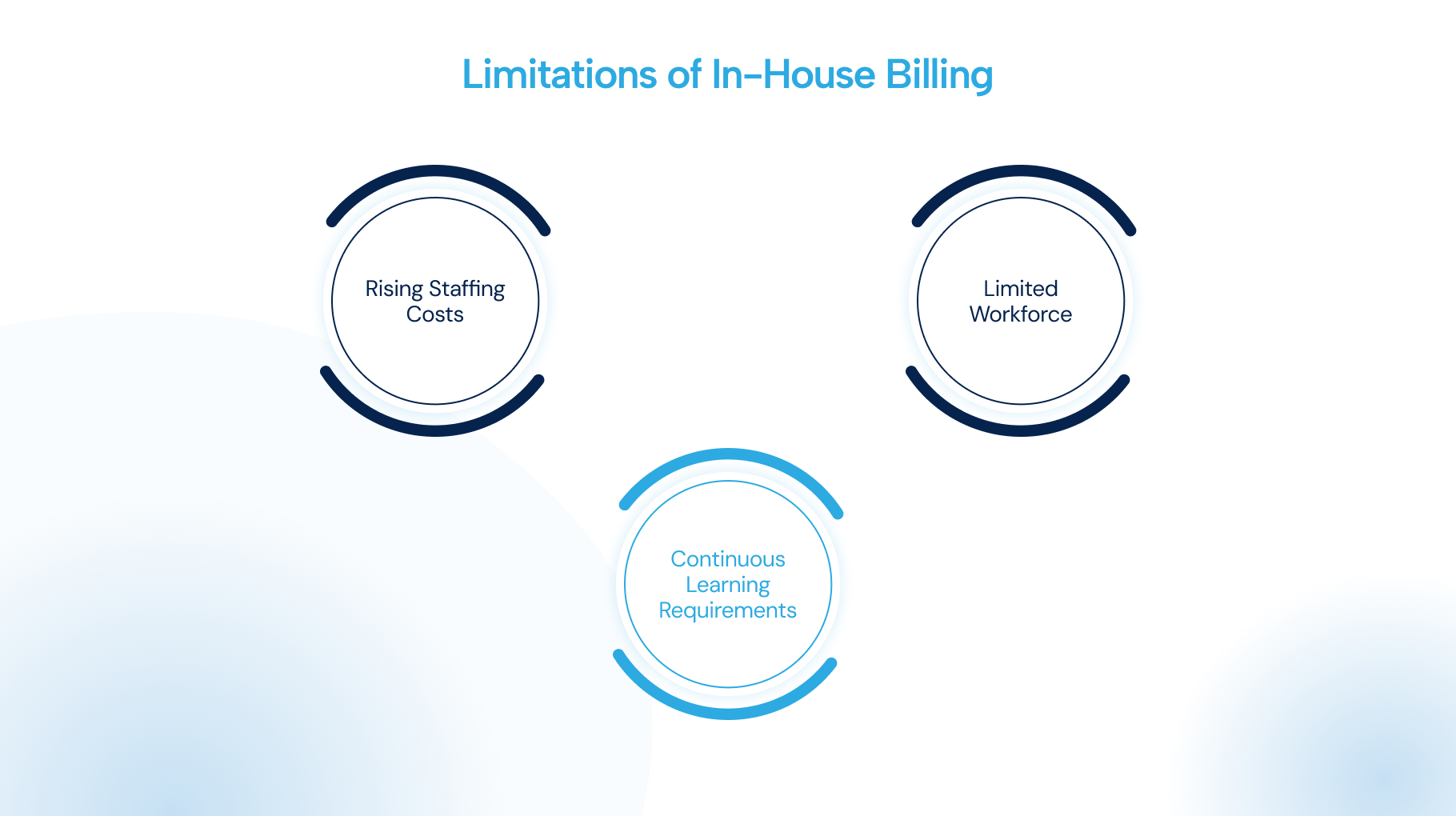
Salaries, benefits, payroll taxes, and training are rapidly adding up. According to the Medical Group Management Association, there are continuing administrative staffing issues, such as increased wage demands in medical offices.
Whenever a single employee in billing quits or goes on leave, the revenue stream might be hindered. Smaller practices tend to be based on one or two individuals, enhancing the risk.
Coding guidelines and insurance policies are subject to frequent changes. The internal staff would need to spend time and finances on continuous education in order to remain in compliance.
Outsourced medical billing is partnering with an external company that manages your billing operations remotely. Instead of hiring and maintaining an in-house billing team, your practice works with trained specialists who handle the entire revenue cycle, including claim submission, payment posting, and denial follow-up.
The only thing these companies focus on is the enhancement of billing accuracy, claims rejection, and speeding up reimbursements. Outsourcing changes the way administrative jobs are conducted by transferring the administrative work to specialists and acquiring organized reporting and performance monitoring aimed at enhancing financial stability.
Healthcare billing has become more complex, with rising denial rates and changing insurance rules. Many practices choose outsourcing to reduce administrative pressure and improve revenue consistency. By working with experienced billing specialists, providers can focus more on patient care while maintaining stronger financial performance.
Medical billing outsourcing models charge a percentage of collections rather than fixed salaries. This means costs adjust with revenue performance.
Companies providing outsourced billing services often employ trained professionals who handle large claim volumes daily. Their exposure to multiple specialties allows them to identify payer patterns quickly.
A 2023 KFF report showed that nearly 19% of in-network marketplace claims are initially denied, and more than half of denied claims are never resubmitted, illustrating how common denials have become in U.S. healthcare billing.
Outsourcing partners typically use automated tools to detect claim errors before submission, reducing preventable denials.
Outsourcing has many benefits, but it is important to look at possible challenges before deciding. Practices should think about how communication will work, how patient data will be protected, and how clearly financial reports will be shared. Choosing a reliable partner and setting clear expectations from the start can help avoid confusion and protect your revenue.
Because the team works remotely, communication depends on digital systems and scheduled meetings. Clear reporting systems are essential.
Not every medical billing company in USA provides the same level of service. It is important to review performance data, references, and compliance standards before signing an agreement.
Shifting from in-house to outsourced billing requires a structured transition. Data migration, workflow adjustments, and staff coordination must be handled carefully to prevent temporary disruptions in claims processing.
| In-House Medical Billing | Outsourced Medical Billing |
| Managed by staff inside your practice | Managed by an external billing company |
| Full internal control over processes | Oversight through reports and service agreements |
| Face-to-face communication with providers | Remote communication via calls and systems |
| Fixed costs (salaries, benefits, training) | Variable cost (typically 4–9% of collections) |
| Revenue risk if staff leave or are absent | Larger team reduces staffing risk |
| Limited to internal team expertise | Access to specialized billing experts |
| Manual denial tracking and follow-up | Automated tools to reduce denials |
| Practice pays for software and upgrades | Advanced tools included in service |
| Must hire more staff to scale | Easily scales as practice grows |
| Ongoing internal compliance training required | Billing partner manages payer updates |
| No transition if already set up | Requires onboarding and data migration |
| Best for practices wanting full control | Best for practices seeking flexibility and growth |
When deciding between in-house and outsourced medical billing, practices should evaluate these important factors:
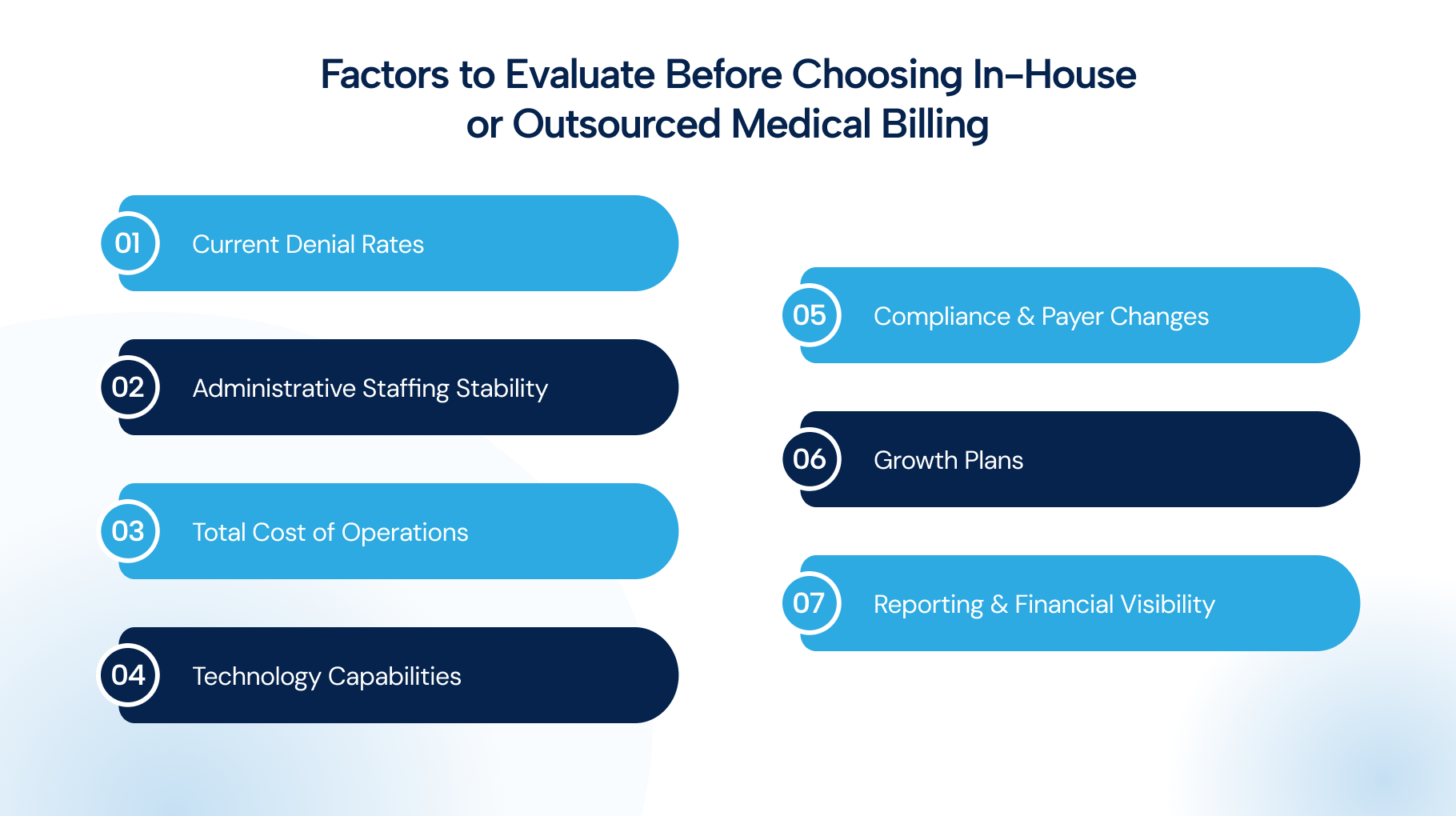
If your claim denials are increasing, you may need stronger denial management systems and expertise.
Frequent turnover or staffing shortages can disrupt cash flow and slow reimbursements.
Compare fixed payroll expenses (salaries, benefits, training, software) with percentage-based outsourcing fees.
Consider whether your practice can afford advanced medical billing software, automation tools, and denial-tracking systems.
Evaluate how well your team keeps up with evolving coding updates and payer rule changes.
If your practice plans to expand, assess whether your current billing structure can scale efficiently.
Ensure you have consistent access to clear performance reports, KPIs, and revenue tracking.
Industry trend analysis shows that rising denial rates and increasing payer complexity are pushing more practices toward outsourced revenue cycle management. Healthcare financial experts suggest that in 2026, flexibility, automation, and specialized billing expertise will be critical for maintaining steady cash flow. As administrative costs continue to climb, outsourcing is widely viewed as a more scalable and financially predictable solution.
Choosing the right billing partner can make a big difference for your practice’s revenue and daily workflow. Many practices now rely on outsourced medical billing to make sure claims are handled accurately while freeing staff to focus on patient care.
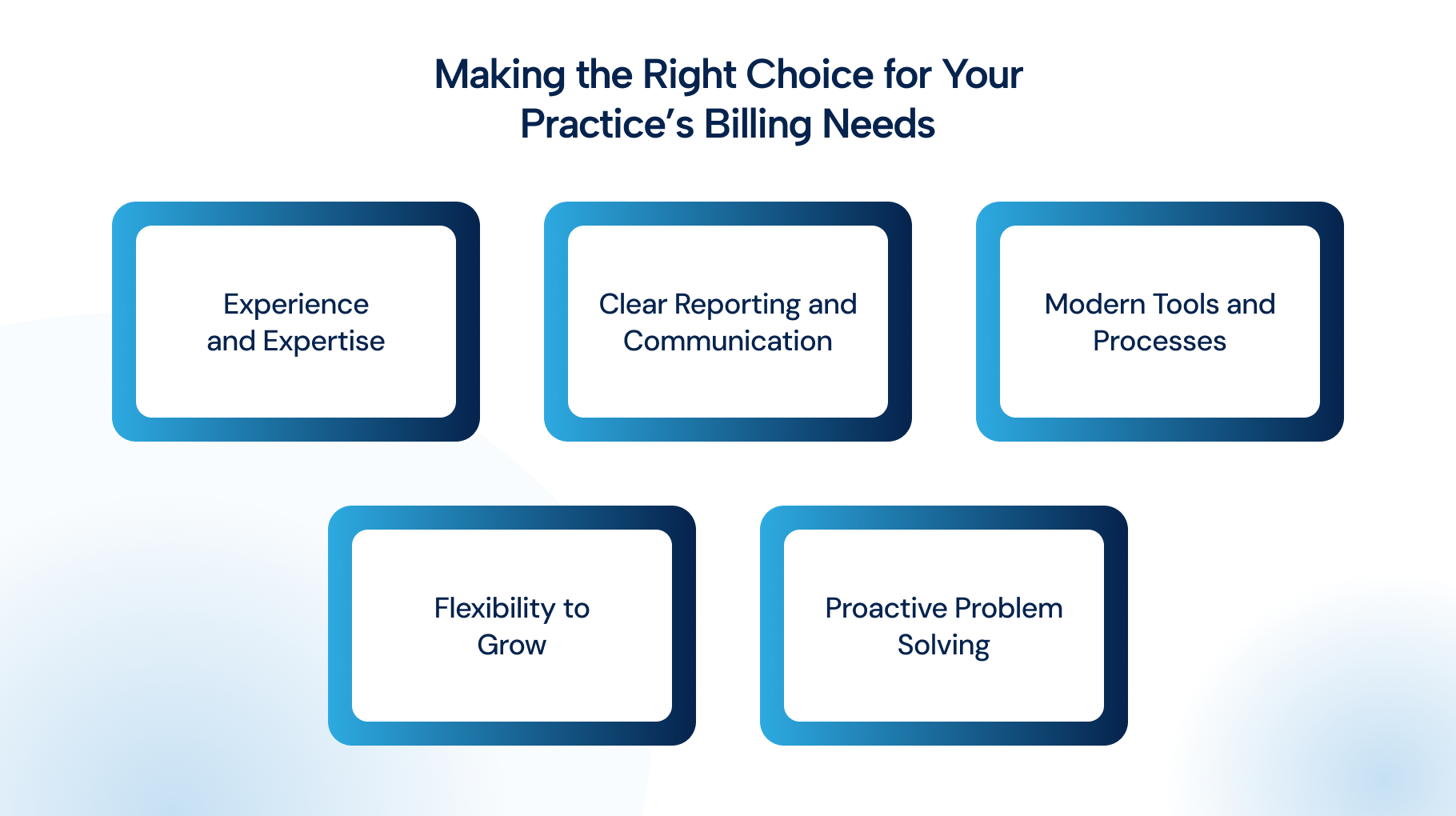
Here’s what to look for:
A partner experienced in your specialty can spot errors quickly and maximize reimbursements, something an outsourced billing team often excels at.
You should always know the status of claims, payments, and denials. A responsive outsourced medical billing provider keeps you updated without endless back-and-forth.
Advanced billing software, automation, and denial-tracking systems save time and reduce errors. A professional external team usually provides these tools as part of the service.
For a deeper understanding of how AI enhances efficiency and reduces errors in medical billing, you can explore this detailed guide; benefits of ai medical billing software for small practices
As your practice expands, your billing needs will too. Outsourced teams can scale quickly without the overhead of hiring new staff.
The best partners focus on preventing claim denials before they happen and following up quickly on any issues.
By choosing a reliable external billing team, practices can reduce stress, improve accuracy, and keep revenue flowing smoothly. That’s why outsourced medical billing continues to be a preferred solution for growing practices
Choosing between in-house billing and outsourced medical billing is not just an operational decision but more of a financial strategy that shapes the stability and growth of your practice. If you value full internal control and have a strong administrative team, in-house billing may work well.
But if you want flexibility, specialized expertise, and scalable support in a changing healthcare environment, outsourcing can provide a stronger path forward. In fact, many clinics that switch to outsourced medical billing services report improved cash flow within the first few months.
That’s why many forward-thinking healthcare organizations are turning to trusted revenue cycle partners like RCM Matter, which is recognized for delivering reliable outsourced medical billing and revenue cycle management services.
Is outsourcing only suitable for small practices?
No. While small clinics often benefit the most, mid-sized and specialty practices also use outsourcing to manage complex payer requirements.
How quickly can outsourcing improve collections?
Improvement timelines vary, but many practices report measurable changes within 3 to 6 months after transition.
How much does outsourced billing typically cost?
Most providers charge between 4 and 9% of collected revenue, depending on specialty and claim complexity.
Can in-house billing be more secure?
Both models can be secure if proper HIPAA compliance and data protection systems are in place.
Is 2026 a good time to reconsider the billing strategy?
With rising denial rates and increasing technology demands, many experts believe this is the right time to reassess billing models for long-term sustainability.
Optimize billing, claims and collections with expert RCM support let our professionals handle the process so you can focus on patient care.