Retro authorization (or retrospective authorization) is the process of asking a health insurance company to approve and cover a medical service after it has already been provided.
What follows covers how the process works, where it breaks down, and what separates an approved request from a denied one.
|
Item |
Details |
|
Definition |
Insurance approval requested after services have been provided |
|
Primary purpose |
Obtain reimbursement when prior authorization wasn't secured beforehand |
|
Common situations |
Emergencies, administrative errors, eligibility issues, urgent care |
|
Requested by |
Healthcare providers or billing staff |
|
Approval |
Depends on payer policy and supporting documentation |
The table covers the basics. What's underneath it decides whether a practice gets paid.
Retrospective authorization is a payer's after-the-fact review of a service delivered without prior sign-off. It sits at the tail end of the authorization process instead of the front. A standard request asks a payer, "will you cover this?" A retro request asks something closer to, "will you still cover this, given what already happened?" That second question is harder to answer.
It's worth separating this from a retrospective review, a broader audit payers run on already-paid claims for accuracy or fraud. What is a retro authorization, by contrast, is narrower: a provider-initiated request tied to one claim, not a payer-initiated look-back.
Providers who want the fuller picture of the standard prior authorization process can see exactly which front-end step this exception sits apart from. Approval is never automatic either way.
|
Feature |
Prior authorization |
Retrospective authorization |
|
Timing |
Before treatment |
After treatment |
|
Purpose |
Obtain approval before services |
Request approval after services |
|
Typical use |
Planned procedures |
Emergencies or missed authorization |
|
Risk of denial |
Lower |
Higher |
|
Documentation |
Medical necessity before care |
Medical necessity plus an explanation for the missing authorization |
The word "retro" simply means backward, or after the fact. Retro in medical terms almost always signals that a step which normally happens before care is instead happening after it.
Payers generally allow retro requests for emergency admissions, urgent situations where delay would cause harm, and administrative errors like a missed submission or a system outage.
Eligibility discovered after the fact is its own category, since a patient sometimes doesn't realize their coverage changed. Can health insurance be retroactive in a way that reshapes an already-filed claim? Sometimes, yes: some plans apply coverage back to a date before the policy was formally issued, though this varies by payer and plan type, so billing staff should confirm it directly rather than assume.
Denials cluster in predictable places, and most competitor guides skip past them. Elective procedures with no attempt at prior authorization get denied far more often than emergencies.
Missed deadlines kill otherwise solid requests before a reviewer reads the clinical notes, and thin documentation reads as an assumption, not a case. Some plans don't allow retro review at all outside true emergencies, and finding that out afterward is expensive.
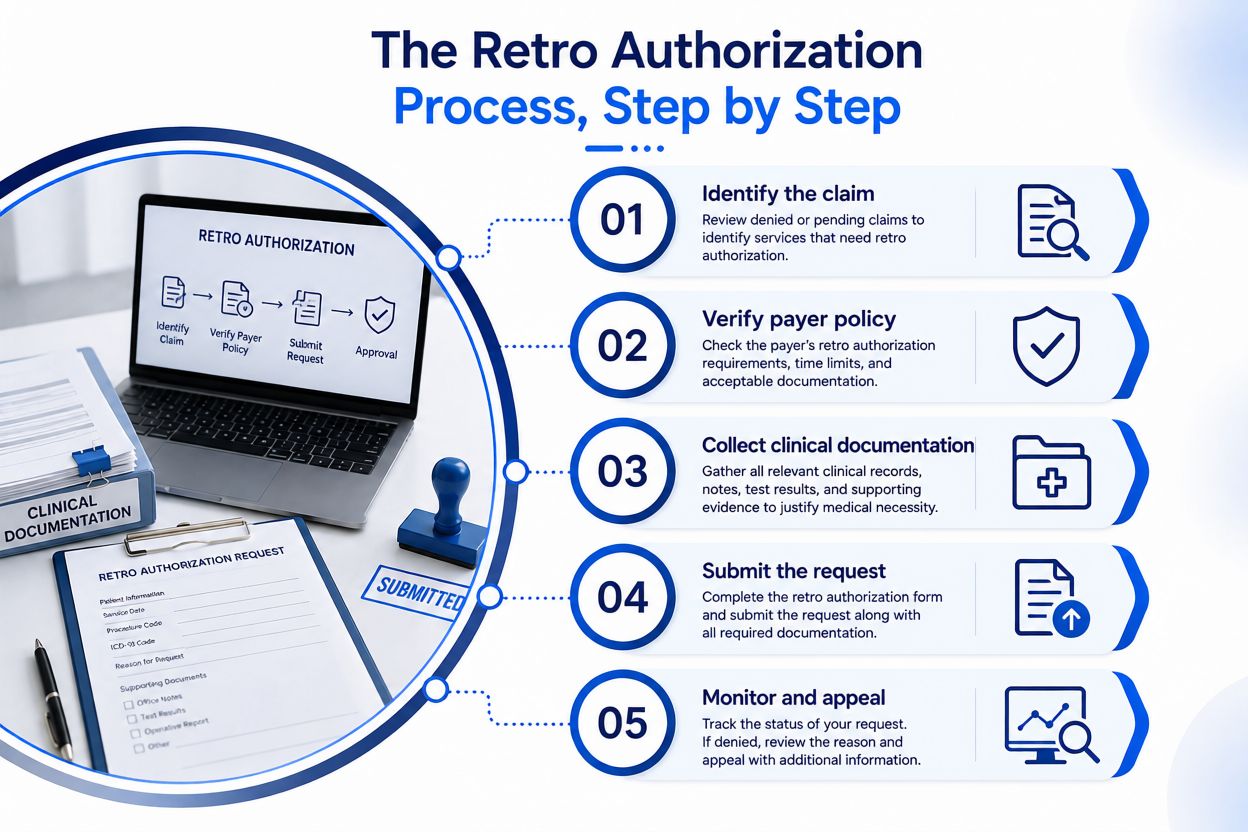
Documentation carries more weight here than in almost any other billing task. Diagnosis codes need to line up with the service billed, and service dates should match the clinical record exactly.
Operative reports, referral records, a provider signature, and a written explanation for the missing authorization round out the package. Practices that turn retro billing into a repeatable checklist see fewer rejected packages.
The biggest mistake is assuming every payer allows retrospective review. Some don't, and finding that out mid-process burns days a practice doesn't have. Missing deadlines is close behind, since windows vary enough between payers that one internal policy doesn't work for all of them.
Incomplete documentation, wrong CPT codes or ICD-10 codes, and waiting too long after a denial round out the list. It's a discipline problem, not a knowledge one.
Two claims can look nearly identical on paper and land in opposite places. A patient arrives for emergency surgery with no time for prior sign-off, the team submits a retro request within days with the operative report attached, and the payer approves it.
An elective MRI performed without authorization, simply because the front desk forgot to check, gets denied outright. Same paperwork, opposite outcome, because the circumstances were never comparable.
The best fix for retro authorization problems is needing fewer of them. Verifying benefits before the appointment is scheduled catches most requirements before they become a scramble. Running eligibility verification at intake, not the week of the visit, closes many of the gaps that lead to retro requests later.
Tracking tools help practices juggle dozens of payers with different rules, and training front-office staff on what triggers a retro request, not just how to submit one, fixes the problem closer to its source.
Regular audits of the authorization workflow catch patterns before they become a backlog of denied claims, and clearing that backlog is where a structured approach to denial management and steady follow-up on outstanding claims start to matter.
A practice that treats retro authorization in medical billing as an exception to manage carefully, not a routine step to lean on, spends far less time fighting denials.
Retro authorization in medical billing works as an exception process, not a substitute for getting things right the first time. Used for genuine emergencies, documented errors, or coverage gaps nobody could have caught earlier, it does its job.
Success comes down to payer-specific rules, fast submission, and documentation strong enough to answer questions before a reviewer has to ask them. Practices that treat front-end authorization as seriously as back-end appeals need this fallback far less often.
RCM Matter works with practices on strengthening that front-end process, so retro requests stay the exception they were always meant to be. If your denial patterns keep circling back to missed authorizations, that's the first workflow worth auditing.
1. What is retro auth, in plain terms?
It's the process of requesting insurance approval for a service after it's already been provided, usually because prior authorization wasn't obtained due to an emergency, an error, or a coverage issue discovered late.
2. Is retro authorization the same as prior authorization?
No. Prior authorization happens before care and carries a lower risk of denial. Retro authorization happens after care, and payers apply more scrutiny because the service already took place regardless of the outcome.
3. When does a payer approve a retro request?
It depends on the specifics. Genuine emergencies and documented errors fare better than elective procedures with no attempt at prior approval, but nothing is guaranteed. What is included in retrospective relief ultimately comes down to the individual payer's policy.
4. How long do providers have to submit a retro application?
This varies, and there's no single industry standard. Some plans allow 30 days from the date of service; others require submission within days of discharge. Checking the specific payer's window is the only reliable approach.
5. What should a provider do if the request gets denied?
Appeal it with more documentation than the original submission, not the same package resent. Reviewers who see a stronger case the second time around tend to reverse course.
Optimize billing, claims and collections with expert RCM support let our professionals handle the process so you can focus on patient care.