A patient comes back for a colposcopy after an abnormal Pap result, the physician takes two cervical biopsies, and three weeks later the claim bounces back denied. Nothing about the visit was unusual. The coder just picked the wrong number from a family of codes that look almost identical on paper. This happens in gynecology practices more often than most billing managers admit, and it usually traces back to one thing: confusing which colposcopy code matches which combination of biopsy and endocervical curettage (ECC). Getting the CPT for colposcopy right on the first submission is what separates a clean claim from a three-week appeal cycle.
This blog breaks down CPT code 57455, how it differs from its close relatives, and what your documentation needs to show before the claim ever reaches a payer.
Payer policy changes are a real driver of denials in gynecologic billing, not just coder error.
According to AAPC's Knowledge Center, 77% of practices surveyed in 2024 said frequent shifts in payer requirements created reimbursement challenges on top of routine coding mistakes.
Colposcopy coding sits right in the middle of that friction, because the difference between a paid claim and a denied one often comes down to a single documented detail.
CPT 57455 describes a colposcopy of the cervix, including the upper and adjacent vagina, with one or more biopsies of the cervix. No ECC. That's the whole distinction that trips people up. If the physician also samples the endocervical canal during the same session, the encounter is no longer 57455.
It becomes 57454. This is a colpo CPT code family built entirely around what was actually sampled, not how many biopsy sites were involved.
|
Item |
Details |
|
CPT code |
57455 |
|
Procedure |
Colposcopy of the cervix with biopsy(s) of the cervix |
|
Category |
Endoscopy procedures on the cervix uteri |
|
Global period |
0 days |
|
Typical setting |
Office, ASC, hospital outpatient |
|
Specialty |
OB/GYN |
Report 57455 once per session regardless of how many individual biopsy sites the physician samples. Three punch biopsies during one colposcopy still bill as a single unit of 57455, not three.
Most of the confusion around this code isn't about the definition. It's about matching the definition to what actually happened in the room.
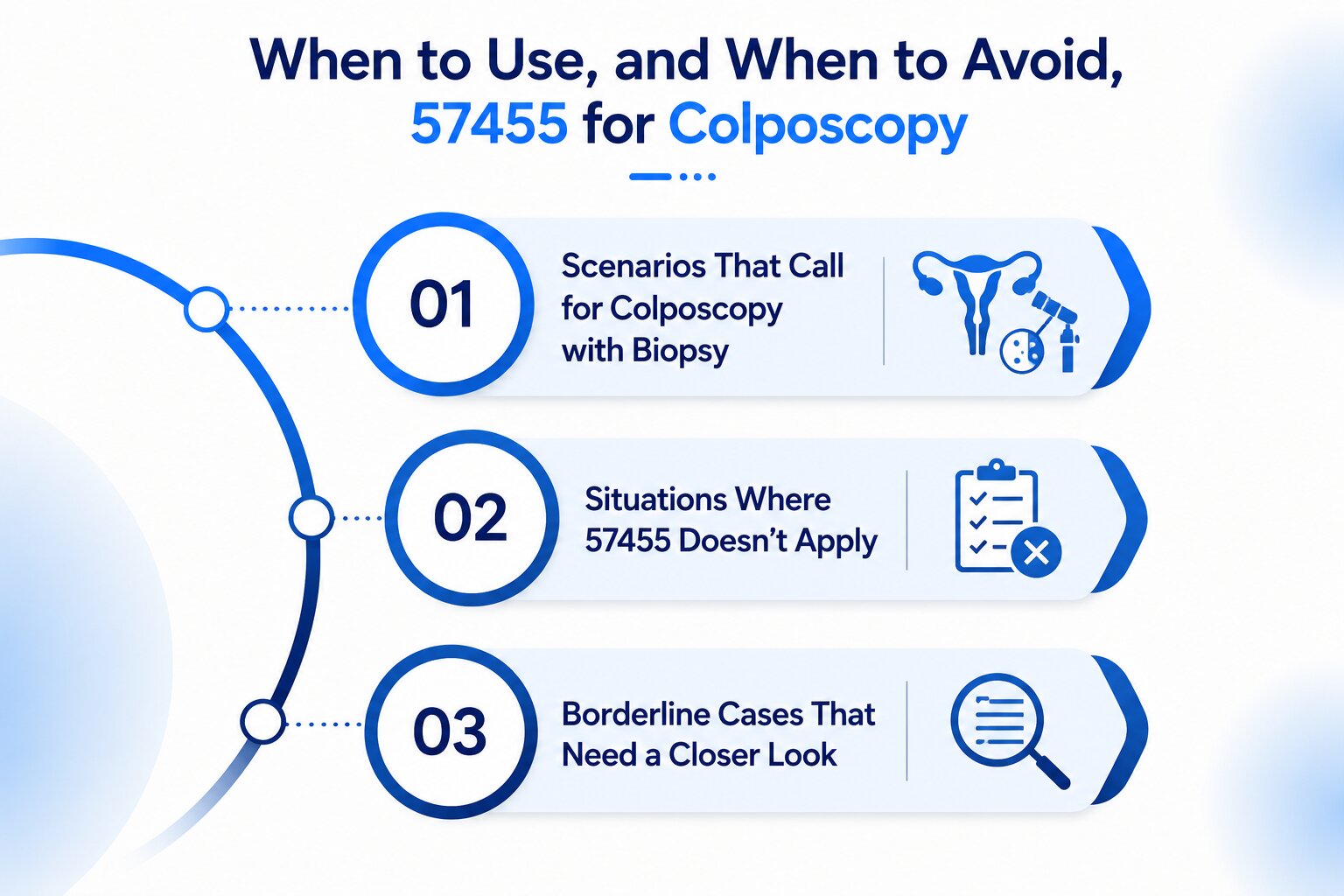
The clearest indication is an abnormal Pap smear that shows ASC-US, LSIL, or HSIL, followed by a colposcopic exam where the physician identifies an acetowhite lesion and takes a targeted biopsy. Persistent high-risk HPV positivity with no visible lesion sometimes leads here too, once the physician decides biopsy is warranted based on colposcopic impression.
A colposcopy with biopsy CPT selection is only correct when the operative note explicitly documents biopsy sites and confirms no ECC was performed. Leave that detail vague, and a payer's medical review team has every reason to question the code.
If the physician visualizes the cervix and takes no tissue at all, that's 57452, not 57455. If ECC is performed without a cervical biopsy, that's 57456. And if a loop electrode is used to excise tissue rather than sample it with punch forceps, you're looking at 57460 or 57461 depending on whether the excision is a simple loop biopsy or a deeper conization.
Coders searching for the right CPT for cervical biopsy sometimes land on 57500 instead, which covers biopsy or local excision of a cervical lesion outside the colposcopic context, and that's a different clinical scenario entirely.
Getting this sorted before submission matters more than most practices realize, and it's one reason gynecology-focused gynecology billing specialists exist as a distinct service line rather than a generic add-on to general billing.
Not every colposcopy note falls neatly into "biopsy only" or "ECC only." A physician performs colposcopy, identifies a lesion, and takes a biopsy, but the note also mentions "endocervical sampling attempted, canal not adequately visualized." That's ambiguous.
If the attempt didn't actually yield a specimen sent to pathology, most coders would still report 57455, but this is exactly the kind of note that draws a payer query. Repeat colposcopies within a short window raise a similar flag.
A patient who had a colposcopy with biopsy three months ago and comes back for another one needs a note that explains why, whether that's persistent abnormal cytology, an inadequate prior exam, or a new finding. Without that context, some payers question medical necessity on the second claim even when the code itself is correct.
|
CPT code |
Procedure |
When to use |
|
57452 |
Colposcopy without biopsy or ECC |
Visualization only, no sampling |
|
57455 |
Colposcopy with cervical biopsy |
Biopsy taken, no ECC performed |
|
57456 |
Colposcopy with ECC only |
ECC performed, no cervical biopsy |
|
57454 |
Colposcopy with biopsy and ECC |
Both biopsy and ECC in the same session |
|
57460 |
Colposcopy with loop electrode biopsy |
LEEP performed instead of punch biopsy |
|
57461 |
Colposcopy with loop electrode conization |
Deeper, cone-shaped excision |
Think of this table as a decision tree rather than a list. Start with whether tissue was sampled at all. Then ask whether the sampling was excisional or a targeted punch biopsy.
A 57454 cpt code claim and a 57455 claim can come from visually similar procedures, sometimes performed minutes apart on different patients, and the only thing separating them is whether the operative note says "ECC performed."
Coders who assume ECC happened because it's common in that clinic get burned here. Documentation has to state it directly.
There's also a code some practices confuse with the entire colposcopy family: cold-knife conization. Cpt 57520 describes conization of the cervix performed without a colposcope guiding the excision, typically under general anesthesia in an OR setting.
It's a fundamentally different procedure from anything in the 57452 through 57461 range, even though both involve removing cervical tissue.
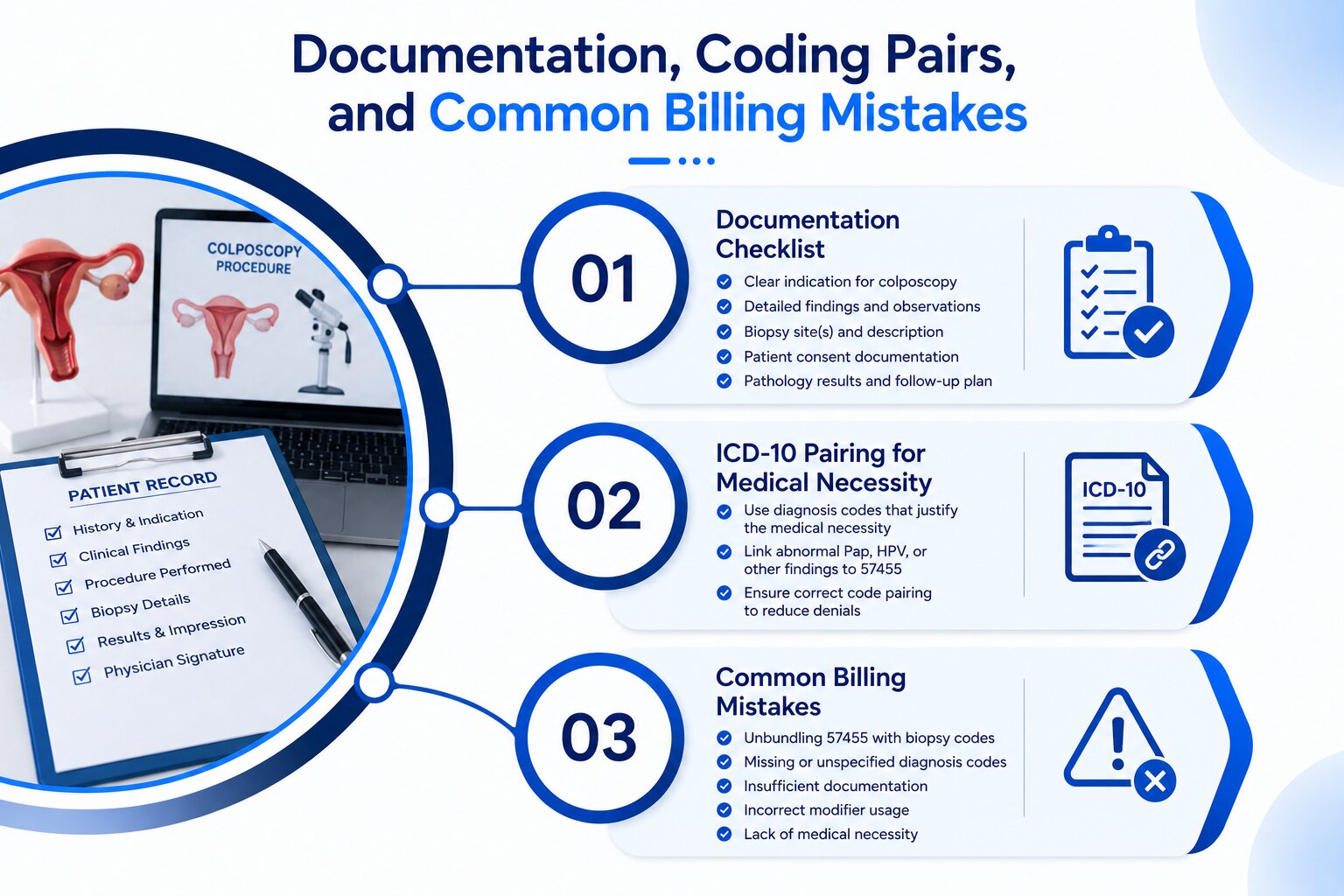
Reimbursement for 57455 lives or dies on the operative note. Payers reviewing these claims want to see, at minimum, the indication for the procedure, the colposcopic findings, biopsy site count, specimen handling, and an explicit statement about whether ECC was or wasn't performed.
Vague notes that say "biopsies taken as indicated" without a count or location invite denial, and appeals for missing documentation take far longer to resolve than getting it right the first time.
Practices leaning on outsourced medical coding services often catch these gaps before submission rather than after a denial, simply because a second set of trained eyes reviews the note against the code before it goes out the door.
The diagnosis code has to justify why colposcopy was medically necessary in the first place, and it needs to match what's documented, not what's typical for the practice. R87.610 supports ASC-US findings. N87.1 supports moderate dysplasia.
D06.- codes apply when carcinoma in situ is the working diagnosis. None of these should be auto-populated from a template; each one should reflect the actual pathology finding or screening result driving the visit. Practices that want a deeper walkthrough of how CPT and ICD-10 codes function together can review this breakdown of CPT and ICD-10 coding fundamentals.
An error caught before submission costs a few minutes. One caught after submission costs an appeal, a resubmission, and weeks of accounts receivable aging. That gap alone is worth building a pre-submission review step into your workflow.
A 34-year-old presents with an abnormal Pap showing LSIL. Colposcopy reveals an acetowhite lesion at the anterior lip, and the physician takes a single punch biopsy. No ECC is documented. This bills as 57455, linked to R87.610, and the claim should process cleanly because the note supports exactly what the code describes.
Compare that to a second scenario. Same clinical picture, but the transformation zone isn't fully visualized, so the physician also performs ECC to check the endocervical canal. That changes the code to 57454, not 57455, even though the biopsy portion of the visit looked identical from the patient's perspective.
A third case involves a high-grade lesion where the physician elects loop excision instead of punch biopsy. That's 57460, and billing it as 57455 because "it's still a colposcopy" is a mistake that shows up regularly in post-payment audits.
CPT code 57455 only belongs on a claim when the documentation shows exactly what the code describes: colposcopy with cervical biopsy, no ECC. The margin for error in this code family is small, and it sits almost entirely in whether the operative note states what was and wasn't sampled.
Practices that treat CPT for colposcopy selection as a documentation exercise rather than a guessing game tend to see fewer denials and faster turnaround on gynecologic claims. RCM Matter's coding team reviews operative notes against payer-specific medical necessity criteria before submission, catching ECC and biopsy documentation gaps that would otherwise trigger a denial weeks later.
If your practice is seeing repeat denials on colposcopy claims, it might be worth having someone outside your usual workflow take a second look at how those notes are being translated into codes.
1. What does CPT code 57455 include?
It covers a colposcopic exam of the cervix and adjacent vagina along with one or more cervical biopsies. Multiple biopsy sites during the same session still count as a single unit.
2. What's the difference between 57455 and 57454?
ECC. If the physician performs endocervical curettage in addition to the biopsy, the correct code is 57454, not 57455. If there's no ECC, stick with 57455.
3. Can you bill an E/M visit on the same day as CPT 57455?
Yes, but only when the E/M service is significant and separately identifiable from the procedure itself, documented with its own history, exam, and medical decision-making, and appended with modifier 25. Routine pre-procedure counseling doesn't meet that bar on its own.
4. What documentation do payers expect to see?
A complete operative note stating the indication, colposcopic findings, exact biopsy count and location, and an explicit statement on ECC status. Missing that last detail is one of the most common reasons these claims come back for review. The note should also confirm specimen handling and pathology submission, since some payers cross-check for a corresponding pathology report before releasing payment.
5. Do you need a modifier every time you bill 57455?
No. Most standalone 57455 claims go out clean without any modifier at all. Modifiers only enter the picture when there's a same-day E/M service, a second distinct procedure at a separate site, or a payer-specific rule requiring one for multiple-procedure logic.
Optimize billing, claims and collections with expert RCM support let our professionals handle the process so you can focus on patient care.