A surgery center bills a simple outpatient case, three units of time, one modifier, one clean claim. Two weeks later, the payer bounces it back over a documentation mismatch nobody caught before submission. That single denial now needs a resubmission, a phone call, and a week of delay before the practice sees a dollar of it. Multiply that by dozens of cases a month, and it becomes clear why anesthesia billing challenges hit harder than almost any other specialty's billing headaches. Anesthesia doesn't bill off a flat fee per procedure. It bills off time, modifiers, and physical status, which means every extra variable is another place for a claim to go wrong.
Most physician billing follows a simple pattern: one code, one fee, one claim. Anesthesia stacks base units, time units, and modifier units, then multiplies the total by a conversion factor that shifts by payer and by year. That layering is exactly why anesthesia denial rates tend to run above the industry average. Hospitals and physicians experienced an initial denial rate of 11.65% in 2025 through November, up from 11.41% in 2024, according to Kodiak Solutions data reported by HFMA. Anesthesia claims, with their added layers of time and modifier complexity, sit right in the middle of that upward trend.
None of this makes anesthesia billing impossible. It makes it unforgiving of shortcuts.
Three problems account for the bulk of anesthesia billing errors, and they tend to compound each other.
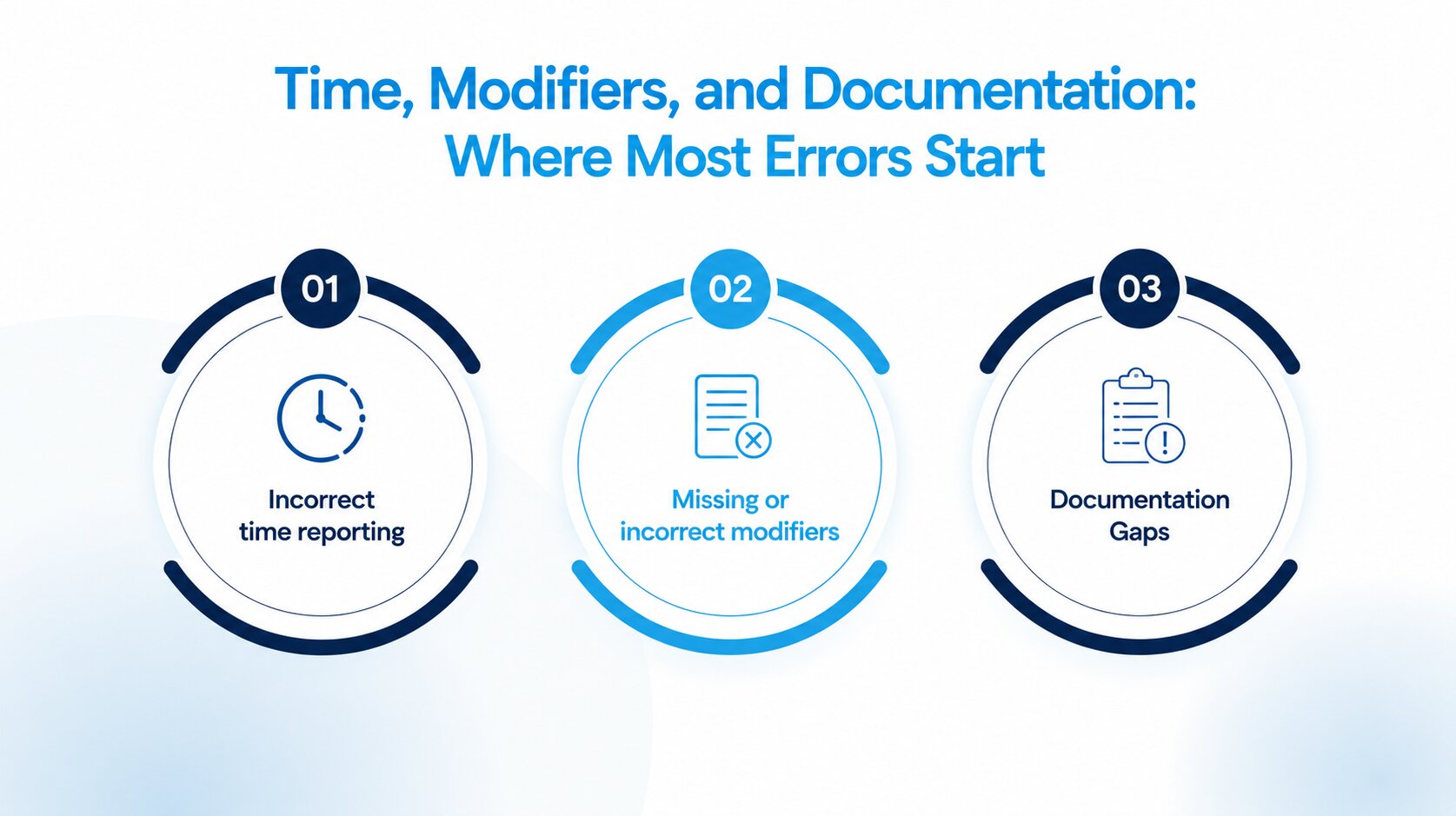
Anesthesia time gets billed in fifteen-minute increments, and a five-minute gap between what happened in the OR and what got charted can shift the unit count enough to change the payment. Interruptions during a case, an unexpected complication, or a second procedure added mid-surgery all need to be captured the moment they happen, not reconstructed afterward from memory.
Modifiers like AA, QK, QX, and QZ tell the payer who provided the care and under what supervision arrangement. Get one wrong, and the claim doesn't just get denied, it can get paid at half the expected rate without triggering an obvious rejection, which means the underpayment can sit unnoticed for months.
Start and stop times, physical status, and the anesthesiologist's attestation all need to line up. A record that's thorough on the clinical side but thin on the billing side still produces a weak claim.
Practices that build these three checks into a pre-submission review catch far more errors than those relying on payer feedback to find them.
Eligibility problems rarely show up where anesthesia teams expect them. The surgeon's office might verify coverage for the procedure itself, but anesthesia coverage, network status, and prior authorization for the anesthesia component specifically can slip through unchecked. When that happens, an anesthesia insurance claim denial often arrives weeks after the case, well past the point where the front desk could have flagged it.
The fix isn't more paperwork. It's timing. Verifying eligibility and any required authorization before the day of surgery, not after, closes most of this gap. Reviewing a professional claims vs institutional claims breakdown also helps billing teams understand why anesthesia, facility, and surgeon claims for the same encounter can hit different authorization rules even though they cover one visit.
Every payer treats anesthesia a little differently, and that variation is where generalist billing teams tend to struggle.
|
Billing factor | Medicare | Commercial payers |
|
Conversion factor | Set annually, split by APM participation status | Negotiated per contract, varies widely |
|
Physical status modifiers | Not separately reimbursed | Often reimbursed as additional units |
|
Concurrency documentation | Strict, seven-factor medical direction standard | Varies by payer, sometimes less rigid |
|
Prior authorization | Rarely required for anesthesia itself | Increasingly required for MAC and certain add-ons |
Layer that variation on top of a billing team stretched across multiple specialties, and coding accuracy naturally slips. Staffing and workflow inefficiencies aren't a separate issue from modifier errors and time-reporting mistakes. They're usually the reason those mistakes happen in the first place. A small internal team juggling anesthesia alongside five other specialties simply doesn't have the bandwidth to track every payer's quirks. That's the practical case for anesthesia medical billing services built specifically around this specialty, where staff aren't splitting attention across unrelated coding rules.
A few operational habits address most of what's covered above. Verify eligibility and authorization before the case, not after. Build a pre-submission checklist that confirms time documentation, modifier selection, and physical status all match the chart. Track denial reasons by category instead of treating each one as isolated, since patterns usually point to one recurring root cause. And when reviewing procedure-level coding, keep a current reference for cpt codes for anesthesia on hand, since mapping the surgical CPT to the correct anesthesia code is a step generalist coders often get wrong. Outsourcing the whole function is also worth weighing here, RCM Matter's breakdown of the advantages of outsourcing anesthesiology billing lays out when that shift tends to pay for itself.
None of the anesthesia billing challenges covered here is unusual or rare. They show up in nearly every practice at some point, and the ones that manage them well tend to share the same habits: verifying early, documenting precisely, and reviewing denial trends instead of just resubmitting and moving on. Anesthesia will likely always carry more billing complexity than most specialties. Whether that complexity turns into lost revenue is mostly a matter of process. Talk to RCM Matter about where your current anesthesia billing workflow has the most room to tighten up.
1. What are the biggest anesthesia billing challenges?
Time reporting, modifier accuracy, and documentation gaps cause most of the trouble, with payer-specific rule variation making each one harder to manage consistently.
2. Why are anesthesia claims denied?
Denials usually trace back to a mismatch between what's charted and what's billed. That's most often a modifier that doesn't match the supervision model, a time calculation that doesn't hold up against the record, or an authorization that wasn't confirmed before the case.
3. How do modifier errors affect reimbursement?
They can cut the payment in half without an outright rejection. That's the part that catches practices off guard. A wrong modifier doesn't always bounce the claim; sometimes it just quietly pays less.
4. How can practices reduce claim denials?
Front-load the verification work. Confirm eligibility and authorization before surgery, review time and modifier accuracy before submission, and track denial patterns by category so the same mistake doesn't repeat every month.
5. What tools improve anesthesia billing accuracy?
Anesthesia information management systems that timestamp cases automatically remove a lot of the guesswork around start and stop times. Beyond software, though, a specialty-trained billing team catches what generic tools miss, particularly around modifier logic and payer-specific documentation standards.
Optimize billing, claims and collections with expert RCM support let our professionals handle the process so you can focus on patient care.