A cardiologist orders a stress echo, a same-day EKG, and a follow-up consult for one patient, all on one visit. The claim comes back three weeks later with two lines denied, one for a missing modifier and one for insufficient documentation of medical necessity. The front desk manager pulls up the note, confirms the physician did everything right clinically, and still has to fight the payer for reimbursement that should have gone through the first time. That scene plays out in cardiology practices every week, and it rarely happens in a family medicine office running the same volume of visits.
The difference isn't staff quality. It's the billing system itself. Cardiology billing vs general medical billing comes down to a handful of structural differences that determine whether a claim gets paid on the first pass or sits in an appeals queue for a month.
Cardiology carries a heavier documentation and coding load than most specialties, and the payer scrutiny that comes with it is not evenly distributed across medicine.
According to the American Medical Association's 2024 prior authorization survey, physicians and their staff complete an average of 39 prior authorization requests per physician each week, consuming roughly 13 hours of administrative time.
Cardiology sits well above that average because of how often its services touch imaging, interventional procedures, and device management, all categories payers flag before they'll approve payment.
General medical billing covers the bulk of primary care and family medicine encounters: office visits, preventive screenings, chronic disease management, and a relatively narrow band of procedures.
The coding is built around evaluation and management (E/M) levels, a handful of common CPT codes, and diagnosis coding that maps cleanly to the visit. A flu visit, a diabetes check-in, and an annual physical all follow a predictable documentation pattern, and payers have seen that pattern so many times that approval is largely mechanical.
General medical billing rewards consistency more than complexity. The same fifteen or twenty CPT codes account for most of a primary care practice's claims volume, and billers who know those codes well can process a high number of claims quickly.
Denials still happen, usually around coding errors, eligibility issues, or missing modifiers, but they tend to be isolated events rather than a structural risk baked into every claim.
That's the baseline. Move into a specialty built around procedures, imaging, and long-term device management, and the entire billing model changes.
Cardiology medical billing service carries more coding density, more modifier logic, and more payer scrutiny than almost any other specialty in outpatient medicine.
A single cardiology visit can generate multiple billable components: an E/M code for the physician's cognitive work, a separate CPT code for a diagnostic test, and in some cases a distinct professional and technical split for the same procedure.
General practices rarely deal with that layering. Cardiology practices deal with it constantly.
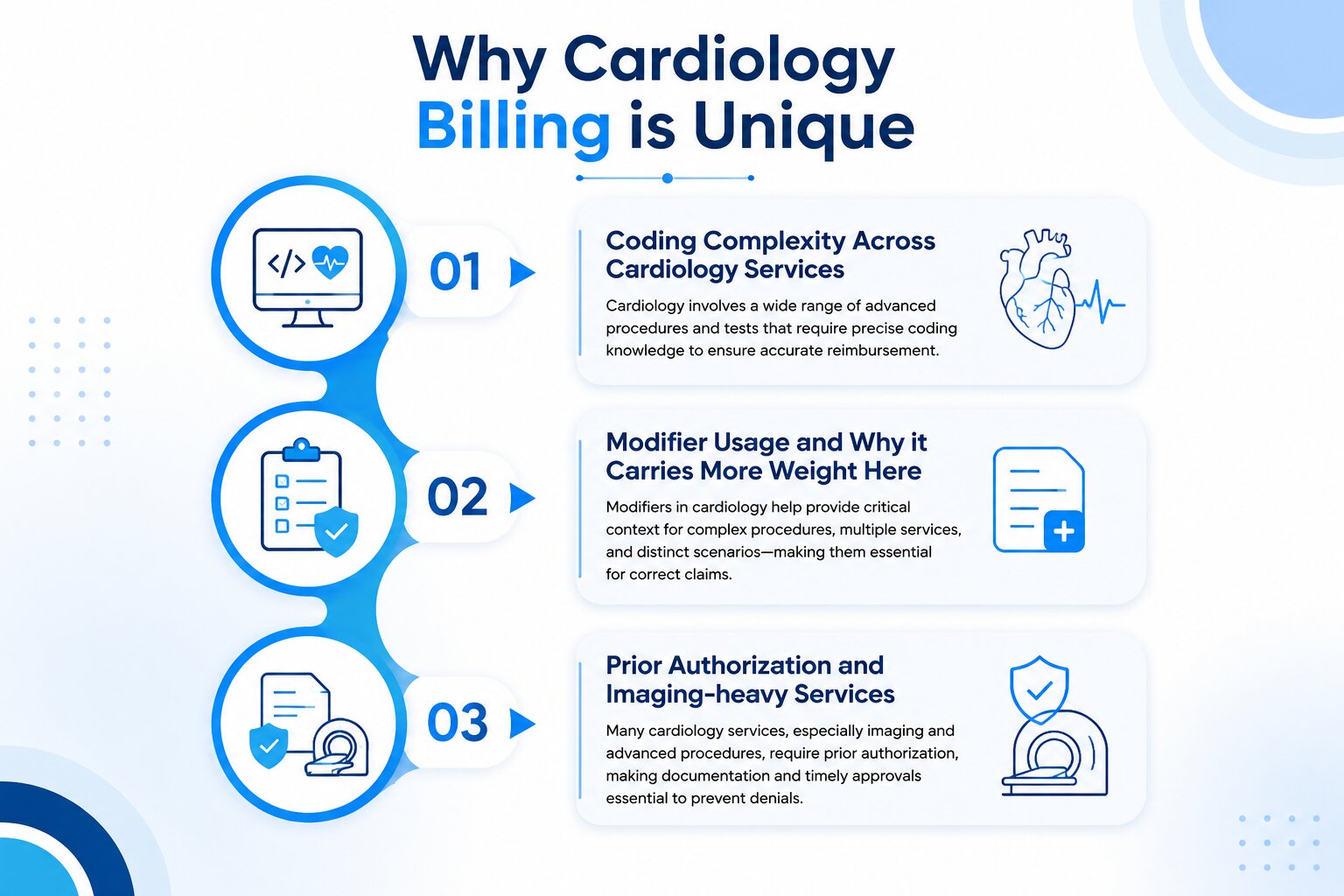
Cardiology CPT codes span diagnostic testing (93000 series for EKGs and stress tests), echocardiography, nuclear cardiology, and interventional procedures like cardiac catheterization and percutaneous coronary intervention.
Each category has its own bundling rules, its own National Correct Coding Initiative edits, and its own documentation expectations.
A biller working a cardiology claim has to know not just which code applies, but which codes are allowed to appear together on the same date of service and which ones payers will automatically bundle unless a modifier justifies separating them.
Modifiers do more work in cardiology than in general practice. Modifier -26 identifies the professional component of a test, -TC identifies the technical component, and -59 or the newer X-series modifiers separate procedures that would otherwise get bundled into a single payment. Leave one off, or apply it to the wrong line, and the claim either underpays or denies outright. General billing uses modifiers too, but rarely with this frequency or this much financial consequence riding on a single two-character code.
Read more; Understanding cardiology modifiers
Advanced cardiac imaging, nuclear stress testing, and elective procedures like ablations routinely require prior authorization before the payer will commit to coverage. That authorization has to match the CPT code submitted, the diagnosis code justifying it, and sometimes a specific date range. A mismatch anywhere in that chain triggers a denial that has nothing to do with whether the care was appropriate. It has everything to do with paperwork alignment.
The clearest way to see the gap is side by side.
|
Factor | General medical billing | Cardiology billing |
|
Types of services | Office visits, preventive care, chronic disease management | E/M visits plus diagnostic testing, imaging, and interventional procedures |
|
Coding complexity | Narrow, repeatable CPT set | Broad CPT range across diagnostics, imaging, and procedures |
|
Modifier usage | Occasional, lower financial impact | Frequent, often determines whether a claim pays at all |
|
Professional vs. technical component billing | Rarely applicable | Common, especially for imaging and diagnostic tests |
|
Documentation requirements | Standard visit notes | Detailed medical necessity documentation tied to each test or procedure |
|
Prior authorization needs | Infrequent | Frequent, especially for imaging and elective procedures |
|
Cardiology Reimbursement risk | Lower per claim, higher volume | Higher per claim, lower volume, more exposure per denial |
Every row on that table points to the same conclusion. General medical billing spreads risk across volume. Cardiology concentrates it into fewer, higher-value claims, which means a single denial carries more weight than it would in a primary care setting.
Diagnostic testing isn't an occasional add-on in cardiology. It's a core part of how cardiologists diagnose and monitor patients, and it shows up on a large share of claims. EKGs, echocardiograms, stress tests, and nuclear imaging studies each carry their own coding rules, and several of them split into professional and technical components depending on who owns the equipment and who interprets the results.
That split matters more than it sounds. A cardiologist reading a stress test performed at a hospital bills only the professional component, using modifier -26, while the hospital bills the technical component for the equipment and staff time.
General practices almost never encounter this distinction because they don't own or interpret imaging equipment at this scale. Get the split wrong, and the claim either pays incorrectly or gets flagged for a payer audit.
Payers ask a harder question of cardiology claims than they ask of most primary care visits: does the documentation actually justify the test or procedure billed? A general office visit for a sore throat rarely triggers a medical necessity review.
A nuclear stress test ordered for a patient with atypical chest pain very often does, and the documentation has to show the clinical reasoning behind the order, not just the result.
This is where a lot of cardiology claims fall apart, and it's rarely because the care was wrong. It's because the note doesn't spell out why the test was medically necessary in language the payer's review criteria recognize.
Grey areas show up here more than providers expect. What counts as sufficient medical necessity documentation can vary by payer, by plan type, and sometimes by the specific test in question, so a note that satisfies one insurer's review criteria might not satisfy another's.
For a more detailed outlook, read a comprehensive guide to cardiology CPT codes.
Picture two visits on the same day. A primary care physician sees a patient for a routine follow-up on blood pressure medication. The visit generates one E/M code, tied to one diagnosis, with documentation that follows a template the practice has used a thousand times. It goes out the door and gets paid without much friction.
Now picture a cardiologist seeing a patient with new-onset palpitations. The visit includes an E/M code for the consult, an EKG performed and interpreted in-office, and a referral for an ambulatory monitor that requires prior authorization before the payer will approve it.
That's three separate billing events tied to one encounter, each with its own coding requirements, and each one capable of denying independently of the others. The primary care visit had one point of failure. The cardiology encounter had three.
A few assumptions keep surfacing in conversations with practice managers, and most of them lead to avoidable denials.
Each of these misconceptions tends to surface after a denial, not before, which is exactly why they cause so much financial damage before anyone notices the pattern.
Cardiology and general medical billing aren't different versions of the same process. They're built around different risks, different documentation standards, and different points where a claim can fail. Cardiology billing vs general medical billing ultimately comes down to concentration: fewer claims, each carrying more coding complexity and more revenue on the line, which means the cost of getting one wrong is far higher than it would be in a general practice setting.
Practices that treat cardiology billing as a specialty in its own right, staffed and trained accordingly, tend to see fewer denials and faster reimbursement. For a closer look at how RCM Matter handles the coding and prior authorization work specific to cardiac care, the cardiology CPT coding guide is a useful next stop.
1. What makes cardiology billing more complex than general medical billing?
It comes down to the volume of coding events per encounter. A single cardiology visit often generates multiple billable components across E/M, diagnostic testing, and sometimes procedures, each with its own rules, while a general visit typically generates one.
2. Why are modifiers used more often in cardiology?
Cardiology relies heavily on diagnostic testing and procedures that get bundled by default. Modifiers like -26, -TC, and -59 tell the payer when two services performed together should actually be paid separately, and cardiology claims hit that scenario far more often than general medical claims do.
3. What is professional versus technical component billing?
It separates the physician's interpretation of a test, the professional component, from the equipment and staff time used to perform it, the technical component. Cardiology imaging studies frequently split this way. Whether both components are billable in a given case depends on who owns the equipment and where the test was performed, and that answer isn't always the same from one payer to the next.
4. Do cardiology procedures require more documentation?
Yes, and the bar is usually higher too. Payers expect the note to justify medical necessity in specific terms, not just record that a test happened, which means the documentation has to do more work than a standard visit note.
5. Can a general medical biller handle cardiology claims?
Not without additional training. A biller who's spent years mastering primary care CPT codes and payer patterns is starting from scratch with cardiology's modifier logic, bundling edits, and prior authorization requirements. It's not a knowledge gap that closes quickly, and treating it as an easy crossover is one of the more expensive assumptions a practice can make.
Optimize billing, claims and collections with expert RCM support let our professionals handle the process so you can focus on patient care.