A mid-sized cardiology group recently pulled its denial report and found something uncomfortable: nearly one in five claims for stress tests and device follow-ups had bounced back before a dollar reached the bank. Prior authorization made the picture worse. Physicians nationwide now complete an average of 43 prior authorizations a week, and that work eats up roughly 12 hours of physician and staff time every seven days, according to the American Medical Association's 2024 Prior Authorization Physician Survey. For cardiology specifically, the sheer volume and complexity of codes make cardiology medical billing challenges harder to solve than a one-size-fits-all denial fix can handle.
Practices that treat cardiology billing like any other specialty tend to lose revenue in places they never think to check.
Every specialty has coding quirks, but cardiology stacks more of them on top of each other than most fields do. A single encounter might involve an E/M visit, an EKG interpretation, a stress test with separate professional and technical components, and a device check, each with its own modifier logic. Cardiology billing requires staff who understand not just CPT codes but how cardiac procedures bundle, unbundle, and interact with National Correct Coding Initiative edits. Cardiology medical billing done well means catching those interactions before the claim ever leaves the office, not after the denial arrives with little explanation of what went wrong.
A cath lab case involving multiple vessels and a same-day diagnostic study can generate five or six line items, and each one needs the right modifier to reflect what actually happened. Get the LC, LD, or RC modifier wrong on a coronary intervention claim, and the payer either denies it outright or pays a fraction of what the work was worth.
Cardiology coding errors rarely show up as one big mistake. They show up as dozens of small ones spread across a month of claims, quietly shaving points off the collection rate.
Ongoing specialty-specific training and a detailed cardiology CPT and modifier reference help close the gap. Claim-editing software that flags mismatched modifiers before submission catches most of what training alone misses.
Cardiologists move fast, and notes sometimes reflect that pace more than a payer's requirements do. A stress test note that skips the testing indication, or an EP study note that doesn't specify which chambers were involved, leaves the biller nothing solid to work from. So the claim goes out with a guess attached, or sits in a queue waiting on clarification.
Standardized documentation templates built around the tests a practice runs most often solve most of this. A short weekly check-in between billing staff and physicians handles the rest, catching recurring documentation gaps before they turn into a pattern across dozens of charts.
Denials in cardiology tend to cluster. A batch of stress test claims gets rejected for missing medical-necessity documentation, then a batch of device checks gets rejected for a bundling edit nobody caught the first time.
Left unexamined, the same root cause keeps generating the same denial month after month, and that repetition is one of the more expensive cardiology medical billing challenges a practice can leave unaddressed.
Root-cause analysis changes the pattern. Sorting denials by payer, by reason code, and by service line shows exactly where the problem lives, and a solid denial management approach catches a recurring issue on the second or third occurrence instead of the twentieth.
Nuclear stress tests, cardiac MRIs, and elective catheterizations almost always require prior authorization, and a missed step here doesn't just delay a claim. It can delay a patient's procedure. Eligibility problems compound things further: a lapsed policy discovered on the day of service turns a scheduled cath lab visit into a billing headache nobody wants mid-appointment.
Front-end verification, completed before the patient sits in the waiting room, prevents most of this. A short authorization checklist tied to each major cardiology procedure, checked at scheduling rather than the morning of, keeps visit limits and renewal windows from slipping past unnoticed.
Medicare's conversion factor dropped again for 2025, and a fresh efficiency adjustment tied to the 2026 fee schedule is already reshaping reimbursement for several high-volume cardiology procedures.
Commercial payers update their own medical policies on a rolling basis, often with little notice, and a rule that applied in January might not apply by summer. It's worth saying plainly that some of this variation never fully settles into a fixed rule; it shifts by payer, plan type, and even by region.
Regular internal audits catch policy drift before it costs real money. A centralized payer policy repository, even a shared document updated as changes come in, keeps the whole billing team working from the same information instead of relying on memory.
A cardiology practice running its EHR and billing software as two disconnected systems ends up re-entering the same patient and procedure data twice, and every re-entry is another chance for a transposed code or a missed modifier.
Older systems also tend to lack live eligibility checks, pushing that verification work onto front-desk staff already juggling a full schedule. Many practices eventually turn to cardiology billing services to streamline these workflows and reduce manual errors.
Integrating the EHR and billing platform, and automating the repetitive parts of claim scrubbing and eligibility checks, removes a surprising amount of friction. Practices that make this shift often notice the change first in medical billing services turnaround time, since claims move through fewer manual touchpoints.
Some practices reach this point and start asking whether an outsourced billing partner makes more sense than rebuilding internal systems from scratch, though that decision depends heavily on practice size and in-house expertise.
|
Challenge | Impact | Recommended solution |
|
Complex coding and modifiers | Underpayment or outright denial on multi-component claims | Specialty coder training, claim-editing tools |
|
Incomplete documentation | Delayed claims, guesswork on code selection | Standardized templates, physician-biller check-ins |
|
Frequent claim denials | Repeated revenue loss from the same root cause | Root-cause analysis, proactive denial tracking |
|
Prior auth and eligibility delays | Delayed procedures, same-day billing scrambles | Front-end verification, authorization checklists |
|
Changing payer and compliance rules | Reimbursement swings, unexpected downcoding | Regular audits, centralized policy repository |
|
Workflow inefficiencies and old systems | Duplicate data entry, slower reimbursement | Integrated EHR-billing systems, automation |
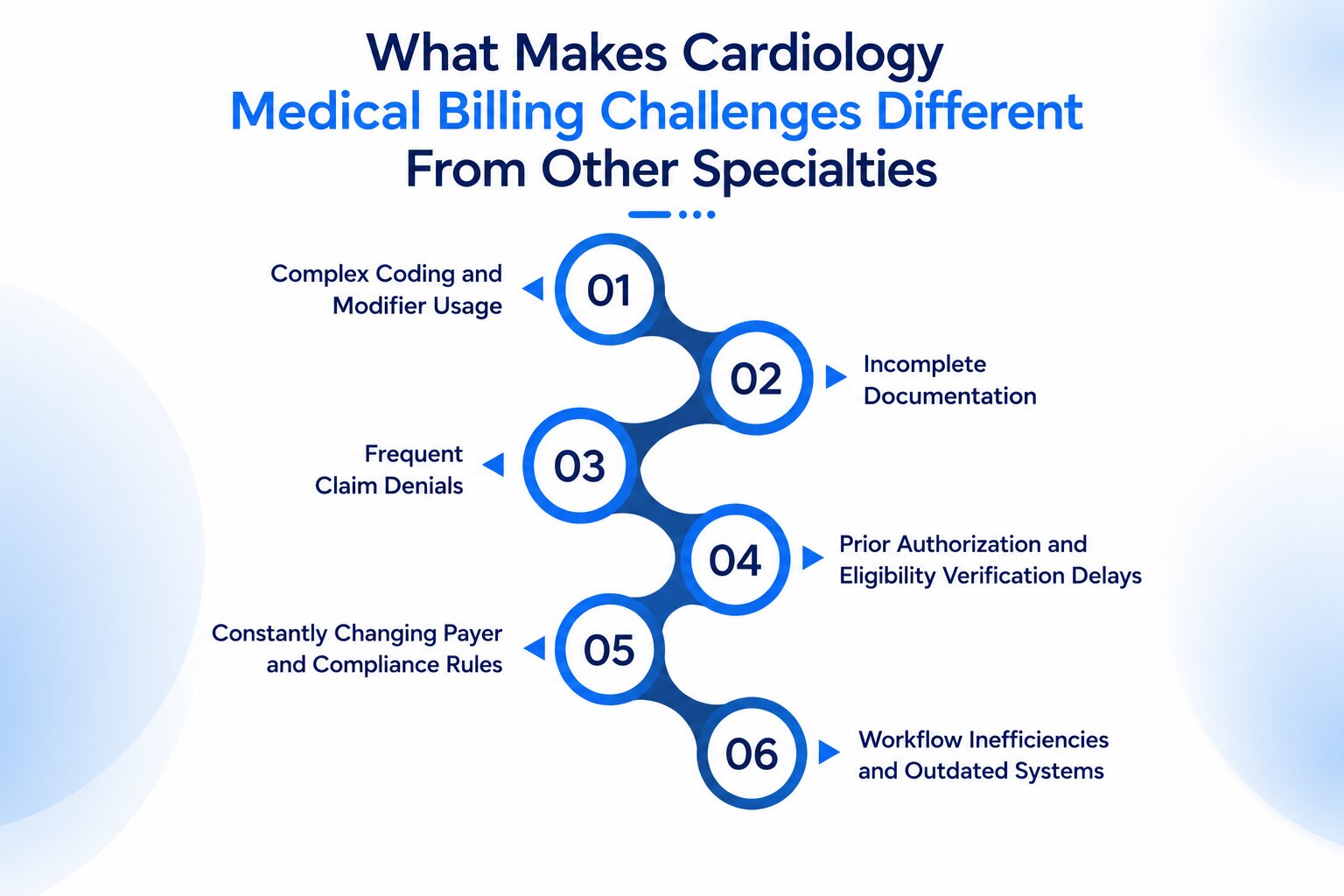
Preventing repeat problems generally costs a practice time rather than money, and the list below reflects where that time pays off fastest.
Specialty-specific coder training: General medical coding and billing knowledge only covers so much ground in cardiology. Coders trained specifically on cardiac procedures catch modifier and bundling issues a generalist would miss.
Monthly payer policy reviews: Rules change quietly. A short monthly review of payer bulletins keeps a practice ahead of updates instead of learning about them through a denial.
Pre-service verification for costly procedures: Confirming authorization and eligibility before the appointment, not the morning of, prevents same-day scrambling.
Denial tracking by root cause: Categorizing denials by payer and reason code turns scattered rejections into a pattern the team can act on.
Periodic internal audits: A quarterly review of even a small claims sample tends to surface issues long before a full external audit would, helping medical billing services teams identify recurring errors before they affect reimbursement.
None of the six problems covered here belong to any one cardiology practice. They show up in nearly every group that bills for cardiac procedures, and they compound each other: a documentation gap causes a denial, the denial takes staff time to appeal, and that time gets pulled from the front-end verification work that would have prevented the next one.
Addressing cardiology medical billing challenges one at a time, starting with whichever pattern shows up most often in last month's denial report, tends to produce results faster than trying to fix everything at once. RCM Matter's cardiology billing team usually starts there too, pulling the last quarter's denial data before touching anything else, since that single report tends to point straight at whichever problem is costing a practice the most.
1. Why are cardiology claims denied so often?
Cardiology procedures involve more moving parts than most specialties, from multiple components on a single stress test to strict medical-necessity documentation for imaging. When any one piece is off, whether it's a modifier, a diagnosis code, or missing documentation, the claim gets rejected.
2. Which cardiology services require the most documentation?
Nuclear stress tests and cardiac MRIs top the list. Payers want a clear indication for the test and a specific enough diagnosis to support medical necessity. Vague notes on these two services cause more denials than almost anything else in a cardiology chart.
3. How can practices reduce modifier-related errors?
There's no single fix that eliminates modifier errors completely, and that's worth saying plainly. Payer interpretation of the same modifier varies, and what one commercial plan accepts, another might deny. Ongoing coder training paired with claim-editing software catches most errors before they turn into denials. It won't get a practice to zero, but it gets close.
4. Why is prior authorization critical in cardiology?
Because so many cardiology procedures, especially imaging and elective catheterizations, simply won't get paid without it. Skipping this step doesn't just risk a denial. It can delay a patient's procedure entirely.
5. How often should cardiology billing audits be performed?
Quarterly works well for most practices, though those with higher claim volume or a recent uptick in denials benefit from a monthly spot-check instead. The exact frequency matters less than consistency, since a practice that audits without fail catches more over a year than one that audits only when something seems wrong.
Optimize billing, claims and collections with expert RCM support let our professionals handle the process so you can focus on patient care.