Claim scrubbing in medical billing is the automated or manual review of a healthcare claim for errors, missing data, and compliance issues before it is submitted to an insurance company. It aims to achieve a "clean claim" to prevent rejections, speed up reimbursements, and avoid costly rework.
Scrubbing isn't a single check. It happens in layers, at more than one point, before a claim reaches a payer.
The process starts inside your EHR or practice management system (PMS). As a claim is built from clinical notes, the system checks it against a set of pre-loaded rules. Those rules cover coding guidelines, national and local coverage policies, and any payer-specific requirements your team has configured. Any problem found gets flagged for correction before the claim moves forward.
Once the internal check clears, the claim travels to a clearinghouse. Think of the clearinghouse as an electronic middleman between your practice and payers. It runs a second round of checks for formatting, HIPAA requirements, and its own payer-rule library. Claims that pass go to the payer. Claims that don't come back with error codes that tell your team exactly what went wrong.
These two outcomes happen at different points in the process. A rejection happens before the payer sees the claim. The data or format failed before adjudication (the payer's internal review), so the claim never entered their system at all. A denial happens after the payer receives and reviews the claim, then refuses to pay.
A well-configured billing scrubber handles both. It catches format and data errors that cause rejections, but it also spots upstream issues that lead to downstream denials, such as missing authorization numbers or procedure codes that don't match the diagnosis.
Read more; What is authorization in medical billing
Worth noting: most practices track payer denials closely but miss clearinghouse rejections entirely. Those rejections are logged separately, go unresolved longer than they should, and quietly drain revenue over time.
Every claim passes through dozens of data-point checks before it moves forward. Common checks include:
Patient name, date of birth, and insurance subscriber ID
Provider NPI (National Provider Identifier) and taxonomy code
Place of service code
ICD-10 diagnosis codes and CPT procedure codes
Modifier use and whether it fits the procedure billed
Procedure-to-diagnosis pairing
Prior authorization status
Duplicate claim detection
Timely filing deadline compliance
Some scrubbers also validate age-specific and gender-specific code rules, along with service frequency limits that individual payers set.
Errors that cause rejections and denials fall into three groups: demographic, coding, and compliance. Each type creates a different problem when it slips through undetected.
A 2024 MGMA benchmarking report found that 60% of medical group leaders reported rising denial rates compared to the prior year. Three of the four most common denial causes happen at the front end of the revenue cycle, exactly where a claims scrubber is built to step in.
That number reflects a pattern most billing teams already feel. The majority of denials don't come from complex clinical disputes or gray-area coverage decisions. They come from fixable errors that leave your system before anyone catches them.
Where your scrubber sits in the workflow determines how much value it actually delivers.
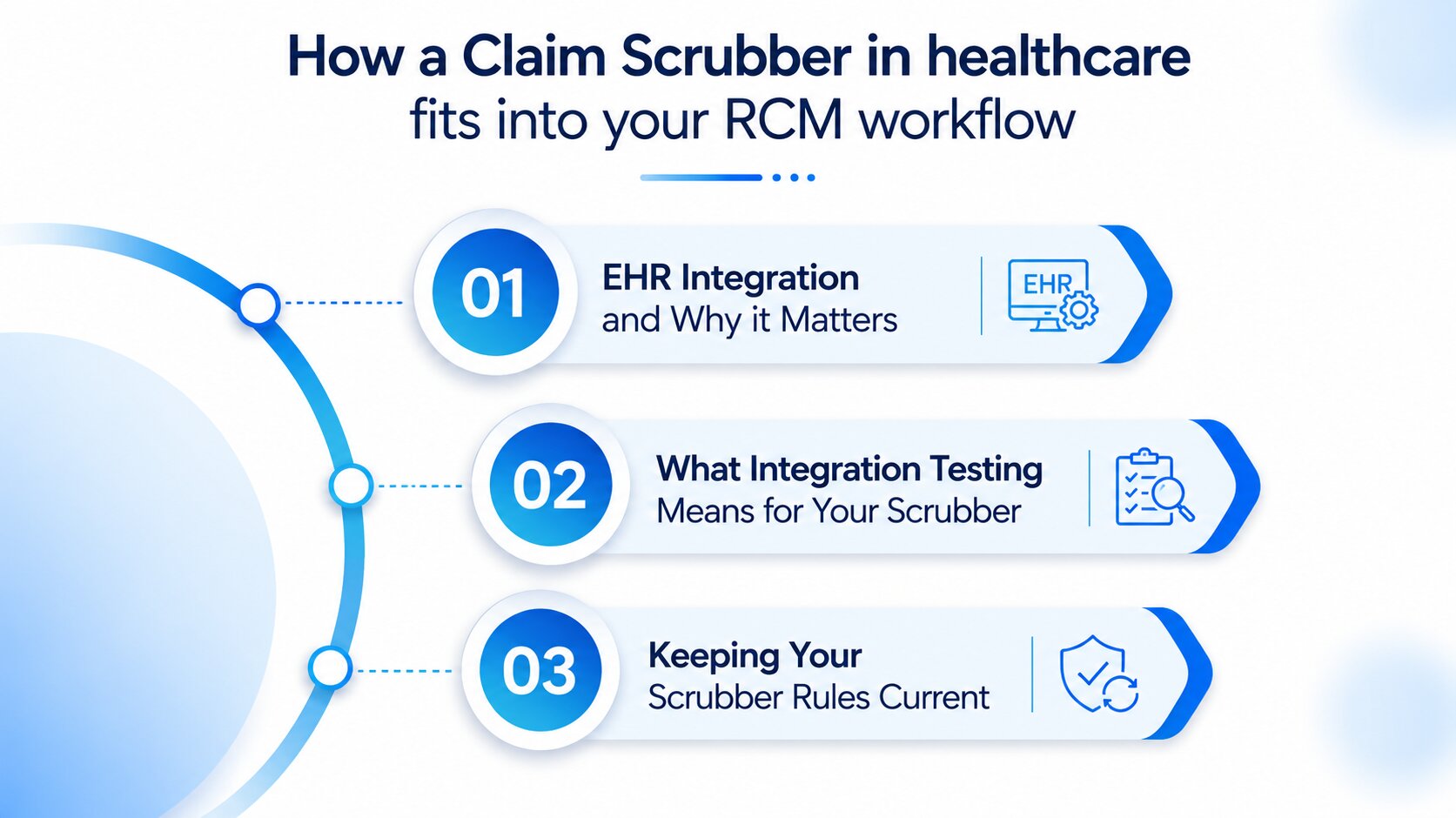
A scrubber that runs only after a claim is fully built is useful, but it's catching problems late. Errors found after coding is complete cost more time to fix than errors caught during documentation. Scrubbers built directly into your EHR or PMS can surface issues before a biller ever touches the claim. That's a meaningful difference in both speed and staff effort.
When a scrubber doesn't connect cleanly with your EHR, clearinghouse, and billing platform, data gaps appear. Edits get bypassed. Claims that pass the internal check can still fail at the clearinghouse because the systems feeding the scrubber weren't passing complete data. That gap shows up directly in your denial rate.
When your practice switches EHR platforms, upgrades billing software, or moves to a different clearinghouse, your scrubber needs to be tested alongside those changes. Integration testing checks that claim data maps correctly between systems, that payer-specific edits load properly, and that error flags trigger when they're supposed to.
Practices that skip this step often see a spike in clearinghouse rejections in the first billing cycle after a system change. The scrubber is still running, but it's receiving incomplete or incorrectly structured data from the systems it depends on. That's a fixable problem, once your team knows to look for it.
Payer rules change frequently, and not all scrubber vendors update at the same pace. Some push rule updates every three to four weeks. Others leave that responsibility to the practice.
Ask your vendor directly how often their rules refresh and which payers are covered. A scrubber running on outdated rules will pass claims that today's payer requirements would catch. How much this affects your practice depends on your payer mix and vendor, and it genuinely varies.
A failed scrub isn't a dead end. It's an instruction.
When a claim fails, the scrubber generates an error code that tells your team what went wrong and what needs to change. Most platforms sort these by severity. High-severity errors, like a missing NPI or an expired authorization, block the claim until the issue is fixed. Lower-severity warnings usually need a human review, but don't always stop the claim from moving forward.
Read more; Clean claim submission process in medical billing
Speed matters here. Timely filing limits vary by payer. Medicare typically allows 12 months from the date of service. Many commercial payers set limits between 90 and 120 days. A growing backlog of flagged, unresolved claims quietly reduces what you can collect. Once a claim ages past its filing window, the revenue from that service is gone, regardless of how valid the visit was.
The main metric is your clean claim rate (CCR). The Healthcare Financial Management Association (HFMA) defines it as the number of claims that pass all checks without manual intervention, divided by the total number of claims accepted into the billing system. The accepted benchmark is 90% or above.
Your clean claim rate alone won't show you where the gaps are. To get a full picture, track these three alongside it every month:
Clearinghouse rejection rate by error type, shows which specific problems are slipping through your internal check
Average days to resolve flagged claims, reveals how quickly your team acts once the scrubber flags an issue
First-pass resolution rate by payer, highlights payers where your rules configuration needs attention
These three numbers together tell you far more about scrubbing performance than the CCR alone.
A denial that reaches a payer is already expensive. One that didn't need to happen is the cost you're trying to prevent. Claim scrubbing in medical billing is where that prevention starts, and its value depends entirely on how well it's configured, integrated, and maintained.
If your clean claim rate is below 90%, or if your practice recently changed billing systems without testing your scrubber alongside those changes, those are two specific places worth reviewing with your billing team or RCM partner.
Track your clean claim rate monthly, and don't look at it without your clearinghouse rejection data beside it because that’s exactly where preventable revenue loss hides, and where RCM Matter focuses its work.
They align scrubber logic with real denial trends instead of static rule sets, so edits reflect what payers are actually rejecting, not what outdated configurations assume.
What is the claim scrubbing process in medical billing?
Claim scrubbing in medical billing is the pre-submission process that checks a claim for errors before it goes to a payer. It reviews coding accuracy, patient demographics, authorization status, and payer-specific requirements.
What's the difference between a claim rejection and a denial?
A rejection means the claim never reached the payer's system because of a data or format error caught at the clearinghouse. A denial means the payer received and reviewed the claim, then chose not to pay. Scrubbing prevents both, but rejections are caught earlier in the process.
Before a claim goes out, what does the scrubber actually look at?
Scrubbers check patient demographics, insurance information, provider credentials, diagnosis and procedure codes, modifiers, place of service, authorization status, and timely filing deadlines. Some also validate age-specific and gender-specific code rules along with service frequency limits set by individual payers.
How often should scrubbing rules be updated?
It depends on your vendor and payer mix. Rules should be refreshed whenever CMS updates coding guidelines, when coverage policies change, or when a payer revises its requirements. Some platforms push updates every three to four weeks.
What does integration testing have to do with claim scrubbing?
When your practice changes billing systems or platforms, integration testing verifies that your scrubber is still receiving accurate, complete data from your EHR, PMS, and clearinghouse. Without it, scrubbers can appear to run correctly while missing errors because the data feeding them isn't structured correctly.
Optimize billing, claims and collections with expert RCM support let our professionals handle the process so you can focus on patient care.