There is no official U.S. fee schedule for outsourced medical billing. Current vendor pricing guides reviewed in October 2026 commonly publish percentage fees of about 4%-10% of collections and per-claim fees of about $3-$12. Published flat monthly prices vary even more widely, from roughly $500 to $6,000 or more. These figures are market signals from service providers, not independent national averages.
The number that matters is the total annual cost for the same scope of work. When comparing medical billing services, define which payments the rate applies to, which tasks are included, which expenses are passed through, and which work remains with your staff. A lower headline price can cost more if denial appeals, patient statements, old A/R, or system fees sit outside the agreement.
Percentage pricing is usually quoted against a defined collection base, but contracts differ on patient payments, old A/R, refunds, recoupments, and payments received after termination.
Per-claim pricing is predictable only when the contract defines a billable claim and addresses corrected, secondary, voided, rejected, and resubmitted claims.
Flat, hybrid, and dedicated-resource arrangements can improve budget predictability, but volume bands, minimums, overtime, and add-on work still need to be priced.
Compare annual total cost, retained internal work, and performance terms. Do not compare a full-service quote with a claim-submission-only quote.
The following ranges summarize figures published by current vendor pricing guides. Medical Billers and Coders lists 4%-10% of monthly collections and $4-$12 per claim. OmniMD lists 4%-9%, $3-$12 per claim, and $500-$2,500+ per month. Other current pages publish different flat-fee ceilings, which is one reason to treat these figures as orientation rather than a benchmark.
For historical context, a 2023 Tebra/Kareo survey of medical billing companies reported that nearly half of respondents using percentage pricing charged between 5% and 7%. Because the report is older and industry-produced, it should not be treated as a current universal rate.
|
Pricing model |
Published market context |
May fit when |
Main question |
|---|---|---|---|
|
Percentage of collections |
About 4%-10% in current vendor guides |
Practices wanting the fee to move with collected revenue |
The collection base and excluded work may change the real rate |
|
Per claim |
About $3-$12 in current vendor guides |
Predictable claim volume and clearly defined follow-up scope |
Vendor may be paid for submission even when the claim is unpaid |
|
Flat monthly fee |
Published figures range from about $500 to $6,000+ |
Stable volume and a tightly defined service package |
Overages, service tiers, and annual resets can change the cost |
|
Hybrid or minimum |
Custom base fee plus a percentage or usage charge |
Growing or seasonal practices |
The practice may pay overlapping fees without clear thresholds |
|
Hourly, project, or dedicated resource |
Custom |
Old-A/R cleanup, audits, temporary support, or purchased capacity |
Cost depends on hours, productivity, supervision, and deliverables |
RCM Matter currently states that pricing plans start as low as 2.99% of monthly revenue. That is a starting price, not a universal quote. Confirm what "monthly revenue" means in the agreement, which services are included, and what conditions apply. The figure was verified on the RCM Matter website on October 16, 2026.
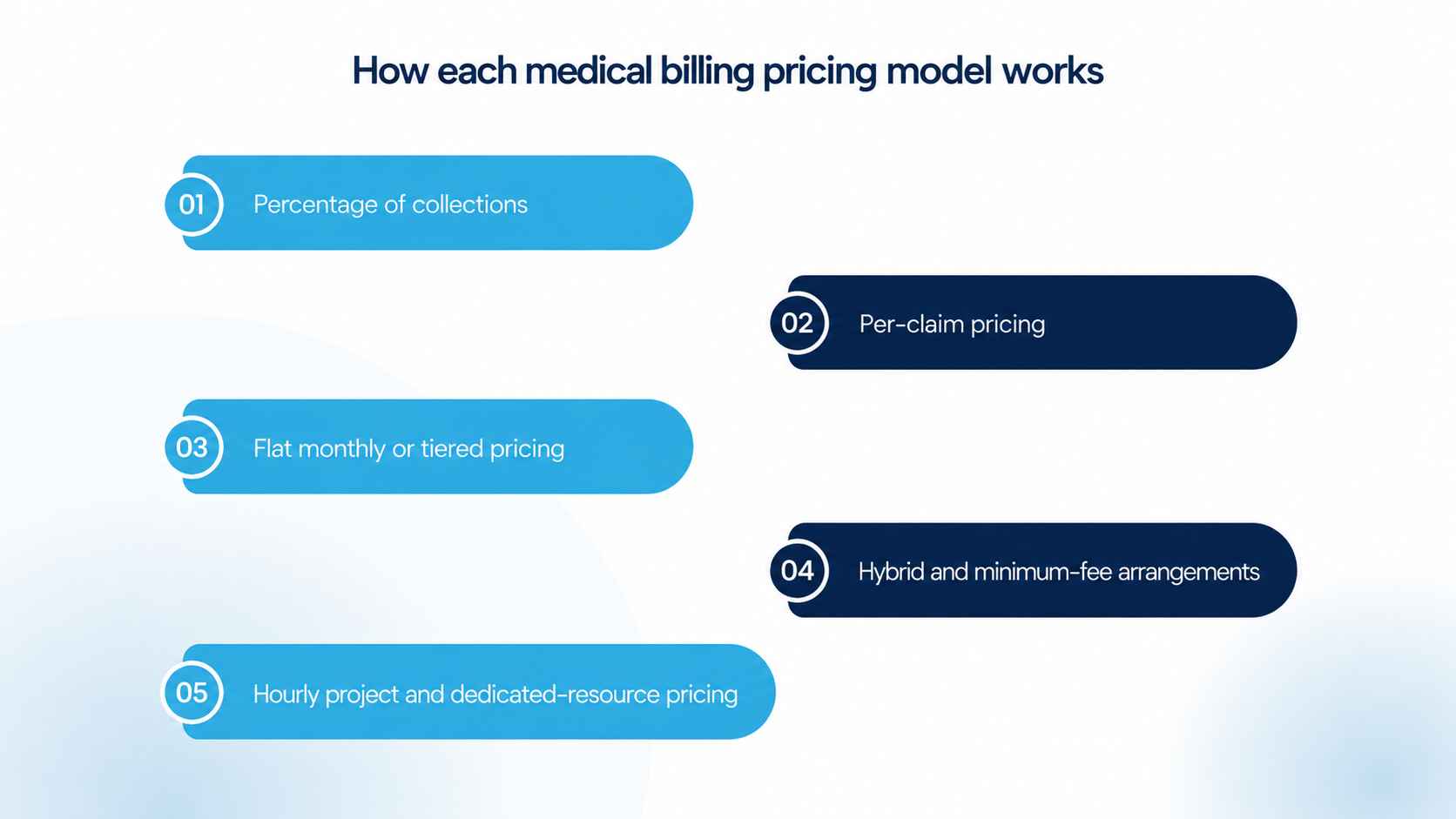
The billing company charges an agreed percentage of a defined pool of payments. If the contract uses 6% and the practice receives $75,000 in eligible collections for the month, the base fee is $4,500. The calculation is simple; the definition of eligible collections is not.
Before signing, confirm whether the percentage applies to:
insurance payments only or insurance plus patient payments;
cash received for claims the vendor submitted or every payment posted during the month;
old A/R collected after onboarding;
secondary and tertiary payments;
capitation, value-based payments, grants, drug revenue, or other non-claim revenue;
payments later reduced by refunds, payer takebacks, chargebacks, or recoupments; and
payments received after the contract ends.
A percentage of charges is different from a percentage of collections. Charges are the amounts billed before contractual adjustments and payment. If a proposal uses charges as the denominator, model the dollar result carefully and have the compensation terms reviewed before accepting them.
Per-claim pricing charges a fixed amount for each billable claim. It can work well when monthly volume and claim complexity are consistent, but only if the agreement explains what counts as one claim.
Ask whether the vendor charges again for corrected claims, replacements, voids, secondary claims, paper claims, rejected transactions, or resubmissions. Also confirm whether the price includes payment posting, payer follow-up, and appeals. A submission-only price and an end-to-end price are not comparable.
A flat monthly fee can make budgeting easier. The fee may cover a certain number of providers, locations, claims, users, or work queues. Once the practice crosses a band, an overage or higher tier may apply.
Request pricing for a typical month, a slow month, and a high-volume month. Confirm whether the fee is reset annually and whether adding a provider, location, payer, or specialty changes the price.
A hybrid arrangement combines a base fee with a reduced percentage or usage charge. A monthly minimum can also apply to a percentage contract. These models may give the vendor baseline coverage while keeping some fees variable, but the practice should calculate the effective rate at low, expected, and high collection levels.
Hourly or project pricing is more common for a defined backlog, audit, migration, credentialing assignment, or temporary staffing need than for ongoing billing. Dedicated-resource pricing buys a specified amount of staff capacity. Define the deliverables, supervision, productivity measures, hours, handoffs, and work that falls outside the assignment.
Scope: Claim submission alone requires less work than eligibility, coding, charge entry, payment posting, denial resolution, A/R follow-up, patient billing, and reporting.
Specialty and setting: Behavioral health, surgery, anesthesia, radiology, therapy, DME, and facility billing have different documentation, coding, authorization, claim, and follow-up workflows.
Volume and locations: More claims can create volume efficiency, but multiple providers, tax IDs, locations, and clearinghouse routes also add configuration and reporting work.
Payer and patient mix: Commercial plans, Medicare, Medicaid, workers compensation, secondary coverage, and higher patient responsibility create different follow-up demands.
Current A/R condition: A backlog of denials, unposted remittances, credit balances, enrollment issues, or aged claims can require a separate cleanup project.
Technology: EHR and practice management access, clearinghouse enrollment, interfaces, data conversion, custom reports, and vendor-required software can affect setup and recurring fees.
Service levels: Dedicated account management, shorter response targets, custom dashboards, extended support hours, and specialty review may affect price.
There is no universal bundle. Use the service agreement to assign each workstream to the practice or vendor and mark it as included, excluded, or separately priced.
|
Workstream |
Questions to resolve before comparing price |
|---|---|
|
Eligibility and registration |
Who corrects failed eligibility, demographic errors, coordination-of-benefits issues, and missing referrals? |
|
Coding and charge entry |
Are coding, chart review, charge capture, documentation queries, and edits included? Review the scope of medical coding services. |
|
Claim submission |
Does the fee include claim creation, scrubbing, clearinghouse submission, rejection correction, and proof of timely filing? |
|
Payment posting |
Are electronic remittance advice, explanation-of-benefits, patient payments, denials, adjustments, and reconciliation included? |
|
Denials and appeals |
Which denial categories, appeal levels, records, letters, payer calls, and root-cause reports are included? |
|
A/R follow-up |
Who owns unpaid claims by age, balance, payer, provider, location, and date of service? |
|
Patient billing |
Are statements, portal notices, calls, payment plans, refunds, and collection-agency handoffs included? |
|
Reporting and governance |
Which reports, definitions, meeting cadence, action logs, and escalation paths are included? |
For scope detail, review RCM Matter's medical coding services, denial management, and accounts receivable follow-up pages. A quote should state whether these workstreams are included in the base fee or contracted separately.
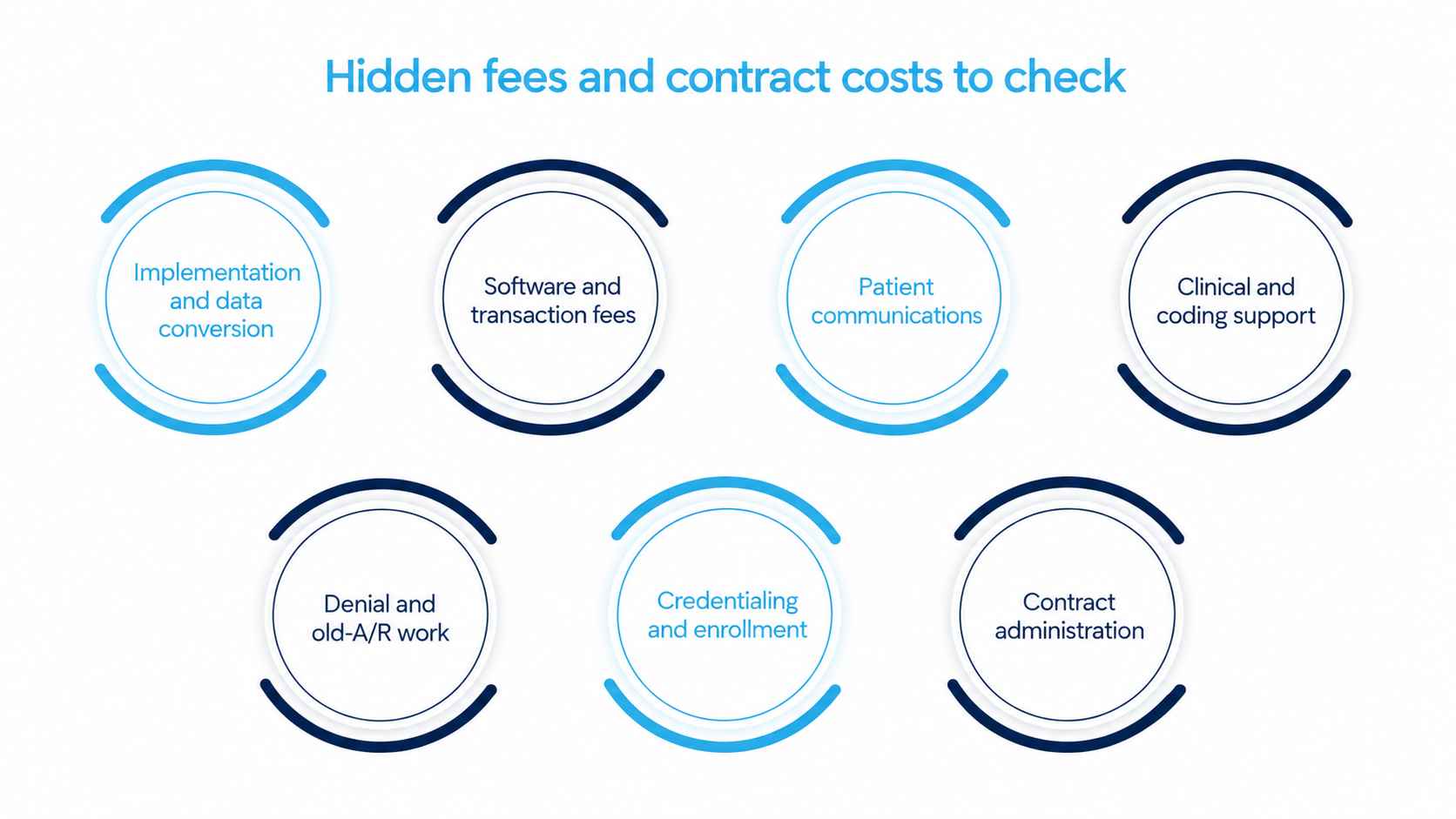


Implementation and data conversion: Account setup, file cleanup, interface work, clearinghouse enrollment, and historical data migration.
Software and transaction fees: Practice management licenses, clearinghouse charges, eligibility transactions, electronic remittance, attachments, and claim status queries.
Patient communications: Paper statements, postage, text messages, payment processing, returned mail, and call-center support.
Clinical and coding support: Coding, chart review, documentation queries, prior authorization, and specialty review.
Denial and old-A/R work: Appeals, records retrieval, external reviews, recovery of balances created before the start date, and work after termination.
Credentialing and enrollment: Applications, revalidation, roster work, electronic funds transfer, and electronic remittance enrollment.
Contract administration: Monthly minimums, volume overages, annual escalation, early termination, transition assistance, data export, and record retention.
Ask each vendor for a sample invoice, a complete fee schedule, and a written example using your actual monthly data. The invoice should reconcile back to the agreement without requiring assumptions.
Define the same scope. Use one list of workstreams for every vendor.
Choose a representative period. Use at least several months of collections and claim counts so seasonal variation is visible.
Calculate the base fee. Apply each percentage, per-claim rate, flat amount, or hybrid formula to the same data.
Add recurring extras. Include software, clearinghouse, statements, coding, appeal, and transaction charges.
Annualize one-time expenses. Spread setup, conversion, and migration costs over the contract term for comparison.
Price retained internal work. Include staff time for authorizations, documentation queries, patient calls, reporting, oversight, or other work the vendor does not own.
Calculate an effective billing cost rate. Divide the total annual billing cost by annual cash collections and multiply by 100. Use the same denominator for every option.
Assume a hypothetical practice has $75,000 in eligible monthly collections and 650 initial claims per month. The following example compares only the base fee. It is not a quote or a prediction.
|
Illustrative option |
Monthly calculation |
Monthly base |
Annual base |
Base fee / collections |
|---|---|---|---|---|
|
6% of eligible collections |
$75,000 x 6% |
$4,500 |
$54,000 |
6.0% |
|
$6 per initial claim |
650 x $6 |
$3,900 |
$46,800 |
5.2% |
|
$4,200 flat monthly fee |
Fixed |
$4,200 |
$50,400 |
5.6% |
The per-claim option appears least expensive at the base rate. If it excludes $600 per month of appeal, statement, or software charges that are included in the other proposals, its annual total rises to $54,000, the same as the 6% option. If staff must also keep working denials or patient calls, add that retained cost before deciding.
Neither model is automatically less expensive. The U.S. Bureau of Labor Statistics reported a May 2025 median annual wage of $51,140 for medical records specialists. That is a broad occupational benchmark, not a medical biller salary quote, and it does not include payroll taxes, benefits, recruiting, supervision, software, or absence coverage.
|
Cost area |
In-house billing |
Outsourced billing |
|---|---|---|
|
Labor |
Salaries, overtime, payroll taxes, benefits, paid leave, recruiting, turnover, and backup coverage |
Usually embedded in the service fee, subject to scope and minimums |
|
Technology |
EHR/PM access, billing software, clearinghouse, eligibility, statement, payment, and reporting tools |
May be included, passed through, or separately licensed |
|
Management |
Hiring, training, quality review, payer escalation, compliance oversight, and performance reporting |
Vendor manages contracted staff; practice still owns vendor oversight and clinical decisions |
|
Workload risk |
Absence, turnover, volume spikes, new locations, and specialty growth require internal capacity |
Capacity depends on the vendor contract, staffing model, and escalation process |
|
Control and access |
Direct day-to-day control and internal knowledge |
Requires defined communication, system access, data ownership, and transition rights |
For a deeper operational comparison, read in-house vs. outsourced medical billing. Use your own staffing, software, collections, and workload data rather than a generic break-even threshold.
What exact dollars or claims form the billing-fee base?
Are patient payments, old A/R, secondary claims, refunds, recoupments, and post-termination payments included?
What is the minimum monthly fee, and at what volume does it exceed the stated percentage?
Which services are included, excluded, passed through, or available only at another tier?
How are rejections, corrected claims, resubmissions, replacements, voids, and appeals billed?
Who owns unresolved A/R when the relationship starts and when it ends?
Which EHR, practice management, clearinghouse, reporting, and data-conversion costs apply?
What reports will the practice receive, how often, and with what definitions?
What response, submission, posting, follow-up, and escalation expectations are documented?
Who can authorize adjustments, refunds, write-offs, collection-agency placement, and patient payment plans?
What are the contract term, renewal, price-escalation, termination, data-export, and transition-assistance provisions?
What security safeguards, incident duties, subcontractor controls, and business associate agreement terms apply?
The U.S. Department of Health and Human Services identifies billing and claims processing as examples of business associate activities involving protected health information. A covered entity generally needs a written business associate contract or other arrangement that defines permitted uses and requires appropriate safeguards. Have the agreement reviewed by the practice's compliance and legal advisers; this article is not legal advice.
Price should be considered alongside service quality, but vendor metrics are meaningful only when both parties use the same definitions, denominator, data source, exclusions, and reporting period. Establish a baseline before transition and compare like periods after onboarding.
Claim acceptance or rejection: Track which claims pass clearinghouse and payer front-end edits, who corrects failures, and how quickly.
Denial rate and root cause: Separate denied claims from rejected claims and report by reason, payer, provider, location, and service line.
Days in A/R and aging: Review total A/R and aged balances by insurance and patient responsibility, not one blended number.
Net collection rate: Document contractual adjustments and exclude amounts the practice was not entitled to collect.
Posting and follow-up lag: Measure the time from receipt to posting and the time from an unpaid status to the next documented action.
Adjustment and write-off control: Require transparent reason codes, approval rules, and audit access.
Communication: Track open issues, response times, owners, due dates, and escalation outcomes.
Do not accept guaranteed collection, denial, or reimbursement outcomes. Performance depends on documentation, coding, patient access, payer behavior, enrollment status, contract terms, and work completed by both the practice and vendor.
|
Practice situation |
Models to evaluate |
Decision focus |
|---|---|---|
|
New or seasonal practice |
Percentage or hybrid with a clear minimum |
Model slow and high-volume months; confirm whether the minimum changes the effective rate. |
|
Stable low-volume practice |
Flat monthly or per claim |
Define volume bands and make sure follow-up work is included. |
|
Growing multi-provider group |
Percentage, tiered flat, hybrid, or dedicated capacity |
Price new providers and locations in advance; require consistent reporting. |
|
Complex specialty or facility billing |
Scope-based percentage, flat, or dedicated team |
Compare coding, authorization, documentation, payer, and appeal responsibilities in detail. |
|
Old-A/R recovery project |
Project, hourly, or separate recovery terms |
Define account inventory, start and end dates, exclusions, documentation, and post-termination collections. |
|
Strong in-house operation |
Keep in-house or use targeted support |
Compare the cost of a specific gap with full outsourcing rather than assuming a complete transition is necessary. |
RCM Matter, a trusted revenue cycle management company publishes support for medical billing, medical coding, payment posting, denial management, A/R follow-up, credentialing, eligibility, and related revenue cycle work. Its website states that plans start as low as 2.99% of monthly revenue, while the medical billing service page describes customized reporting, technology integration, and dedicated management.
Use the same evaluation standard you would use for any vendor. Ask RCM Matter to define the fee base, included workstreams, setup and pass-through charges, performance-report definitions, internal responsibilities, and transition terms in writing. A practice-specific quote is the only reliable way to determine the actual cost.
A medical billing proposal is useful only when the practice can trace the invoice back to a defined fee base and confirm who owns each revenue cycle task. Start with actual collections, claim volume, payer mix, A/R condition, staffing cost, and system expenses. Then compare every vendor against the same service list and contract assumptions.
The best option may be percentage-based, per claim, flat fee, hybrid, or targeted support. The decision should reflect total annual cost, operational fit, reporting visibility, data and transition protections, and the vendor's ability to perform the agreed work. RCM Matter can provide a customized quote based on the practice's specialty, volume, systems, and required scope.
What percentage do medical billing companies charge?
Current vendor pricing guides commonly publish about 4%-10% of collections, but there is no official national rate. Confirm the exact collection base, monthly minimum, included services, and additional fees before comparing percentages.
How much do medical billing companies charge per claim?
Current vendor guides commonly publish about $3-$12 per claim. Ask what counts as a billable claim and whether rejected, corrected, secondary, replacement, voided, and resubmitted claims create additional charges.
Is a flat fee better than a percentage of collections?
Neither is always better. A flat fee can improve budget predictability, while a percentage fee moves with the defined collection base. Model both options with the same scope at low, expected, and high volume.
What is usually excluded from medical billing fees?
Commonly separate items may include credentialing, prior authorization, coding, patient statements, clearinghouse charges, software, complex appeals, old-A/R recovery, data conversion, and transition work. Exclusions vary by contract.
Is outsourced medical billing cheaper than hiring an in-house biller?
It can be, but the answer depends on staffing, benefits, management, software, claim volume, retained work, and performance. Compare the fully loaded annual cost of each option using the same collection period.
What should a practice ask for before signing?
Request a complete service matrix, fee schedule, sample invoice, data-based cost example, reporting definitions, service expectations, security and business associate terms, renewal and termination language, and a plan for unresolved A/R and data export.
Optimize billing, claims and collections with expert RCM support let our professionals handle the process so you can focus on patient care.