Diabetes touches nearly every specialty a billing team works with, from primary care to nephrology to ophthalmology. It's also one of the most frequently miscoded diagnosis groups in outpatient medicine. Practices routinely leave revenue on the table by defaulting to E11.9, the "no complications" code, even when the chart clearly documents neuropathy, kidney disease, or retinopathy. Others get denials from the opposite mistake: pairing a complication code with the wrong companion code, or skipping the underlying-cause sequencing that E08 and E09 require.
This guide walks through the diagnosis codes, the newly added remission code for FY2026, the billing codes for the diabetes education and monitoring services practices actually get paid for, and the documentation gaps that trigger denials or leave HCC risk scores understated.
It's built to work two ways: read start to finish if you're newer to diabetes coding, or jump straight to the section you need if you're already fluent in E-codes and just need the FY2026 updates or the billing codes. Every code is followed by what has to be documented before you're allowed to use it.
ICD-10-CM splits diabetes into five category codes, plus a separate obstetric category for pregnancy. The category you choose depends entirely on what caused the diabetes, not just what type it is:
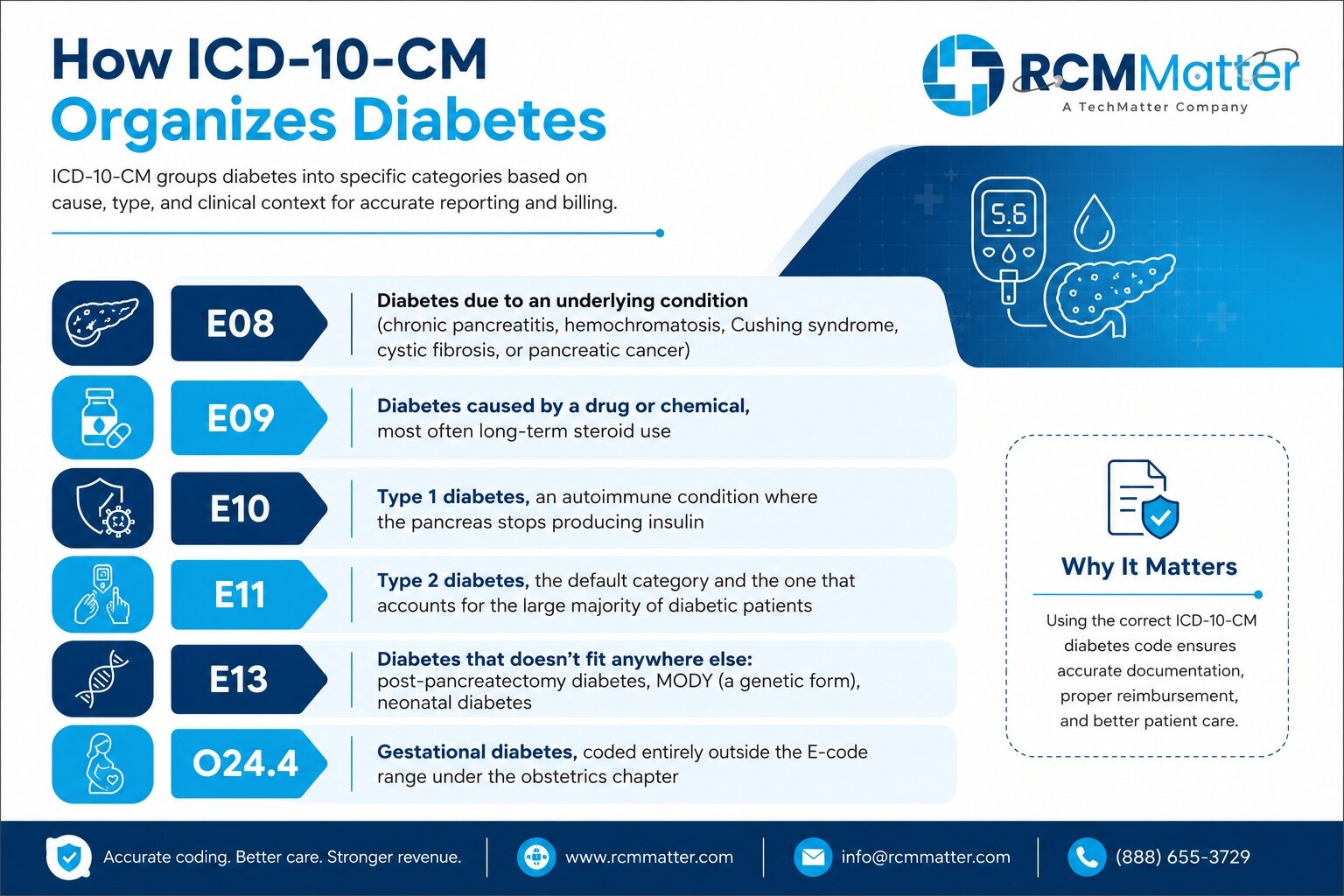
There's no E12. It was retired in an earlier version of ICD-10-CM. If it's still sitting on an old superbill or charge template, that template needs an update.
Every diabetes code follows the same seven-character logic once you're inside a category. Take E11.3211: E11 identifies Type 2, .32 narrows it to moderate non-proliferative retinopathy, the next digit specifies whether macular edema is present, and the final digit identifies the eye.
Four clinical facts, one code. That's also why swapping a specific code for a vague one is a bigger problem than it looks. The payer, the auditor, and the risk model all read that missing detail differently.
Work through the cause before you touch the type:
That sequencing requirement for E08 and E09 isn't a style preference. It's written into the ICD-10-CM Official Guidelines, and auditors check it specifically because it's so often skipped.
Because E11 covers the majority of diabetic patients, it's also where undercoding causes the most financial damage. Here's a working list of the codes that come up most often:
|
Code | Meaning | Documentation needed |
|
E11.9 | No complications | Full chart review confirms none are documented |
|
E11.42 | Peripheral polyneuropathy | Physician documents diabetic neuropathy or polyneuropathy |
|
E11.43 | Autonomic neuropathy | Affects digestion, heart rate, or bladder function |
|
E11.12 | Diabetic CKD, stage 3 | Requires a paired N18.3 code |
|
E11.311/E11.3211 | Retinopathy with/without macular edema | Type, severity, and laterality all required |
|
E11.51 / E11.52 | Peripheral angiopathy, without / with gangrene | The word "gangrene" must appear in the note for .52 |
|
E11.621 | Diabetic foot ulcer | Requires a paired L97.x code |
|
E11.649 / E11.641 | Hypoglycemia, conscious / unconscious | Reflects the current encounter |
|
E11.65 | Hyperglycemia | Documented for the current encounter |
|
E11.A | Type 2 diabetes without complications, in remission | See the section below; this is new for FY2026 |
Add-on codes track how the patient's diabetes is managed: Z79.4 for insulin, Z79.84 for oral agents like metformin, both if the patient uses both, and no Z code at all for diet-controlled diabetes.
These three don't come up as often as E11, but skipping them when the documentation supports them is a compliance gap, not a shortcut.
E08 requires the physician to state that another condition caused the diabetes, not just that both exist. A patient with years of alcohol-related chronic pancreatitis whose pancreas can no longer produce insulin is a textbook E08 case: K86.1 first, then E08.9 or the relevant complication code.
E09 follows the same logic for drugs. Long-term prednisone is the most common trigger. The adverse-effect T-code comes first, drawn from the Table of Drugs and Chemicals, followed by the E09 code and any Z-code for current management.
E13 picks up what's left: diabetes following pancreas removal, MODY, neonatal diabetes, and secondary forms that don't match E08 or E09. Its complication structure mirrors E11 exactly, so E13.42 means the same thing as E11.42, just under a different root cause.
Gestational diabetes lives entirely in the obstetrics chapter, not the E-code range:
A quick note that trips up newer coders: Z79.4 does not get added to E10 codes, since insulin use is already implied by a Type 1 diagnosis. It only applies to Type 2, E08, E09, and E13 patients who are actually on insulin.
Effective October 1, 2025, CMS added a code that didn't exist before: E11.A, Type 2 diabetes mellitus without complications, in remission.
It's part of a broader FY2026 release that added roughly 490 new ICD-10-CM codes across the entire code set, but this one is specific to diabetes and it changes how a growing number of patients should be coded.
The clinical logic behind it: more patients are reaching sustained normal blood sugar through weight loss, bariatric surgery, or intensive lifestyle programs, without staying on any diabetes medication. Before FY2026, there was no way to code that status accurately.
Coders either kept using E11.9, which implies the patient still has active, unmanaged diabetes, or used a personal-history Z code that understated the ongoing monitoring these patients still need.
What has to be in the chart before you assign E11.A:
If the documentation is ambiguous about whether the diabetes has truly gone into remission, the correct move is a physician query, not a guess. Remission also isn't permanent.
Ongoing follow-up, A1C monitoring, and re-coding if the patient relapses are all still expected, and the code should be reassessed at each qualifying encounter rather than carried forward indefinitely.
For practices billing Medicare Advantage or other risk-adjusted plans, this code matters for a second reason: it removes a patient from active HCC diabetes categories once remission is confirmed, which changes the risk score calculation.
Getting the timing right, coding E11.A the moment remission is documented rather than months later, keeps risk-adjusted data accurate in both directions.
Complications are what separate a well-documented diabetic patient from an undercoded one, and payers, auditors, and risk models all weight them heavily. Code every complication that's documented for the encounter. There's no cap on how many complication codes a single claim can carry.
Kidney disease uses the .1x extension and always needs a paired CKD stage code from category N18. E11.13 without N18.4 is an incomplete claim, not a complete one with a missing detail.
Eye disease requires three pieces of information from the physician: the type and severity of retinopathy, whether macular edema is present, and which eye. Severity runs from mild non-proliferative through proliferative, and the final digit of the code identifies laterality (1 = right, 2 = left, 3 = both, 9 = unspecified). If the note says "left eye" and the claim says unspecified, that's undercoding, not a rounding error.
Nerve damage breaks into four types: unspecified (.40), mononeuropathy (.41), polyneuropathy (.42, the most common and usually what a chart calls "peripheral neuropathy"), and autonomic neuropathy (.43), which covers digestive, cardiac, or bladder effects.
Circulatory complications split at whether gangrene is present. The word "gangrene" has to be in the documentation for .52; a wound that merely looks necrotic isn't sufficient without it.
Skin and joint complications include diabetic dermatitis, foot ulcers (paired with an L97.x code), other skin ulcers (paired with L98.x), periodontal disease, and Charcot joint from repeated unnoticed trauma.
A single complex patient often needs five or six codes on one claim. A Type 2 patient on insulin and metformin with polyneuropathy, stage 3 CKD, and bilateral moderate retinopathy would need the neuropathy code, the CKD code plus its N18 companion, the retinopathy code, and both Z79.4 and Z79.84.
Every one of those codes reflects something real about how much care that patient needs, which is exactly what risk-adjusted reimbursement is built to capture.
Hierarchical Condition Category (HCC) scoring is how Medicare Advantage plans and many commercial payers calculate how much a practice should be paid to manage its patient population.
Sicker patients need more visits, more monitoring, and more resources, so payers weight reimbursement accordingly, but only if the diagnosis codes on file actually reflect that acuity.
Diabetes sits in three HCC tiers:
A patient who genuinely has kidney disease and neuropathy but gets coded as E11.9 every year lands in HCC 19. The payer pays as though that patient is healthier than they are. Multiply that across a full panel and the revenue gap becomes significant, not incidental.
HCC scores are also reset annually. A diagnosis captured in January doesn't automatically carry into the following year's risk model; it has to appear on a claim again.
This is the strongest argument for making sure annual wellness visits and chronic care management encounters capture every active complication, not just whatever brought the patient in that day.
Getting the diagnosis codes right is half the picture. The other half is billing for the actual services diabetic patients receive, and this is where a lot of practices leave reimbursable work uncaptured entirely.
Uses HCPCS codes G0108 (individual, per 30 minutes) and G0109 (group session, two or more participants, per 30 minutes). Medicare covers 10 initial hours in the first 12 months after a referral, then two follow-up hours each subsequent year with a new referral.
DSMT has to be delivered through an accredited diabetes education program, and the plan of care needs to be documented in the chart, including the reason for individual rather than group training if that's what's ordered.
Runs on CPT codes 97802 (initial assessment, 15 minutes), 97803 (reassessment, 15 minutes), and 97804 (group, 30 minutes). MNT can only be billed by a registered dietitian or qualifying nutrition professional.
Medicare covers it in full, with no patient cost-sharing, and a beneficiary can receive both the full DSMT allotment and MNT in the same year as long as the two aren't billed for the same date of service for the same patient.
Billing depends on whose equipment is used. CPT 95249 covers patient-owned CGM equipment, including sensor placement, training, and printout. CPT 95250 covers a professional CGM device supplied by the practice and can be billed monthly.
A separate interpretation code applies when a clinician reviews and reports on the CGM data. Because these codes are frequently billed incident-to a physician, the supervising provider's documentation needs to support that relationship.
Billed under CPT 99490 and related codes, applies to diabetic patients with two or more chronic conditions who need ongoing non-face-to-face care coordination.
This is one of the more underused billing opportunities in diabetes management, since a diabetic patient with hypertension or CKD almost always qualifies, and the monthly time-based documentation requirements are lighter than many practices assume.
None of these billing codes appear anywhere near most diagnosis-focused diabetes coding guides, which tend to stop at ICD-10. But a practice that captures accurate E11 complication codes and misses G0108, 97802, or 99490 for the same patient population is still leaving money uncollected every month.
Defaulting to E11.9 without a full chart review. The coder sees "Type 2 diabetes," codes E11.9, and moves on without checking specialist notes or the problem list for documented complications.
Forgetting Z79.4 on insulin patients. It's a secondary code, so it's easy to skip. Build the habit of checking the medication list every time an E11.x code is assigned.
Wrong sequencing on E08 and E09. The underlying condition or the causative drug always comes before the diabetes code, not after.
Coding a complication without a causal link in the note. CKD plus diabetes in the same chart isn't enough to justify E11.12. The physician has to connect the two explicitly, with language like "diabetic nephropathy."
Missing the required companion code. E11.12 needs N18.x. E11.621 needs L97.x. One without the other is an incomplete claim.
Carrying resolved complications forward as active. An old ulcer that healed years ago belongs under Z86.39 (personal history), not an active complication code.
Using an unspecified code when a specific one is documented. E11.40 means the neuropathy type isn't specified. If the note says "peripheral polyneuropathy," the correct code is E11.42, not the vaguer default.
Knowing the codes only helps if the documentation actually supports them. Coders can't infer a diagnosis from a lab value or a medication list; a qualifying provider has to write it. Here's what each category requires before you're allowed to assign it:
A query is a documented, objective request for clarification, not a suggestion of what to write. Send one when:
Present the clinical facts and ask for clarification. Never suggest the answer you're hoping to code.
Reading the rules is one thing. Applying them to an actual chart is where coding accuracy either holds up or falls apart. Here are five representative encounters worked through start to finish.
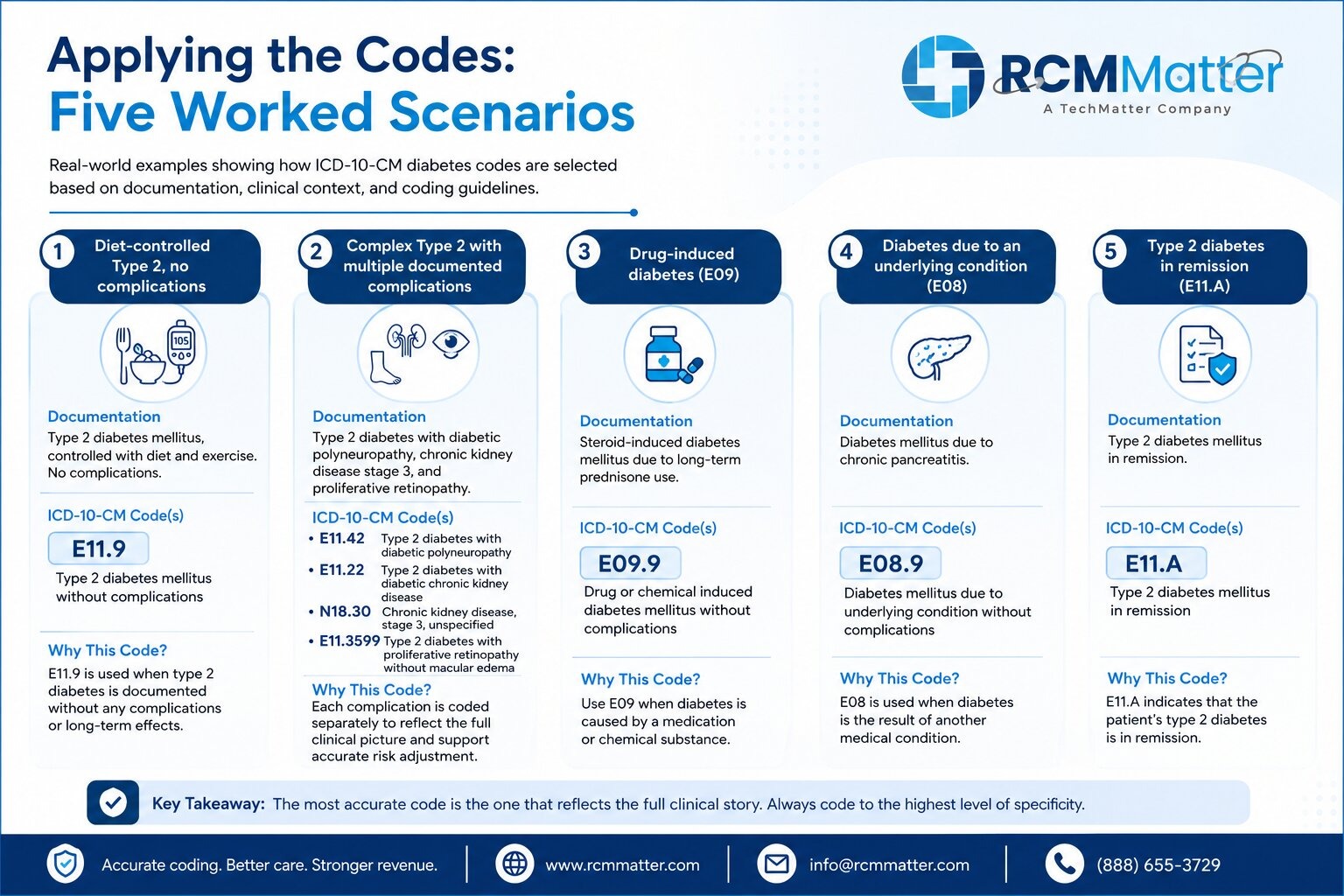
A 52-year-old man comes in for a diabetes follow-up. His Type 2 diabetes is managed through diet and exercise alone, no medications. HbA1c is 6.8%. Nothing in the chart, including the problem list and any specialist notes, documents a complication. Code: E11.9 only. No Z79.4 or Z79.84, since he isn't on any medication.
A 61-year-old woman has Type 2 diabetes managed with insulin alone. Today's visit documents a partial-thickness diabetic foot ulcer on the right heel and mild non-proliferative retinopathy in both eyes, no macular edema noted. Codes: E11.621 (diabetic foot ulcer) plus the matching L97.4x code for the ulcer's location and severity, E11.3293 (mild non-proliferative retinopathy, both eyes, without macular edema), and Z79.4 (long-term insulin use).
A 39-year-old woman has been on long-term prednisone for lupus. Her rheumatologist documents new-onset diabetes as a direct result of chronic steroid therapy. She's currently managed with metformin alone, and no complications are documented. Codes: T38.0X5A (adverse effect of glucocorticoids, initial encounter) sequenced first, then E09.9 (drug-induced diabetes, no complications), then Z79.84 (oral hypoglycemic use).
A 70-year-old man has hereditary hemochromatosis. His physician documents that iron overload has damaged his pancreas and directly caused his diabetes, along with diabetic autonomic neuropathy affecting his gastric motility (gastroparesis). Codes: E83.111 (hereditary hemochromatosis) sequenced first, because it's the causative condition, then E08.43 (diabetes due to underlying condition, with autonomic neuropathy).
A 58-year-old woman had Type 2 diabetes for years, managed with metformin and later insulin. Following bariatric surgery and sustained weight loss, she has been off all diabetes medications for eight months. Her most recent HbA1c is 5.9%, and her physician's note explicitly states: "Type 2 diabetes mellitus, in remission, achieved through bariatric surgery and sustained weight loss." No complications are documented. Code: E11.A only. No Z79.4 or Z79.84, since she isn't on any diabetes medication, and no complication codes, since none are active.
Category and sequencing
|
Category | Cause | Sequencing rule |
|
E08 | Another disease caused it | Underlying condition coded first |
|
E09 | A drug caused it | Adverse-effect T-code coded first |
|
E10 | Type 1 | No Z79.4 needed; insulin use is implied |
|
E11 | Type 2 (default) | Add Z79.4 for insulin, Z79.84 for oral agents |
|
E13 | Other specified | Post-surgical, MODY, neonatal |
|
O24.4 | Gestational | Obstetrics chapter only, not E-codes |
|
E11.A | Type 2, in remission | Requires explicit "remission" documentation |
Complication extension guide (applies across E08, E09, E11, E13)
|
Extension | Complication | Companion code required |
|
.1x | Kidney / nephropathy | N18.x for CKD stage |
|
.2x | Peripheral vascular | Add a gangrene code if gangrene is present |
|
.3x | Eye / retinopathy | Laterality required: 1 = right, 2 = left, 3 = both |
|
.4x | Nerve / neuropathy | None required |
|
.5x | Circulatory | None required |
|
.61 / .62x | Foot or skin ulcer | L97.x (foot) or L98.x (other skin) |
|
.64x | Hypoglycemia | Specify with or without loss of consciousness |
|
.65 | Hyperglycemia | None required |
|
.9 | No complications | Confirm with a full chart review |
|
Service | Code(s) | Who can bill |
|
DSMT, individual | G0108 | Accredited diabetes education program |
|
DSMT, group | G0109 | Accredited diabetes education program |
|
Medical nutrition therapy | 97802, 97803, 97804 | Registered dietitian or nutrition professional |
|
Personal CGM setup and training | 95249 | Often billed incident-to a physician |
|
Professional CGM (practice-supplied) | 95250 | Often billed incident-to a physician |
|
Chronic care management | 99490 and related codes | Physician or qualifying practice staff |
Adverse effect: A harmful reaction to a medication taken as prescribed. Coded with a T-code, not treated as a coding error on the prescriber's part.
Angiopathy: Damage to blood vessels. In diabetes, peripheral angiopathy refers to vessel damage in the feet, legs, or hands.
Autonomic neuropathy: Nerve damage affecting involuntary body functions such as heart rate, digestion, and bladder control.
CKD (chronic kidney disease): Progressive, permanent loss of kidney function, staged from 1 (mild) to 5 (kidney failure requiring dialysis).
Companion code: A second, required code that adds detail a primary diagnosis code can't capture on its own, such as an N18.x stage code alongside a kidney complication code.
Gangrene: Tissue death, usually from lost blood supply. Must be explicitly documented by the physician before it can be coded.
HbA1c: A blood test reflecting average blood sugar over roughly two to three months. It's a monitoring tool, not a diagnosis by itself.
HCC (Hierarchical Condition Category): A risk-scoring model payers use to estimate patient acuity and set reimbursement levels accordingly.
Hyperglycemia / hypoglycemia: High and low blood sugar, respectively. Coded when documented for the current encounter, not as a general history.
Macular edema: Swelling in the central retina, a serious complication of diabetic eye disease that affects central vision.
Nephropathy: Kidney damage. Diabetic nephropathy specifically means the kidneys were damaged by chronically elevated blood sugar.
Neuropathy: Nerve damage from prolonged high blood sugar. Mononeuropathy affects one nerve; polyneuropathy affects many, most often in the feet and hands.
Physician query: A formal, objective request asking a provider to clarify a diagnosis or its connection to another condition in the record.
Remission (in diabetes coding): A documented status where a previously diagnosed Type 2 diabetic patient has sustained normal blood sugar without any diabetes medication. Distinct from "controlled" or "resolved," and requires the term itself to appear in the note.
Retinopathy: Damage to the retina's blood vessels, ranging from mild non-proliferative changes to advanced proliferative disease.
Risk adjustment: The process of modifying payments based on how sick a patient population actually is, as reflected in the diagnosis codes submitted.
Sequencing: The order codes appear on a claim. The causative or principal diagnosis is always listed first.
Z code: A code capturing health-related context, such as ongoing medication use or personal history, rather than an active diagnosis on its own.
Does E11.A replace E11.9 for all controlled diabetic patients?
No. E11.A is only for patients whose provider has explicitly documented remission, meaning no current diabetes medication and no active complications. A patient who is well-controlled on metformin still gets coded as E11.9, not E11.A.
Can a diabetic patient with a resolved complication still be coded as being in remission?
Only if the complication is fully resolved and the physician documents remission of the underlying diabetes itself. If a complication is still present, even a minor one, E11.A shouldn't be used alone; code the complication alongside it.
How often does HCC risk adjustment require diabetes complications to be re-documented?
Every calendar year. HCC models don't carry a diagnosis forward automatically, so a complication that isn't captured on at least one claim in the current year effectively disappears from the risk score, even if the patient still has the condition.
Can DSMT and Chronic Care Management be billed in the same month for the same patient?
Yes, as long as the time and services documented for each don't overlap. They're distinct services with different documentation requirements, and many diabetic patients qualify for both.
Getting diabetes coding and billing right takes more than knowing the codes. It takes a team that reviews every chart for the complications, companion codes, and billable services that get missed under deadline pressure. RCM Matter's medical coding services and denial management team work directly with practices to close these gaps, from accurate HCC capture to DSMT and CCM billing that's often left on the table. Request a free practice analysis to see where your diabetes claims may be underperforming.
Optimize billing, claims and collections with expert RCM support let our professionals handle the process so you can focus on patient care.