Medicare could have saved close to 18 million dollars on anesthesia payments tied to spinal pain management procedures alone, according to a 2025 audit from the HHS Office of Inspector General. That single figure confirms something most anesthesia groups already suspect. A large share of anesthesia payment problems has nothing to do with patient care. An anesthesiologist can run a flawless case and still lose the reimbursement because a time stamp got rounded wrong or a modifier got picked in a hurry three weeks later. The pattern repeats across practices of every size, and it rarely improves without someone deliberately hunting for it.
Read more; Strategies to maximize anesthesia reimbursement in 2026
Once a practice starts tracking where its common anesthesia billing mistakes actually happen, the fixes usually turn out to be simpler than the lost revenue would suggest.
A single denied anesthesia claim rarely stays a one time loss. It turns into a phone call to the payer, a resubmission, and often a delay of thirty to sixty days before the practice sees any money at all. Multiply that by even a handful of claims a month, and the staff hours add up fast, long before anyone tallies the actual dollars written off.
Smaller practices feel this hardest. They often don't have a dedicated denial-management team, so the same biller who is trying to get next week's claims out the door also has to stop and chase down last month's rejections. That's usually when problems start compounding instead of getting resolved.
This is part of why many groups eventually bring in dedicated anesthesia billing services rather than trying to keep the whole process in-house. Not because in-house billing can't work, but because anesthesia coding carries enough unique rules (time units, modifiers, medical direction requirements) that a generalist biller can miss things a specialist would catch at a glance.
Most anesthesia billing errors fall into a short, predictable list. These specific Anesthesia Billing Mistakes show up again and again across audits, regardless of practice size or specialty mix.
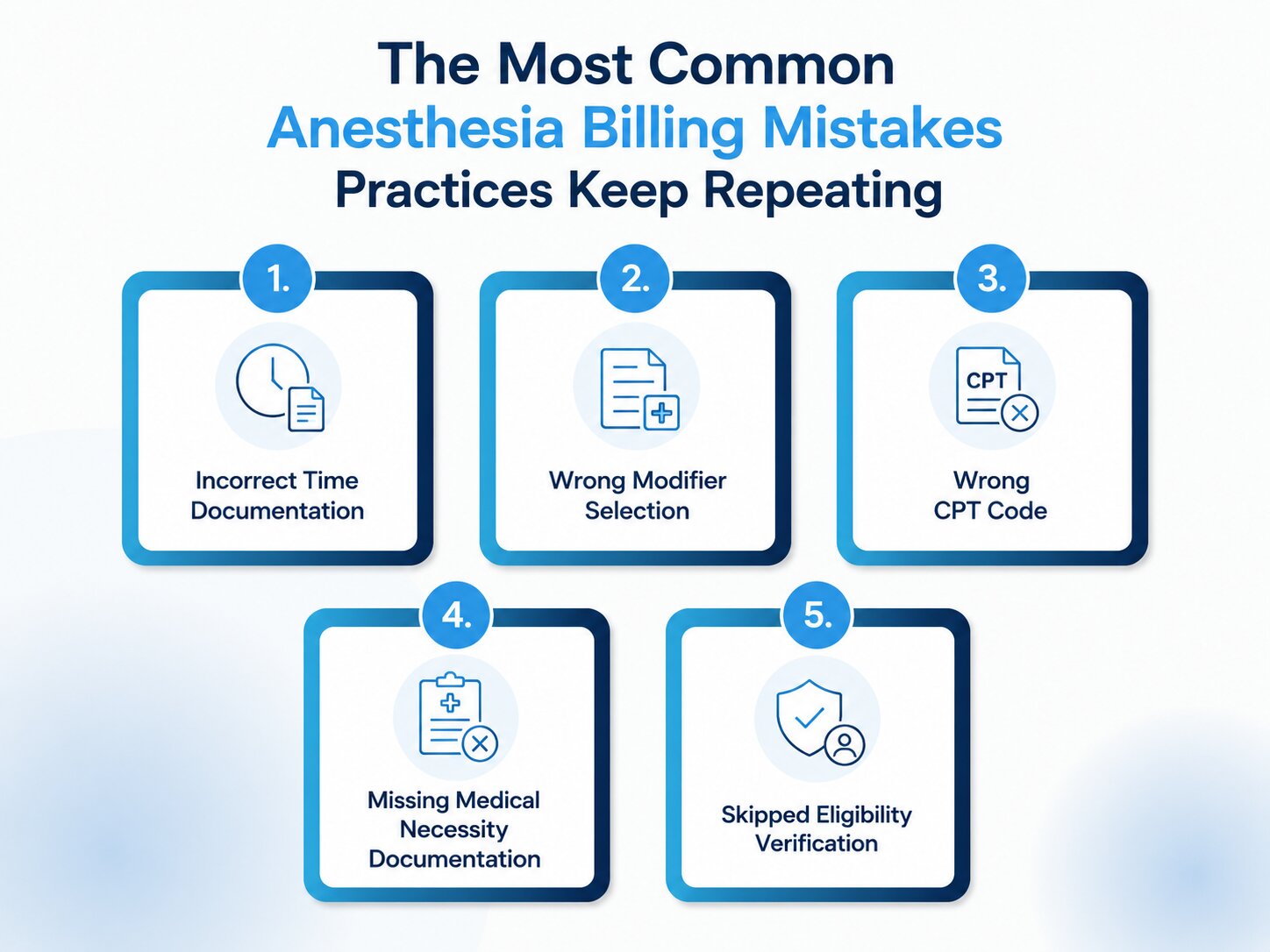
Anesthesia time starts when the provider begins preparing the patient and ends when the patient can be safely placed under postoperative care, and rounding that window even slightly changes the reimbursement. A five-minute miscalculation across a busy month can quietly cost a practice thousands of dollars.
Choosing AA instead of QK, or QZ instead of QY, tells the payer a completely different story about who performed the anesthesia and how. Get it wrong, and the claim either underpays or gets flagged outright.
Anesthesia CPT codes are tied to the surgical procedure, not to a general anesthesia catalog, so picking a code that doesn't match the operative report is one of the fastest ways to trigger a denial.
Payers want to see why anesthesia was needed for that specific case. When the note doesn't support it clearly, the claim looks unjustified even if the care was entirely appropriate.
If coverage details are wrong before the first appointment, every claim tied to that case inherits the problem before it's even submitted.
Modifiers exist to tell the payer who did what during a case, and anesthesia has more of them than almost any other specialty. Getting them right depends on understanding the difference between personally performed care, medical direction, and medical supervision, and those distinctions are easy to blur when a practice is moving fast.
|
Modifier | Meaning | Common mistake |
|
AA | Anesthesia is personally administered by an anesthesiologist | Used when a CRNA actually performed the case |
|
QK | Medical direction of two to four concurrent procedures | Applied without meeting the required documentation steps |
|
QX | CRNA service with medical direction by a physician | Confused with QZ when supervision requirements aren't met |
|
QZ | CRNA service without medical direction | Billed alongside a directing physician's claim by mistake |
|
QY | Medical direction of one CRNA by an anesthesiologist | Mixed up with QK when more than one case is involved |
None of these errors shows up on the surface of a claim. They only surface once a payer cross-references the anesthesia billing codes against the documentation, and by then, the claim has already been denied or delayed.
Patients ask their billing office some version of this constantly. If someone on staff has ever fielded the question why do I have two anesthesia bills, the answer usually comes down to separate billing for separate providers.
The anesthesiologist bills for medical direction, and the CRNA bills separately for the personally performed portion of the case. Two providers, two claims, two lines on a statement that look confusing but are billed correctly.
Read more; Common challenges in anesthesia billing and how to solve them
The trouble starts when the modifiers on those two claims don't align. If the CRNA bills QZ while the anesthesiologist bills as though direction occurred, the payer sees two claims telling contradictory stories about the same case.
That mismatch is a documentation problem more often than a fraud problem, but it still results in a denial that takes real time to unwind.
Prevention here isn't complicated, but it does require consistency. Verify eligibility and benefits before the case, not after.
Confirm the anesthesia record captures exact start and stop times rather than estimated ones. Cross-check the modifier against the actual direction or supervision that took place, every single time, even for routine cases that feel low-risk.
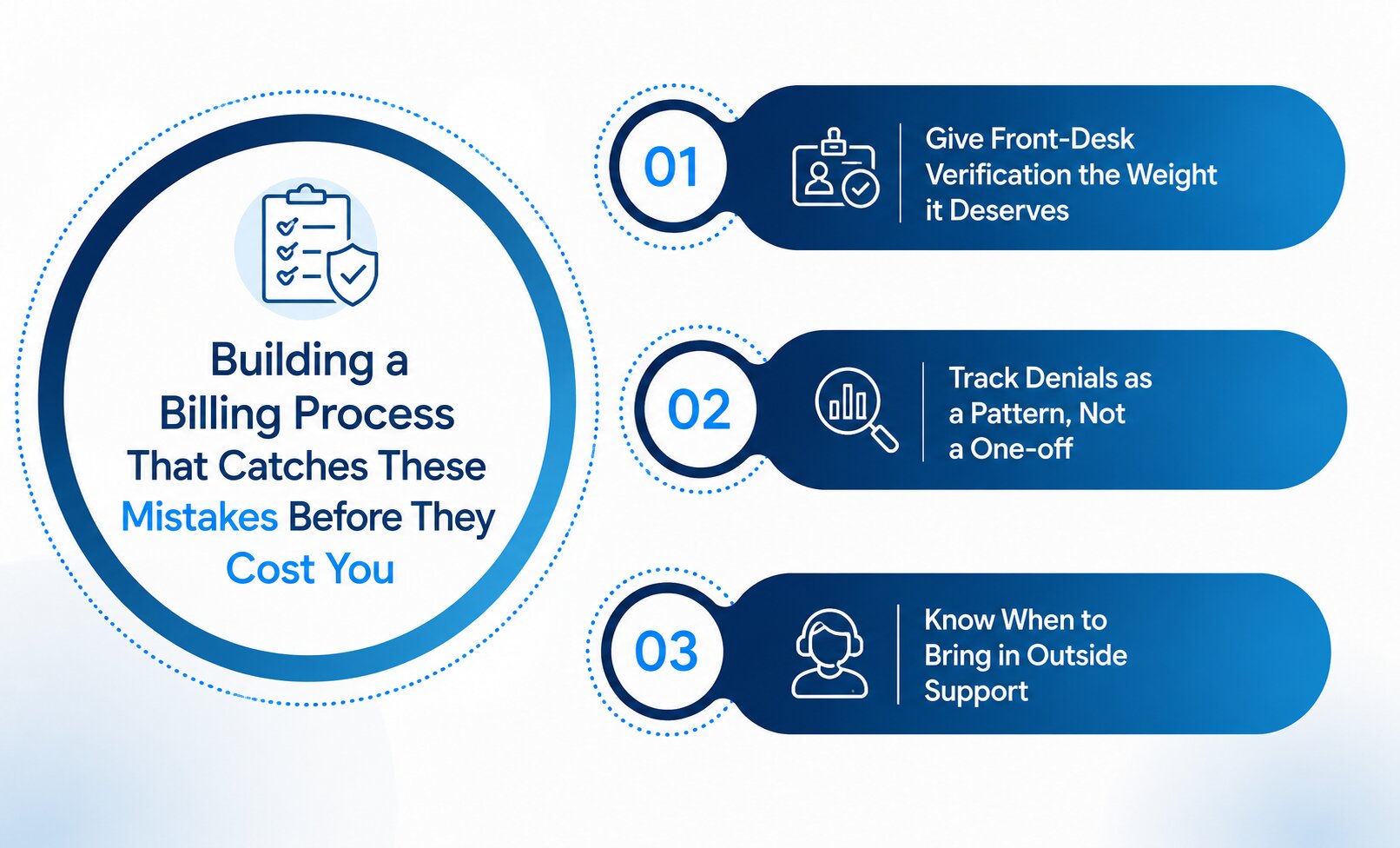
Eligibility checks often get treated as an administrative formality rather than a billing safeguard, and that's a mistake in itself.
A coverage detail entered incorrectly at intake doesn't just cause a scheduling headache. It travels straight through to the claim, and by the time anyone notices, the case has already happened, and the documentation is locked in.
Practices that treat front-desk verification as part of the billing process, not a separate task owned by a separate team, tend to see fewer of these errors reach a claim at all.
Most practices review denials one claim at a time and move on once it's resolved. A better approach is logging the reason code every time and watching for repeats. If the same modifier error shows up three times in a month, that's not bad luck. That's a training gap.
Some practices reach a point where in-house staff simply can't keep pace with anesthesia's coding complexity alongside everything else on their plate.
Outsourcing anaesthetic billing to a team that specializes in it, similar to the approach outlined in this guide to outsourcing anesthesiology billing, often closes these gaps faster than adding more internal training ever could. It's worth noting that the right call here varies by practice size, payer mix, and how much denial volume a group is already absorbing, so there isn't a single answer that fits every group.
RCM Matter's anesthesia billing services and denial management support both focus specifically on catching these errors before claims go out, not just cleaning them up after a denial arrives.
Most common anesthesia billing mistakes aren't complicated once they're identified. They're small, repeatable errors in time capture, modifier selection, and documentation that compound quietly until a practice finally sits down and counts what they've cost. Catching them earlier is almost always cheaper than fixing them after the fact.
If the same denial patterns keep resurfacing despite your team's efforts, an outside review can often uncover process gaps that are easy to miss internally.
That's the kind of analysis RCM Matter focuses on, helping anesthesia practices identify recurring billing issues, strengthen workflows, and improve reimbursement before those mistakes continue affecting revenue.
1. What is the most common anesthesia billing mistake?
Incorrect time documentation. It's the single error that shows up most consistently across audits, largely because start and stop times get estimated rather than recorded precisely.
2. How do incorrect modifiers affect claims?
A wrong modifier changes what the payer believes happened during the case, and that mismatch alone is enough to trigger a denial or a significant underpayment, regardless of how accurate the rest of the claim is.
3. Why is time documentation important?
Anesthesia reimbursement is calculated in time units, not flat fees. Get the start or stop time wrong, and the payment calculation is wrong too, even if every other part of the claim is correct.
4. Can coding mistakes cause denials?
Yes. A CPT code that doesn't match the operative report is one of the fastest ways to get flagged, and it happens more often than most practices realize.
5. How can practices prevent billing errors?
Consistency matters more than any single fix. Verify eligibility before the case, document time accurately, double-check modifiers against what actually happened, and track denial reasons so patterns get caught early instead of repeating quietly for months
Optimize billing, claims and collections with expert RCM support let our professionals handle the process so you can focus on patient care.