The share of ambulatory surgery centers expecting to pay anesthesia stipends jumped from 28% in 2024 to 44% in 2025, according to Becker's ASC (2025), and that shift alone tells most of the story. Payers are paying less per unit, coverage costs are climbing, and the gap in between is landing directly on practice margins.
A group can run a full surgical schedule this month and still watch collections slide against last year's numbers, and that slide rarely comes from fewer cases. It comes from payers chipping away at anesthesia specifically, through modifier restrictions, split conversion factor updates, and stipend pressure that barely existed two years ago. Practices that respond with deliberate anesthesia reimbursement strategies built on real data close that gap before it becomes permanent.
Quick summary: The fastest way to improve anesthesia reimbursement in 2026 is to fix time capture accuracy, reconcile every payment against the contracted conversion factor, and track denial rate, days in A/R, and net collection rate monthly instead of quarterly. Practices that do this typically hold A/R days under 30 to 35 and net collection above 95%.
Medicare anesthesia reimbursement rates have already dropped 5.5% over the past four years, according to MGMA (2024), and that decline lands on top of a workforce shortage most practices are already feeling in scheduling. Smaller drops compound. A conversion factor cut of a few points combined with a payer's new modifier restriction rarely triggers an alarm on its own, but stacked across a full year of case volume, it adds up to real money leaving the practice quietly.
This is where anesthesia billing gets treated as an administrative function instead of a financial one. Practices that keep it purely operational tend to miss the pattern until a full quarter has already gone by.
Read more; What is Anesthesia Billing? A Complete 2026 Guide for Healthcare Providers
Most leakage doesn't show up as a denial. It shows up as a payment that technically posted but landed below what the contract actually allows, or a case where the anesthesia time on the claim doesn't match what actually happened in the OR.
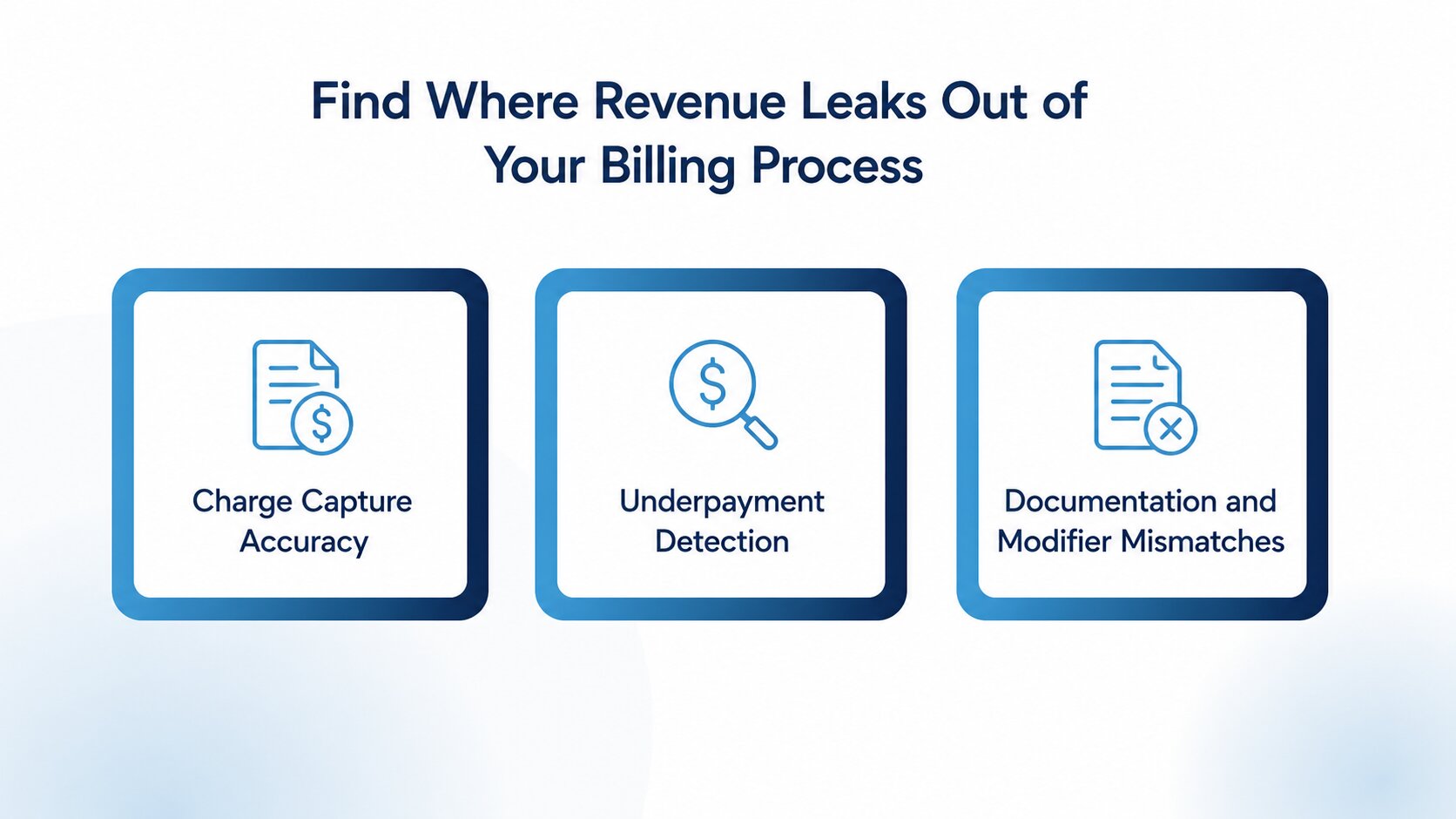
Effective anesthesia medical billing services rely on accurate time capture down to the minute, not on rounding for convenience. A CRNA case that runs 92 minutes but gets billed as 90 creates a small loss on its own. Across a full month of cases, that rounding habit turns into a five-figure gap that never shows up as a denial, because the claim still gets paid. It just gets paid for less than it should.
Reconciling every payment against the contracted conversion factor catches the underpayments that denial reports never flag. A payer can process a claim cleanly and still pay 8% under contract, and unless someone is checking allowed amounts line by line, that gap never surfaces on its own.
A missing physical status modifier or a mismatched CRNA attestation can turn a clean case into a partial denial weeks later. These mismatches rarely surface during the case itself. They show up when the payer's system flags a modifier combination that doesn't match its own edit rules, by which point the claim has already been sitting in the queue for days.
Read more; Common Challenges in Anesthesia Billing and How to Solve Them
Strong anesthesia revenue cycle management treats medical billing, medical coding, credentialing, and collections as one connected system rather than four separate departments handing off paperwork. When credentialing lags behind a new CRNA start date, every claim tied to that provider sits unbillable until the enrollment catches up. That's not a coding problem. It's a workflow gap that shows up as a billing delay months later.
Practices with disciplined follow-up routinely hold A/R days under 30 to 35, while practices without a structured process regularly drift past 50. The difference usually isn't staffing. It's whether someone owns the 31 to 60 day bucket before it becomes the 91 to 120 day bucket, which is a much harder claim to collect. A dedicated AR follow-up process built around aging buckets, not just total balance, keeps that transition from happening quietly.
Anesthesiology payment collection improves fastest when eligibility is verified before the case, not after the claim is denied. A patient whose coverage lapsed the week before surgery creates a collections problem that no amount of clean coding can fix retroactively.
Tracking the right numbers matters more than tracking a lot of numbers. Five stand out for anesthesia practices specifically.
Denial rate: Anesthesia practices performing well typically hold this under 5%. Anything meaningfully higher usually points to a specific payer or code pattern worth isolating, not a general billing problem.
Days in A/R: Under 30 to 35 days signals a follow-up process that's actually working. Past 45, claims start aging into the range where collection odds drop sharply.
Net collection rate: This should sit above 95%. A lower number, even with a clean denial rate, often means underpayments are slipping through uncaught.
First-pass clean claim rate: High performers submit the large majority of claims correctly the first time. Every claim that bounces back adds rework cost, and rework alone runs $25 to $118 per claim, depending on complexity.
Charge lag: The gap between the date of service and the date the charge posts. A short lag keeps everything downstream, including collections, moving on schedule.
Strong anesthesiology revenue cycle management turns these five into a monthly dashboard rather than a year-end surprise, and that shift alone changes how quickly a practice catches a problem before it compounds.
Some practices manage all of this internally. Others bring in anesthesia billing services built specifically around the concurrency rules, modifier logic, and payer nuances that anesthesia carries that general medical billing doesn't.
Read more; How Anesthesia Billing Differs from Traditional Medical Billing
|
Factor | In-house billing | Specialized anesthesia billing services |
|
Modifier and concurrency expertise | Depends on staff tenure | Built into the process from day one |
|
Denial recovery workflow | Often reactive | Structured and proactive |
|
Staffing risk | Turnover creates coverage gaps | Consistent coverage regardless of staffing |
|
KPI visibility | Manual, often delayed | Ongoing benchmark tracking |
|
Cost structure | Fixed salary and overhead | Typically, the percentage of collections |
Neither option is automatically right. A practice with a stable, experienced billing team and low denial rates may not need to change anything. A practice watching anaesthetic billing denials climb while internal staff turns over every year is usually better served by bringing in a team that already knows where anesthesia claims tend to fail. RCM Matter's anesthesia billing services build denial prevention and payer-specific rules into the process before a claim ever gets submitted, working alongside a structured denial management program to catch what still slips through.
Anesthesia reimbursement rarely erodes all at once. It happens through a rounded time unit here, a slow credentialing update there, and a payer policy change that nobody flagged until the quarterly numbers came in lower than expected. Practices that build anesthesia reimbursement strategies around measurable benchmarks, not just modifier accuracy, catch that erosion months earlier than those relying on year-end reports. At RCM Matter, this kind of ongoing reconciliation helps practices identify revenue gaps before they become long-term financial losses. Pull last quarter's remits and check the actual allowed amounts against contracted rates before assuming the shortfall is just a slow season.
1. How can anesthesia practices increase reimbursement?
The fastest gains usually come from fixing time capture accuracy and reconciling payments against contracted rates, not from renegotiating every payer contract at once.
2. What causes revenue leakage in anesthesia billing?
Rounded time units, credentialing delays, and silent underpayments account for most of it. Denials get the attention, but underpayments that still post as "paid" often cost more over a full year.
3. How can practices recover underpaid claims?
Start by pulling every remit for the past 90 days and comparing the allowed amount against the actual contracted conversion factor. Flag anything that doesn't match, group the mismatches by payer, and file corrected claims or appeals within 14 days of identifying the gap, since appeals filed early recover at meaningfully higher rates than ones filed a month later. It takes a few hours of reconciliation work to set up, and after that, it becomes a monthly check rather than a project.
4. What KPIs should anesthesia practices track?
Denial rate, days in A/R, net collection rate, first-pass clean claim rate, and charge lag. All five are covered above with specific benchmark targets.
5. Are anesthesia billing services worth it?
For a practice with strong internal staff and low denial rates, not necessarily. For one watching turnover eat into billing consistency, usually yes, and often within the first two quarters.
Optimize billing, claims and collections with expert RCM support let our professionals handle the process so you can focus on patient care.