In today's fast-paced healthcare environment, revenue cycle performance is under more pressure than ever. Rising claim denial rates, complex payer rules, and an increasingly overwhelmed administrative workforce have pushed accounts receivable (AR) days to uncomfortable highs for many practices and health systems.
The longer a claim sits unpaid, the greater the risk it never gets paid at all. That is where artificial intelligence is changing the game. AI-powered solutions are no longer a futuristic concept reserved for large hospital networks.
They are actively being deployed to streamline medical billing and medical coding, accelerate claim adjudication, and help practices get paid faster, all while reducing the burden on staff.
In this article, we break down exactly how artificial intelligence aids in reducing AR days, where it delivers the most impact, and what healthcare organizations should consider when evaluating AI tools.
Accounts receivable days, commonly referred to as AR days or days in AR, measure the average number of days it takes a healthcare provider to collect payment after a service is rendered. It is one of the most critical indicators of revenue cycle management (RCM) health.
Read more; Why ar follow up important medical billing
Most practices aim to keep AR days under 40. When AR days creep above 50 or 60, cash flow suffers, administrative workloads spike, and the probability of write-offs increases significantly. Common culprits include:
Incomplete or inaccurate patient information
Incorrect or missing diagnosis and procedure codes
Claim denials due to eligibility or authorization issues
Slow follow-up on unpaid or rejected claims
Complex payer-specific billing rules that staff must manually navigate
Addressing these root causes is exactly where AI healthcare billing solutions are making a measurable difference.
Before diving into solutions, it helps to be precise about what is actually driving AR days higher. The most common contributors are:
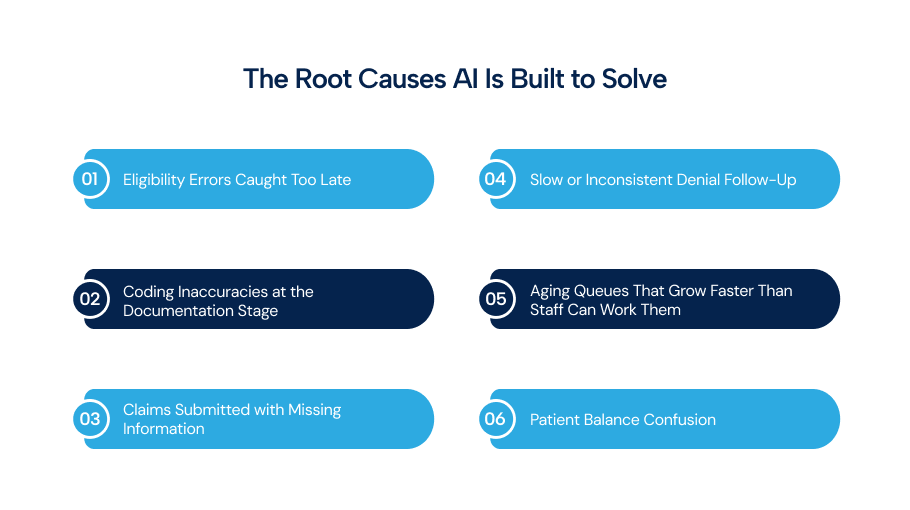
Coverage gaps, lapsed plans, and missing authorizations that are not caught until claim submission, or worse, after denial.
Incorrect or incomplete diagnosis codes, missing modifiers, and misaligned procedure codes trigger denials requiring the provider to go back through the clinical workflow to resolve.
Incomplete claim data that fails payer edits and cycles back into the AR queue before it was ever adjudicated.
When billing staff are overwhelmed, high-value claims sit in denial queues for weeks before anyone acts. Every day of delay compounds the AR problem.
Once a backlog reaches a certain size, manual management becomes reactive. Staff fight fires on the oldest claims instead of preventing new ones from aging.
Patients on high-deductible plans who are surprised by their out-of-pocket responsibility delay payment, ignore statements, and generate call volume that pulls staff away from payer-side AR work.
Each of these problems produces data. Each follows a pattern. And each has a direct AI application that addresses it at its source.
Traditional claim scrubbing tools apply fixed rules uniformly across all claims and all payers. They catch known errors but miss the payer-specific patterns that experienced billers learn over years of working a particular book of business.
AI-powered claim scrubbing works differently. It learns from historical claim and denial data to identify the specific code combinations, documentation gaps, and payer behaviors that trigger rejections for your practice specifically.
Higher first-pass acceptance rates
Fewer claims entering the denial and rework cycle
Less time spent on corrections before resubmission
AR days that reflect a cleaner claim flow from the start
This is one of the most upstream interventions available. Fixing problems before submission eliminates an entire category of AR aging.
Eligibility verification has traditionally happened at check-in, the morning of an appointment. By that point, the window to resolve coverage issues before a claim is submitted is already narrow.
AI-driven eligibility tools shift that window to the point of scheduling, giving practices days or weeks to act rather than hours.
Lapsed or terminated coverage
Plan changes that affect benefits or cost-sharing
Missing prior authorizations for scheduled procedures
Secondary insurance that should be on the claim
Patient cost-sharing amounts for upfront collection conversations
The result is fewer eligibility-related denials entering the AR queue and higher rates of patient responsibility collected before the visit rather than aging into patient-side AR.
Denial management has historically been reactive. A claim comes back denied, a team member reviews it, determines the reason, corrects it if possible, and resubmits. That cycle takes time, and when denial volumes are high, the backlog compounds.
AI introduces a predictive layer that shifts the dynamic entirely.
By analyzing historical denial data across thousands of claims, AI systems can score the denial risk of a new claim before it is submitted. High-risk claims are flagged for review, routed to a specialist, or held for additional documentation before they go out.
Weighing claim age, dollar value, payer appeal deadlines, and overturn likelihood
Routing the highest-impact work to the right team members first
Categorizing denials by reason code automatically, without manual triage
If there is one area where manual processes consistently fail at scale, it is AR follow-up. The logic is straightforward: contact the right payer or patient, about the right claim, at the right time, with the right information.
The execution of that logic across hundreds or thousands of open claims is where human bandwidth runs out.
AI-powered follow-up automation handles the routing, timing, and escalation logic that billing staff would otherwise need to apply manually.
When a claim reaches a set age without payment, an outreach action is triggered automatically
When a payer's average processing time is exceeded, the claim is flagged before it ages further
When a denial arrives, it is categorized and routed without manual triage
Escalations happen on schedule, not whenever a staff member gets to them
The result is an AR queue where no claim is forgotten, aging buckets stay disciplined, and follow-up consistency does not depend on staffing levels or workload fluctuations.
The connection between documentation quality and AR days is direct but often underappreciated.
Coding errors originate at the documentation stage. Resolving them means going back through the clinical workflow, which takes time and creates a delay that AR days reflect immediately.
AI-powered natural language processing tools address this at the source by reading clinical notes in real-time and surfacing coding suggestions based on the documented encounter.
Identify when documentation supports a higher-specificity diagnosis code
Flag when a procedure requires additional documentation to support medical necessity
Alert coders to code combinations likely to trigger payer scrutiny
Reduce both under-coding (revenue loss) and over-coding (compliance risk) simultaneously
When codes are aligned with documentation from the start, claims go out cleaner, adjudication is faster, and coding-related denials stop accumulating in the AR pipeline.
Patient AR is a growing problem that most practices are still managing with tools designed for a different era of healthcare finance.
When patients had low or no cost-sharing responsibility, generic paper statements and occasional phone calls were enough. Today, with patients routinely owing hundreds or thousands of dollars per visit, those approaches fall short.
AI tools reduce billing confusion for patients through communication that is timely, personalized, and accessible.
Automated text and email reminders through channels patients actually use
24/7 chatbot availability to answer billing questions without staff involvement
Plain-language explanations of what insurance covered versus what the patient owes
Self-service payment plan options that process agreements automatically
Reduced inbound call volume on your billing team
When patients understand their bills and have a clear, easy path to pay them, collection rates improve and patient-side AR days decrease.
Traditional RCM reporting tells you what has already happened: your current aging, last month's denial rate, and your collection percentage by payer. That information is useful, but it describes a situation that has already developed.
AI-driven analytics surface patterns and trends in real-time, enabling proactive management rather than reactive response.
Flagging a specific payer that is taking longer than usual to process claims, before it has materially impacted AR days
Identifying a denial pattern around a specific code or provider before it generates a backlog
Showing exactly where in the workflow claims are stalling
Prioritizing resources toward the payer categories and aging buckets with the greatest dollar impact
The practices that manage AR most effectively are those that can see their revenue cycle clearly and respond to signals early. AI-driven reporting makes that visibility possible without requiring a dedicated analytics team.
Artificial intelligence is not a future investment. It is a present-day capability reducing AR days for practices that have put it to work across their revenue cycles.
The organizations seeing the most improvement are not necessarily the largest or the most technically sophisticated.
They are the ones that have matched the right AI tools to the right problems at every stage of the workflow, from eligibility and claim submission through denial management, follow-up, and patient collections.
In a healthcare environment where every day of outstanding AR represents real money sitting outside your practice, that compounding effect adds up fast.
If your practice is ready to reduce AR days and improve revenue cycle performance, contact our RCM specialists today to schedule a consultation.
What is a good AR days number for a medical practice?
Most practices should aim to keep AR days below 40. Anything above 50 typically signals friction in the revenue cycle, and above 60 carries significant write-off risk, particularly for claims in the 90-day or 120-day aging buckets.
What causes AR days to increase?
The most common drivers are eligibility errors, coding inaccuracies, slow denial follow-up, manual aging queue management that cannot scale, and patient balance confusion that delays collections on the patient side.
How does AI reduce claim denials?
AI reduces denials by learning payer-specific patterns from historical data and flagging high-risk claims before submission. It also verifies eligibility in real-time, surfaces coding gaps at the documentation stage, and prioritizes denial rework by dollar value and overturn likelihood.
Can small practices benefit from AI billing tools?
Yes. Cloud-based AI billing solutions have made this technology accessible to practices of all sizes. Small and mid-sized practices can access the same quality of AI-powered claim scrubbing, denial prediction, and eligibility verification that larger organizations use, often through their existing RCM partner.
Does AI replace medical billing staff?
No. AI handles the high-volume, repetitive tasks that consume staff time, freeing experienced billers to focus on complex cases that require human judgment. Most practices find that AI makes their existing team significantly more effective.
Optimize billing, claims and collections with expert RCM support let our professionals handle the process so you can focus on patient care.