A solo family practice loses its third biller in two years. The replacement takes eleven weeks to hire, and claims sit untouched while patients keep showing up. By the time that hire is trained, the practice is carrying ninety days of uncollected revenue and a stack of appeals nobody has filed. That story repeats across small practices constantly, and it's why so many owners ask whether outsourcing medical billing is the fix or just a different problem in a nicer suit. Per a June 2025 MGMA Stat poll, 90% of medical groups reported higher year-to-date operating costs compared to the same point in 2024, with average expense growth around 11.1%. That number explains why medical billing for small practices has become a pressing financial question rather than a quiet back-office task. The honest answer to whether outsourcing pays off depends on numbers most owners have never run.
Small practices used to treat billing as something one trusted employee handled quietly in the back office. That model is under real strain now.
Payer rules shift faster than most front-desk staff can track, and a single missed prior authorization can turn a routine visit into a write-off. Outsourcing medical billing has moved from a niche option into a mainstream one.
Private practice itself is shrinking to prove it: per the AMA's 2024 Physician Practice Benchmark Survey, the share of physicians in private practice fell from 60.1% in 2012 to 42.2% in 2024, an 18-point drop tied largely to administrative burden and thin payment rates.
A single-biller practice is one bad month from a cash flow crisis. If that person takes a vacation, gets sick, or quits without notice, claims stop moving, and nobody notices the backlog until the bank balance says something's wrong.
That's exactly the vulnerability outsourced billing is built to absorb, since a partner spreads the work across a team instead of one person's calendar.
Ask most owners what in-house billing costs, and they'll quote a salary. That number is almost always low because it leaves out everything around the paycheck.
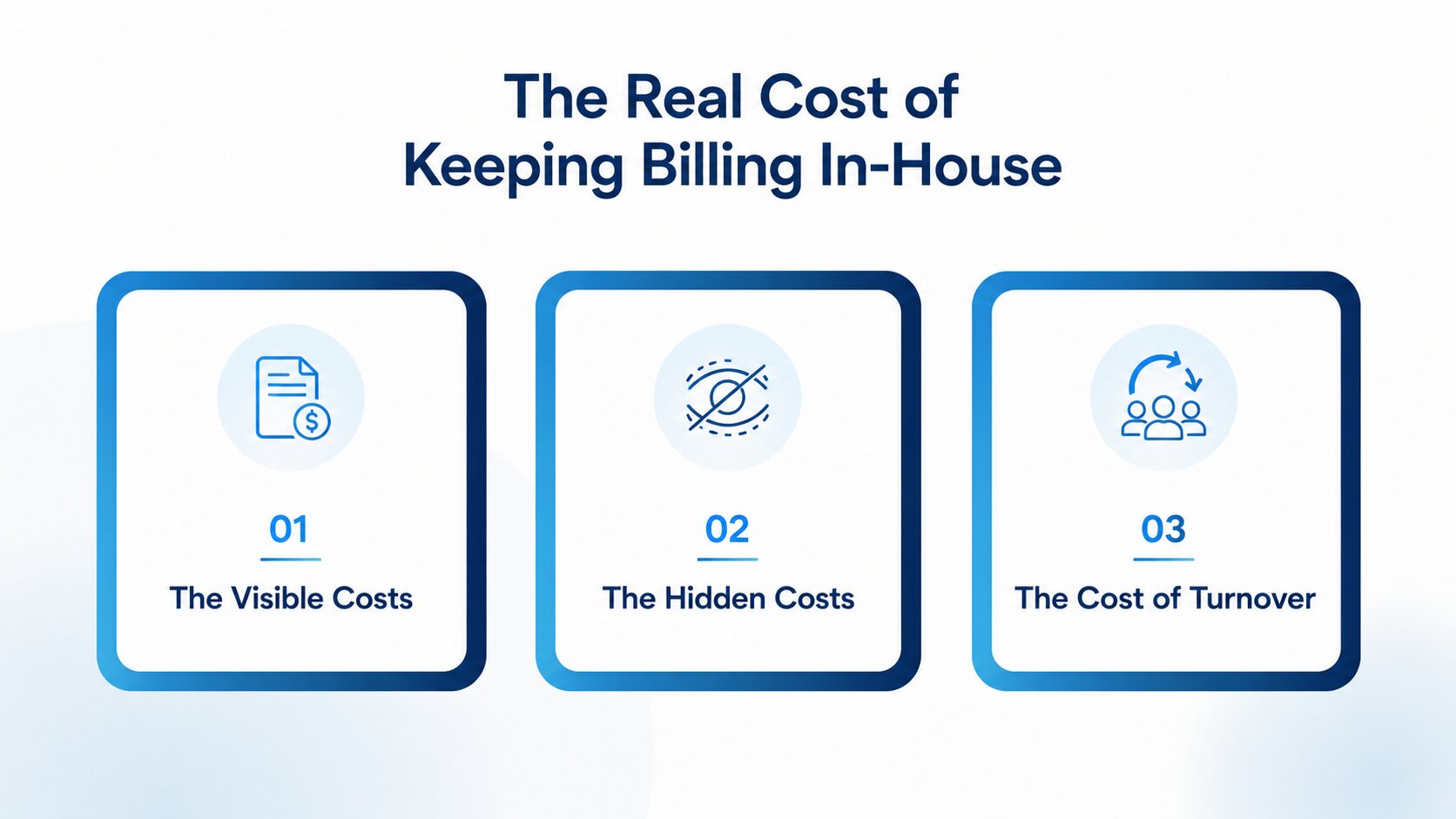
A full-time biller typically earns $42,000 to $58,000 before benefits. Add payroll taxes, health coverage, and paid time off, and the loaded cost climbs another 25% to 35%.
Practice management software and clearinghouse fees add $12,000 to $25,000 a year on top, and a new hire in a specialty practice can take months to reach full speed.
This is where the real damage happens. Denied claims that never get reworked. Underpayments nobody catches because there's no time to audit contracted rates against what gets paid.
Consider a two-provider dermatology practice running a clean claim rate near 88%, well below the 95%+ benchmark that strong practices target. Nobody had flagged it, because nobody was measuring it.
Over a year, that gap alone meant tens of thousands in delayed or lost revenue that the owner had simply assumed was normal.
Every departing biller takes payer knowledge out the door with them: which plans stall on authorizations, which codes trigger audits, which patients still owe balances.
A new hire has to relearn all of it from scratch, usually while a backlog builds behind them. That knowledge gap rarely shows up on a spreadsheet, but it shows up in the bank account a few months later.
Providers weighing outsourcing healthcare billing tend to focus on the pitch: fewer denials, faster payments, less stress. Some of that holds up, and some depends heavily on which vendor gets picked. Here's what a competent outsourced billing partner should realistically deliver.
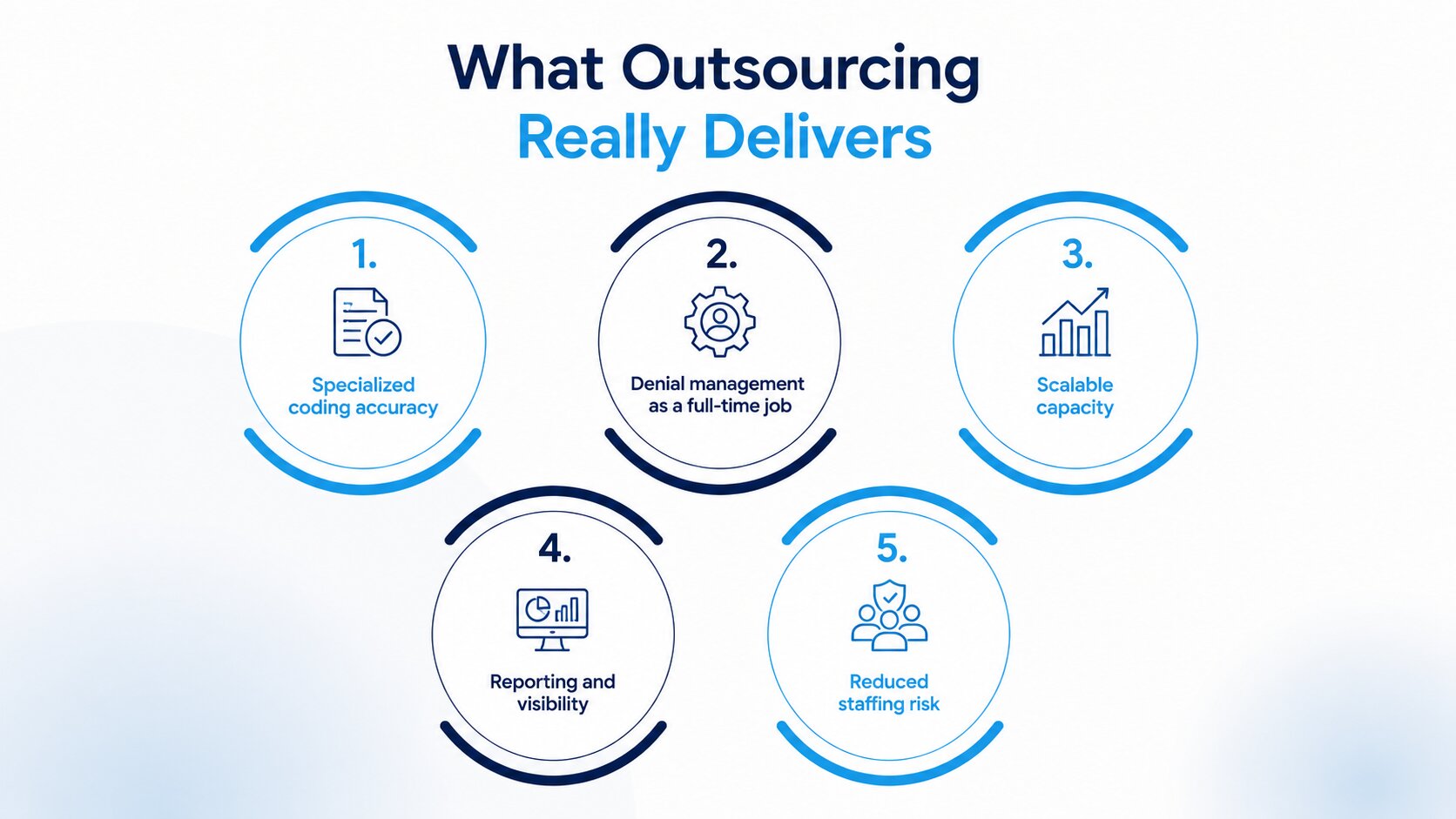
1. Specialized coding accuracy
A team working across dozens of practices catches payer quirks and coding errors that one in-house employee, however capable, hasn't seen often enough to recognize instantly.
2. Denial management as a full-time job
Instead of piling up behind whatever's urgent that week, appeals become core work rather than something squeezed in between phone calls.
3. Scalable capacity
Adding a provider or a location doesn't mean hiring and training another biller from scratch. The team absorbs the volume, which matters for a practice planning to grow.
4. Reporting and visibility
Good vendors provide dashboards showing net collection rate, days in accounts receivable, and denial trends. Owners who've never seen these numbers are often startled by what they reveal.
5. Reduced staffing risk
No single point of failure. If one biller is out sick, work still moves.
Outsource medical billing arrangements typically run 4% to 9% of monthly collections, sometimes with a flat per-claim option for very low-volume practices. Whether a practice is outsourcing primary care billing services or handling a single specialty, the fundamentals above hold steady.
None of this makes outsourcing automatic. Any billing company promising zero downside is telling you what you want to hear, not what's true.
Control is the biggest tradeoff. When billing sits down the hall, an owner walks over and asks a question. When it sits with a vendor three states away, answers happen on the vendor's schedule. Fee structure matters too, and it varies by specialty.
A percentage-of-collections model aligns incentives nicely until a practice with strong collections realizes that percentage now costs more in raw dollars than an in-house team ever did.
The cost of outsourcing medical billing can end up higher than expected in exactly that scenario, which is why the fee structure deserves real scrutiny before anything gets signed.
Before signing anything, get straight answers on the fee basis, what happens to claims in appeal if the contract ends, and whether there's a Business Associate Agreement with clear data terms.
Practices that outsource healthcare billing across multiple locations should also ask how consistent the service is from site to site. A vendor that hesitates on any of this deserves a second look.
|
Factor | In-house billing | Outsourced billing |
|
Typical cost | $55,000–$80,000+/year loaded, plus software | 4%–9% of monthly collections, or flat per-claim |
|
Staffing risk | High: one absence can stall claims | Low: team-based coverage |
|
Scalability | Requires new hires as volume grows | Absorbs growth without new hiring |
|
Communication speed | Immediate, same office | Depends on the vendor |
|
Denial follow-up | Often deprioritized under daily workload | Usually a dedicated function |
|
Best fit | Stable, low-turnover team, simple payer mix | Growing practices, or those with denial and staffing strain |
Medical billing services for small practices tend to make the most financial sense once denials, turnover, or growth plans start pulling an owner's attention away from patients.
If a practice already runs a net collection rate above roughly 95% with a biller who's been there five years, keeping billing in-house can genuinely beat outsourcing on both cost and control.
Read more; In house billing vs. outsourced medical billing: Which is best for your practice?
Understanding professional claims vs. institutional claims also helps explain why some practices generate far more denial volume than others, which feeds directly into this math.
Outsourcing isn't a universal upgrade, and it isn't a universal risk either. It depends on your collection rate, your staffing stability, and how much physician time is going toward billing oversight instead of patients.
For practices carrying denial problems, turnover, or growth on the horizon, medical billing for small practices tends to improve measurably once a dedicated partner takes over the follow-up work nobody had time for.
For a stable, high-performing in-house team, the math often points the other way. Run your own numbers before deciding, and if you want a clear look at where your practice's cost and denial data lands right now, reach out to RCM Matter for a direct walkthrough.
1. How much does it cost to outsource medical billing?
Most vendors charge 4% to 9% of monthly collections, occasionally with a flat per-claim option for very low-volume practices. The right number for your practice depends on specialty, claim volume, and how much denial cleanup is included.
2. What are the benefits of outsourcing medical billing?
Specialized coding knowledge, dedicated denial follow-up, and staffing stability top the list. How much that's worth depends on how strong your current process already is.
3. What are the risks?
Reduced day-to-day control is real, and so is a fee structure that costs more than expected once collections rise. Get exact terms in writing first.
4. How do small practices calculate ROI?
Compare your fully loaded in-house cost against the vendor's fee at your actual collections, then run it again assuming a five-to-ten-point improvement once denials get proper attention.
5. When should a practice outsource?
When turnover keeps disrupting claims, when denials climb with nobody dedicated to fixing them, or when growth outpaces what one internal hire can handle.
Optimize billing, claims and collections with expert RCM support let our professionals handle the process so you can focus on patient care.